Gratitude, Anyway: A Christmas Message for Finding Happiness

Image of Little Debbie Christmas Tree Cakes, one standing and one cross section showing cake icing.

I got stuck while writing this post. I knew I wanted to write about being grateful for my life and everything and everybody in it. I knew I wanted to frame it around having gratitude when those blessings might be blurred by shiny objects, such as ambition and wanderlust. I had most of it completed, but I couldn’t decided how to wrap it up without it having a rosy, yet empty, ending. Not too much as seen from the front porch is rosy; there are cobwebs and dust on my front porch. Then I took a walk on a frosty December night and the ending found me.

Does this ever happen to you? You come up with a brilliant idea—something you think is groundbreaking—only to find someone else has already beaten you to it. I suspect it happens to most writers. A blog idea I thought would be perfect was already taken. I began exploring memoir writing, only to discover someone else has already captured the same experiences with the same folksy charm! I have thought of an ideas for a book, and as I begin doing research for it, there it is–already published by somebody else! Even academic journal articles I’ve envisioned writing often already exist, in forms eerily close to what I had in mind. And every time it happens, it stings. These aren’t rare occurrences—they’ve happened more than just once or twice in my life. Here’s one that happened today: A very fine post by Jim Wallis called “Singing the Lord’s Song in a Strange Land” discusses thoughts I’ve had as an Armchair Quarterback for years—even before the election. It’s title even sounds like something I would have thought of. It’s beautiful. You should read it. Dang it. Singing the Lord’s Song in a Strange Land.
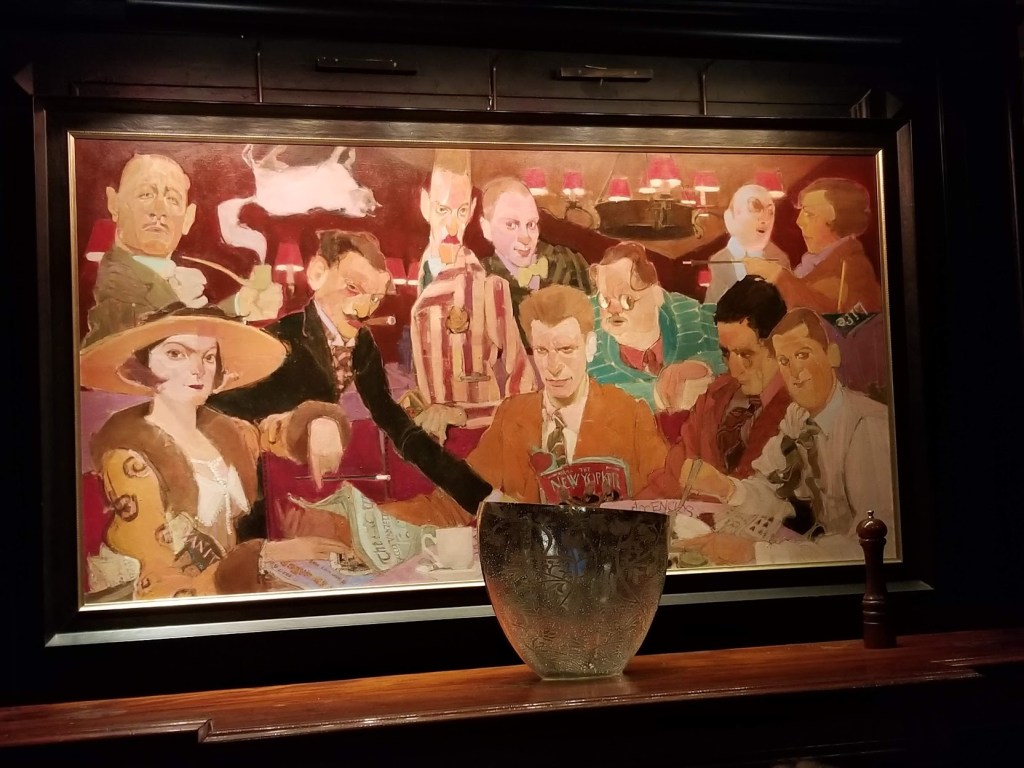
Image of painting of the Round Table at the Algonquin Hotel in New York City
The Round Table at the Algonquin Hotel

And then there’s the yearning. I can’t deny feeling a twinge of envy when I see friends and colleagues celebrating their achievements on Facebook. It’s a humbling reminder of my own aspirations and the work I still want to accomplish. A dear friend recently mentioned seeing several plays on a trip to New York City. She misses New York very deeply, and I’m happy that she makes regular visits; it does her soul good. Now, I’ve been fortunate to see my share of Broadway musicals—I even saw Bette Midler in Hello, Dolly!—an experience I still count as one of the best of my life. But life changes, as it always does, and I don’t have those same opportunities now. Sarah prefers camping with the dogs, and while I finally convinced her to upgrade tent to a pop-up camper, our adventures now involve hoisting Bruno the Bulldog up the steps to his bed.
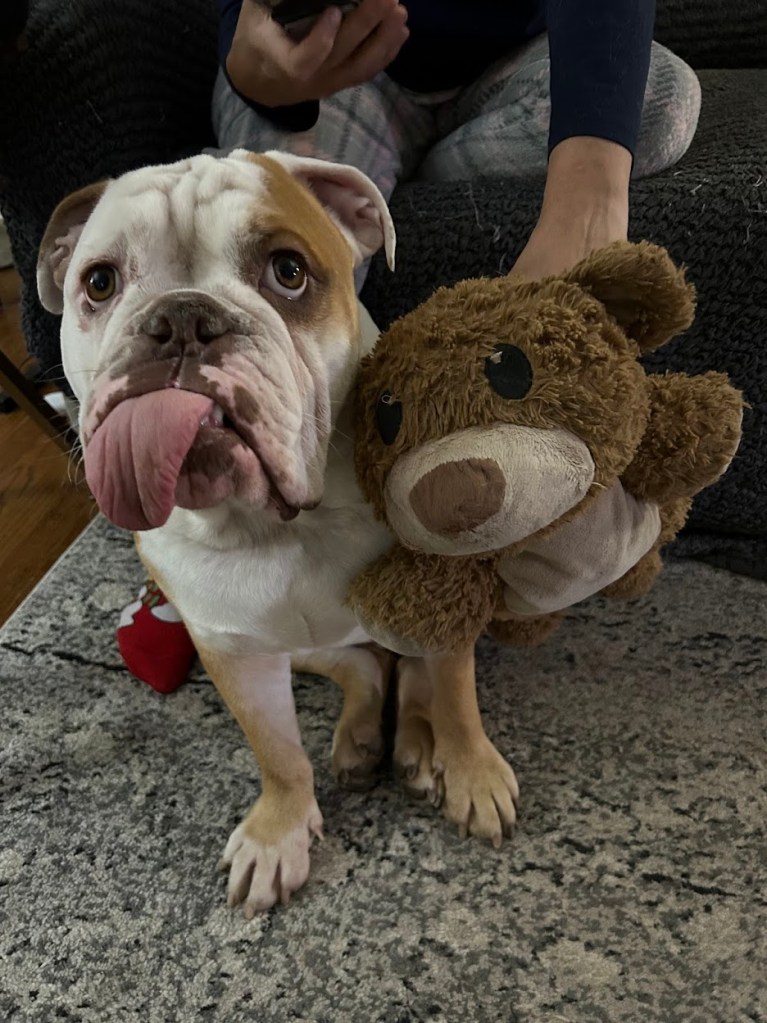
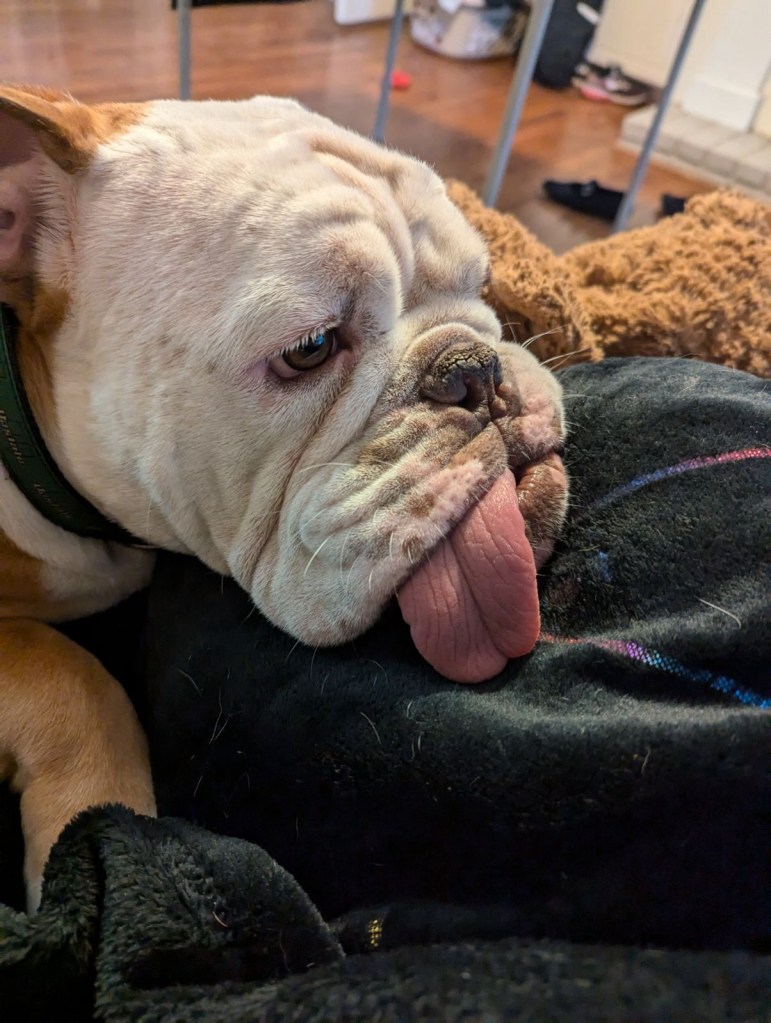
Image of English Bulldog and stuffed bear.
Bruno and Snugs Baby

I don’t want to be a globetrotter, and I don’t long for the lifestyle of the rich and famous. I admit, though, when I’m out in the woods at midnight with a flashlight, waiting for Bruno to finish his business, it can feel like a bit of a step down from the lights on Broadway. Travel, especially to historically rich locales, thrills me. I relish every minute of it. I soak up the salty air and sea breezes of beaches from New England to Miami. And yes, theater makes me breathless. Euphoria has its place, and I appreciate it when I have it.

But adventures are the in-between spaces. The wholeness of life, for me, is found in simple joys. The whole fabric of life takes place in Spartanburg, feeding the dogs and cats—and in Alabama at my childhood homeplace. Whether tending to dogs and cats or listening to the stories my mother tells about pictures and treasures we sort through-both of us aware of time pressing down upon us—these are the things I am fiercely grateful for.

I think back to how I grew up, a child of hardworking people in Alabama. My parents taught me to be proud of where I came from, to appreciate the simple joys of home and family. They have always begun and ended every prayer by giving thanks to God. Even now, my heart remains etched with gratitude that I learned from them. I look around and see a life I love—a cozy old house in a picturesque neighborhood, my quirky cars in the driveway, my family within a few hours’ drive, and my pets curled up with Sarah and me on the couch. I’m comfortable in my own skin, grateful for work that fulfills me, and thankful for the profound blessing of having stability in my life. I’m blessed not to face food or housing insecurity, unlike so many others on this earth. I do a quick check and confirm that the reason I blog in the first place is to find joy and fulfillment–which I do.

Here’s the thing I’ve noticed: life is full of moments like these. No matter what you achieve or experience, there will always be someone smarter, more accomplished, more traveled, or more adventurous. It’s easy to let envy creep in or to feel like I’ve missed out. But at this stage in my life, I’ve learned to lean into a different perspective: gratitude, anyway. Choosing gratitude is a practice, and I have to practice it. Being grateful is as simple as the adage: It’s not having what you want but wanting what you have. I didn’t say it was an easy practice.

Image of actor Nathan Lane leaving Broadway theater after the play Angels in America
Nathan Lane Leaving Theater After Angels in America

Yes, I would really like an occasional New York weekend getaway. I’d love to see my name on the cover of a groundbreaking book or a memoir about a girl from a working-class family in the South–kind of like “The View from Rural Missouri by Jess Piper, which is a terrific collection by a Renaissance Woman from Missouri, at https://jesspiper.substack.com/. Dang it. But I also find happiness in where I am, not just in those imagined greener pastures. There’s a profound joy and relief in realizing that life isn’t a race or competition. I take satisfaction in setting my own goals and working toward them at my own pace—leaving room for reflection and leisure along the way. I will get where I get when I get there. I wonder why it has taken me so long to be at peace with this. I am grateful that I am.

Image of the Statue of Liberty
Statue of Liberty

Here is where I had trouble sticking the ending. So I set it aside and went to the Spartanburg Christmas Parade. We live in a neighborhood that looks like Bedford Falls in It’s A Wonderful Life, and we can walk the two blocks to the parade route. We walked arm-in-arm to Main Street, got hot chocolate, and found a spot among the crowd to watch the parade. If you’ve ever been to a hometown Christmas parade, you know exactly what it was like. There were fire engines driven by Grinches, lights strung from cars and trucks and tractors, local beauty queens wearing Santa hats instead of tiaras, and marching bands. Oh, the marching bands. One of my most wonderful experiences was marching in my high school band. Memories of it fill me with happiness and exhilaration. As soon as I heard the drum cadence marking the band’s approach, I felt that feeling again. Then they began to play. It was at that moment the meaning of what I had been trying to capture in my writing became physically real to me. I began to cry as they marched by, joyful in the present and in jubilant memories. This, I knew, was gratitude.


Image of parade float and parade walkers in Spartanburg Christmas Parade.
Spartanburg Christmas Parade Float

While I’ve been struggling with disappointment at the parade passing me by, I just needed the reminder that parades don’t pass a person by—we experience them, marching right alongside. So, I’ll keep dreaming and working toward new goals, and I’ll keep finding happiness right here, in this moment. Gratitude, I understand, is not to be approached as “anyway.” Gratitude is an attitude–a mindset of unwavering, ongoing appreciation, regardless of the circumstance. Although I won’t always be successful, and although some days will be easier than others, I choose Gratitude, always.

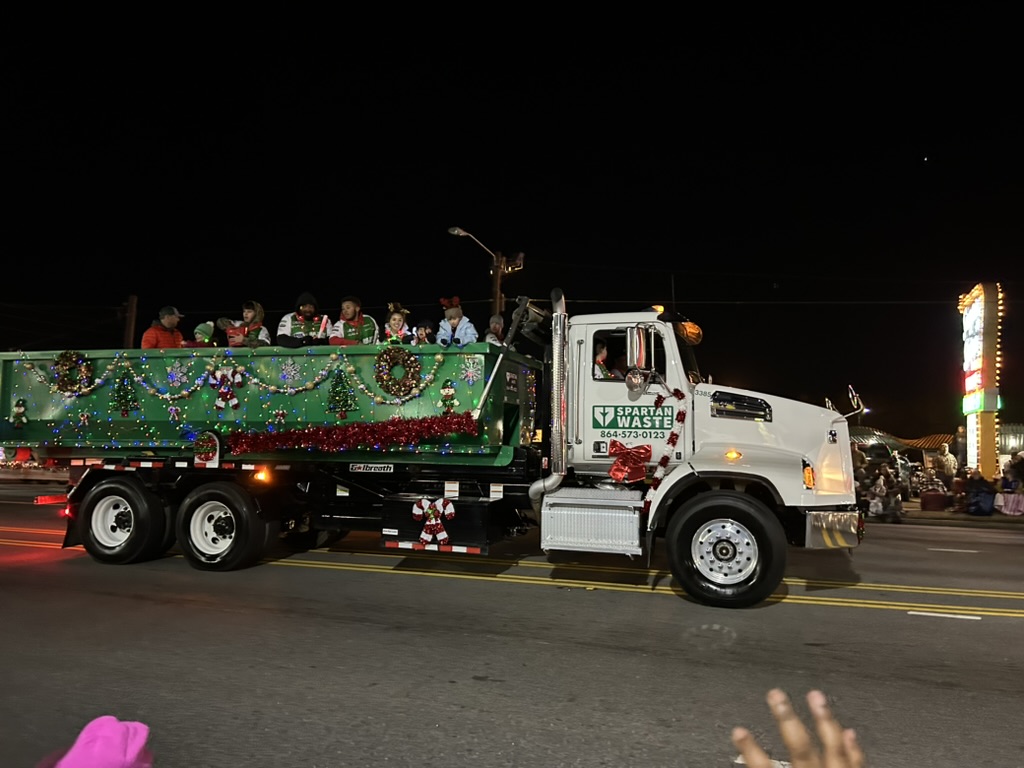
Image of Spartanburg School for the Deaf and Blind Bus in Spartanburg Christmas Parade
Spartanburg School for the Deaf and Blind Bus in Spartanburg Christmas Parade
Image of Spartanburg Waste Truck in Christmas Parade
Spartanburg Waste Co. Truck in Christmas Parade

The Battle for GLP-1 Drugs: Trulicity, Mounjaro, Zepbound, and Compounded Drugs (Semaglutide and Tirzepatide)

Image of feet standing on scales. Scales spell HELP! in display.

First, let’s talk about the latest news around the drugs themselves. In a recent article in The Atlantic titled “Ozempic Killed Diet and Exercise,” Daniel Engber refutes the long-held premise that weight loss is simply a matter of eating less and moving more. Engber speaks with Dr. Tom Wadden, an obesity expert at the University of Pennsylvania, who argues that diet and exercise should remain the standard therapy for people with moderate obesity. However, for those with significant weight to lose (BMIs over 35), he concedes, “I don’t think lifestyle modification is any longer the cornerstone of obesity treatment.” To which—and I think I speak for many of us who have struggled with obesity and tried to lose weight—I respectfully say, duh. https://www.theatlantic.com/health/archive/2024/12/diet-exercise-ozempic/680909/

The Rise of GLP-1 Medications

What has worked are GLP-1 receptor agonist medications, such as Trulicity, Mounjaro and Zepbound, manufactured by Eli Lily; and Ozempic and Wegovy, manufactured by Novo Nordisk. (Based on how they work, Ozempic and Wegovy are classified as semaglutides; Mounjaro and Zepbound are tirzepatides, and Trulicity is a dulaglutide.) While each medication has been proven effective to varying degrees, paying full price for them can be prohibitively expensive. Generic versions are available online at significantly lower costs, but these often come in vials rather than injection pens, requiring users to administer shots with syringes.

Image of man injecting compounded GLP-1 drugs into stomach.
Self-injection of Compounded GLP-1

Today, Eli Lilly announced a partnership with the direct-to-consumer service Ro to provide more affordable vials of Zepbound. This move is likely a response to competition from compounding pharmacies, which sell vials at around 70% less than the full price of Zepbound. Compounding pharmacies can do this because they mix the medications themselves rather than just sell mass-produced drugs ordered from companies like Eli Lily–like conventional pharmacies do. A one-month vial of Semaglutide costs $249 through compound pharmacies, compared to $600 or more for brand-name versions. https://www.cnbc.com/2024/12/11/ro-to-offer-weight-loss-drug-zepbound-vials-by-working-with-eli-lilly.html

The Shortage and Big Pharma’s Response: The Plot Thickens

Over the last two years, Eli Lilly and its main competitor Novo Nordisk have struggled to keep up with the skyrocketing demand for GLP-1 drugs. Once word got out about their effectiveness for weight loss, everyone with pounds to shed wanted in. Public figures like Elon Musk famously used Wegovy, and the internet exploded with people scrambling to fill prescriptions. Without insurance coverage, the full price of Zepbound is around $1,200 per month. Using Lily’s discount card, I paid $600 per month. In case you are wondering, it was worth every penny.

Then I discovered OrderlyMeds, which works with compounding pharmacies to offer generic vials of the meds for a fraction of the price. Get ready for this: a one-month vial of Semaglutide is $249; Zepbound is $350. 70% cheaper than full price. There’s a catch: The FDA will only allow compounding pharmacies to manufacture during drug shortages.

Suddenly–shock–Lily and Novo Nordisk declared the shortage over! Citing issues of safety and principle, they petitioned the FDA to order compounding to stop. But as University of California law professor Robin Feldman quipped in an NPR report, “When someone tells you, ‘it’s not the money, it’s the principles,’ [it’s] the money.” Shocking. Ro to offer lower-price vials of weight loss drug Zepbound by teaming up with Eli Lilly.

Image of two vials of Eli Lily's GLP-1 drug Zepbound.
Vials of Zepbound

What Comes Next?

The FDA has allowed compounding pharmacies to continue production while reviewing the shortage designation. However, most experts anticipate that compounding will soon be prohibited. This leaves patients with four options, as I see it:

1. Hope for Insurance Coverage: Many insurers only cover GLP-1 medications for Type II diabetes, but not for obesity treatment. My insurance through the State of South Carolina will not cover any kind of bariatric treatment (surgery or GLP-1 drugs). Instead, they provide diet and exercise lifestyle coaches to promote the diet and exercise option. See above–it still doesn’t work.

2. Pay Full Price: $1,200 is higher than most mortgages.

3. Use Discount Cards from the Manufacturer: Lilly’s 50% off coupon lowers costs to around $600 per month. These cards have expiration dates and can be discontinued at any time.

4. Wait for competition among drug companies to result in lower prices for the GLP-1 meds. This will happen, but it could take a decade. https://www.protectourcare.org/wp-content/uploads/2024/02/greedwatch2023.pdf

Image of injection pens of Zepbound by Eli Lily Company.
Zepbound Injection Pens

The Bigger Picture

The pharmaceutical giants’ resistance to compounding reveals their priorities. In 2023, Eli Lilly and Novo Nordisk each reported revenues of over $34 billion. I understand profit margins, but c’mon—let’s think about affordability and access here.

Adding insult to injury, the upcoming administration’s appointment of Robert F. Kennedy Jr. as Secretary of Health and Human Services raises further concerns. Kennedy’s dismissive stance on GLP-1 medications—advocating instead for “three meals of good food for every man, woman, and child”—shows a lack of understanding about the challenges of obesity. Again, please see above: diet and exercise do not work.

For those of us who have lived with this struggle, the idea that better food alone can solve obesity not only feels both naive and dismissive, it makes me mad! If I could regulate three healthy meals a day, I wouldn’t have spent most of my adult life clinically obese. But, said Dr. Jody Dushay, an assistant professor of medicine at Harvard Medical School and an attending physician in endocrinology at Beth Israel Deaconess Medical Center, declared to CNN, “It is wrong to assume that people with high body weight and BMI just sit around and eat low-quality food.”

Image of Little Debbie Christmas Tree Cakes, one standing and one cross section showing cake icing.
My Weakness: Little Debbie Christmas Tree Cakes

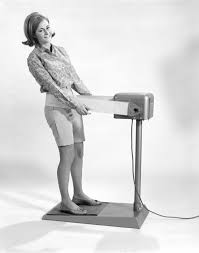
To be honest, I have eaten my share of high caloric junk food. Over the last 50 years (I was overweight by the time I was in 3rd grade),I have also tried Weight Watchers, Nutri System, Slim Fast, Alli (with gross results,IYKYK), low-carb diets, Keto, and old-fashioned calorie counting. That doesn’t include going with my mom to the Elaine Powers Studio when I was 10 years old (remember the old belt machines that were supposed to melt the fat away?). The only other time in my life, before GLP-1, that I lost a significant amount of weight, 40 pounds before plateauing, was when I counted Weight Watcher “points” and walked 30-minutes every day. When I stopped, all the weight came back plus more. This is life for millions of people like me. “Serves you right,” you may be saying, “for stopping your healthy lifestyle!” Blaming folks like me supports insurance companies’ refusal to pay for treatments–other than, you guessed it, healthy lifestyle programs. https://www.cnn.com/2024/11/17/health/rfk-jr-ozempic/index.html

Black and white image of woman using vibrating belt machine
Vibrating Belt Jiggling Fat Machine

As we move into a new year, the battle over GLP-1 medications—and the broader issue of healthcare affordability—is far from over. Patients like me deserve solutions that prioritize health over profit. Until then, we’re left navigating a system where greed and ideology often outweigh the needs of the people. Those of us clinging to GLP-1 medications as a lifeline will keep scrambling to find ways to stay on them as long as we can, fully aware of what will happen if we can’t.

Image of marching band, includes trumpet players, tuba players, and drums in background. Ugena Whitlock with mellophone in foreground.
Ugena at higher weight, marching with the Atlanta Freedom Bands and about to play mellophone

My Friend Duncan: The Scottish Terrier Who Won My Heart and Changed My Life

Image of Scottish Terrier Puppy sitting among potted plants

I still look for Duncan when I move from one room to another. I hear the little “click, click, click” of his toenails as he toddles across the wood floor. I think of him every time the leaves fall, expecting him to chase the light that dances between the shadows. I keep his little blue plaid collar with a spiffy bowtie on my dresser. I call our new dog–and sometimes call my son Daniel–“Duncan” when I’m in a hurry. I miss him.

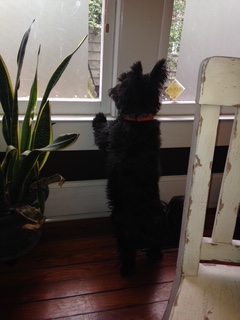
Image of Scottish Terrier standing on two legs looking out the window. Also pictures are potted plant and distressed dining chair.
Duncan standing on two legs looking out the window

I got Duncan for company and road trips, having been without a dog in the house for a few years. I had owned terriers before, but never a Scottish Terrier. While he was typical of the terrier breed, he was a Scottie, which gave him unique attributes, like not wanting his feet touched. He would yip and howl in holy terror at nail clipping time. He was a detached little fellow who did not need to be in my lap. In fact, I think he preferred to lie quietly at my feet. I discovered his staunch independence the day I brought him home. He was 10 weeks old, and I took him outside to the big front yard to start working on toilet training. I am used to puppies who want to be right with you–underfoot. Scottish Terriers have old people personalities even as puppies. I looked away from him for a minute to speak to a neighbor, and when I turned around, he was gone.

I looked all over for him–up and down the street, all sides of the house, under the porch, under the car. By this time my neighbor, who had returned to her porch, could see I was getting frantic. I yelled across our yards, “I just got him, and now he’s gone!” My neighbor had four kids, who all had friends, and who were all out in her driveway on bikes. She gave them marching orders: “Get on your bikes and look for the puppy.” And off they peddled, circling the block. It reminded me of communities coming together in movies, you know, like you don’t often see in real life. None of them had Duncan with them when they came back together.

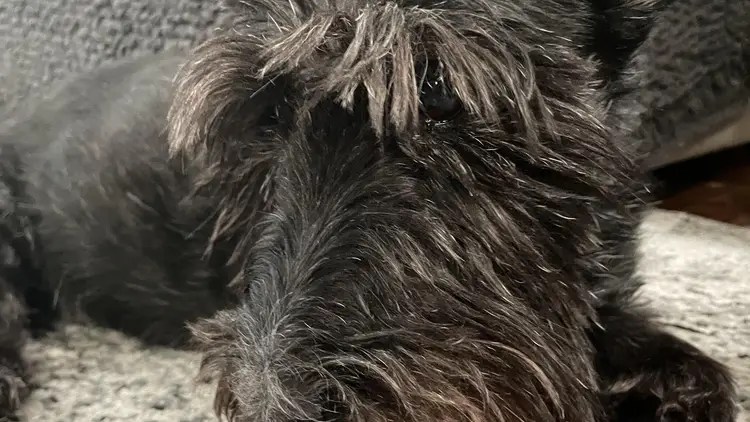
Image of a senior aged Scottish Terrier
My old man

It was then the next-door neighbor on the other side yelled to me from his back porch. “I see something little and dark. Is that him?” To this day, I don’t know how he had seen Duncan. I trudged to the pine tree he was pointing at in the far back of my wooded, sloped lot. There, under the tree in a patch of knee-high weeds sat Duncan. He was calm and stoic looking, peering through the fence toward the woods like Ferdinand the Bull in the story. This was the first of his sojourns, each one scaring me worse than the ones before.

When he was a young dog, he could escape from the average fence by burrowing under it. Terriers–from the French word “terre,” which means earth–were bred to “go to ground.” His favorite escape was to the woods to sniff for critters. Once, he cornered an especially slow squirrel and did not know what to do with it; fortunately for everyone but the squirrel, it died sitting there before Duncan could acquire the taste for blood. Usually, he headed off in the same direction–toward the woods–and the same neighbor would report a sighting after Sarah and I had been driving around the neighborhood for half an hour.

Image of Scottish Terrier next to a laptop computer
Duncan at work

One Sunday we came home from church to discover that not only had one of the kids left the gate open, but I had rushed out of the house (typical Sunday) without remembering to bring Duncan inside from his morning potty. Animal control had left a yellow note on the front door telling us when and where to come to bail him out. The one crabby neighbor in the neighborhood had called them. She had been afraid of a Scottish Terrier who was sniffing the ground and heading away from her house. We rushed to the pound, where one of the volunteers brought him out, jauntily jogging and smiling as he met us. The volunteer was happy with him, but not with us. She frowned as she took the opportunity to chastise us and issue warnings about consequences if it happened again. It didn’t. After that escape, we reinforced the bottom of the chain link fence with chicken wire, which I’m sure did not increase our property value.

He lived longer than the typical 10-year lifespan of a Scottie. One day I suddenly realized he was approaching 13, and I knew then he was living on borrowed time. He was noticeably slowing down, asking to be pulled in the wagon as we explored local trails. I had never been able to train myself to be a good leash walker (note how I said train me, not him). Duncan tugged and ran ahead until he found the perfect patch of ground, where he would have sniffed every blade of grass if I had let him. I couldn’t take him on brisk walks with cardio benefits because he would take three steps, stop to sniff, repeat. Now that he was a senior, we went on short walks with fewer stops and tugs. He reverted to peeing in the house on corners of the furniture when he got up for his nightly midnight drink. We began to crate him at night.

In the spring of his thirteenth year, he started throwing up. He was still eating and drinking, behaviors that I knew usually slowed and stopped at the end of life. I did not think we were there yet. The vet gave us a prescription for pancreatitis and told us to bring him back in a couple of weeks if the vomiting continued. After a few days, it got better…until it started again. The first night he threw up in his crate, we held our breath hoping it was a fluke. The second night we planned to take him to the vet for a re-check on the pancreatitis. Our wonderful vet gave us the dreadful news. “The pancreatitis is fine,” he said. “It’s these lumps I’m worried about. Let’s get him a scan.” The results showed golf ball-sized tumors in his abdomen. That was the first time I cried at the vet’s office.

Image of Scottish Terrier sitting on window ledge looking outside at a tree and building
Duncan on guard

Being the thoughtful person that she is, and to bring me out of my sadness to focus on what was really important during all of this, Sarah began to plan Duncan’s “bucket list.” At first, I just went along. But then I started to understand; it was really our bucket list–mine and his, together. We loaded up the little red wagon we had bought to cart the old man around and went camping. It makes me happy to think of him sitting in the middle of the campsite in that little wagon. We hit the trails and took road trips. He got a pup cup from the local ice cream shop. The only item on the list we did not get to was taking a trip to Alabama so that my folks could see him again. My sweet mother proudly reminds me that it was she who house trained Duncan when he stayed with them for a couple of weeks. She misses him, too.

The end came soon after. In three weeks, his belly was hard and swollen, and he began panting through the night. He was dying. I held him in my arms as we went into the veterinary room, held him when the kind vet administered the first shot, the one that sent him into a deep, peaceful sleep. But I could not bear the final shot. When I broke down and collapsed in the chair, Sarah petted and soothed him for the last time. It is the hardest thing I have ever done, and it broke me. I am crying now as I remember, and it is only now, months after, that I can bear to write about it. I still cannot look at the rosewood box with his ashes; Sarah has put it away for now.

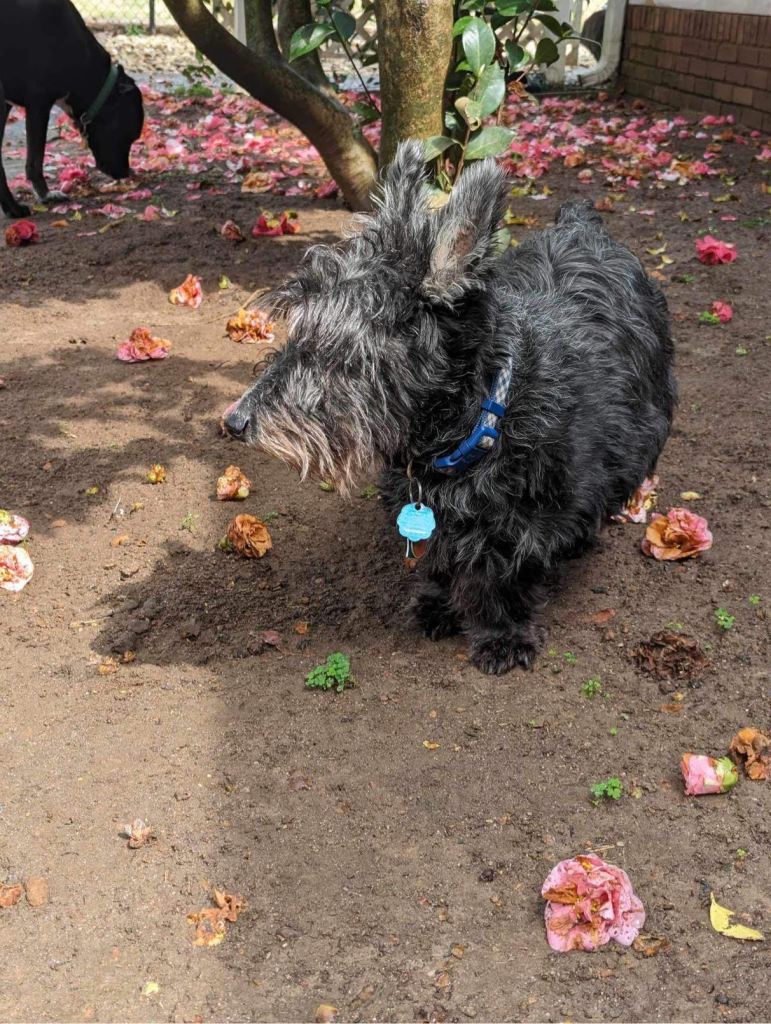
Image of Scottish Terrier under gardinia bush with gardinia flowers. Also pictured is a lab mix black dog.
Duncan under the gardinias

I don’t use the word “pet” when I can help it now. I don’t use the language of ownership anymore. I have done so here to reflect the lessons learned from my Duncan. He was my friend. A stalwart sentry, he was a proud dog who carried himself with dignity. Even during his last months, he never slouched or walked with his head down. Each step was deliberate and graceful, almost tiptoeing. He had the presence of a little gentleman. Duncan was lovingly stubborn until the end, tilting his head and gently pulling on his leash if he was not yet ready to continue our stroll. When he was groomed in that standard “show dog” cut, his brindle patterns were tiger-colored, swirling around on his back and neck like a chocolate and caramel brownie. He was magnificent.

Duncan has helped me navigate the passing of time, which is the gift from him I appreciate most. Life is short; if you want to see how short, reflect on the lifespan of a beloved furry companion. I grieved his death more deeply than I ever have before, with my immediate family still living. I am forced to prepare for inevitable loss of parents and the sad yearning of looking into the void where they once were. I picture Duncan looking at me and tilting his head, like when he was listening to me. “Yes, it’s indescribably hard,” he seems to think. “Just keep your nose down and keep tracking.” On days I work from home, I look at the sunbeams on the rug and think about how he used to sit and stare at the beams, expecting to catch one at any minute, his whole body alert and quivering, his tail wagging in anticipation. And after all, that’s life, isn’t it? Head down, keep tracking, and always look for that sunbeam you’re about to catch. Thank you, friend.

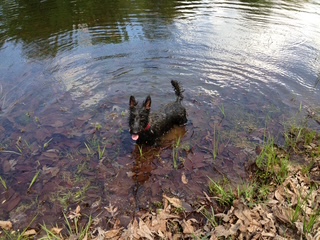
Image of Scottish Terrier named Duncan in a pond. His tongue is out as though he is smiling.
Duncan in a pond

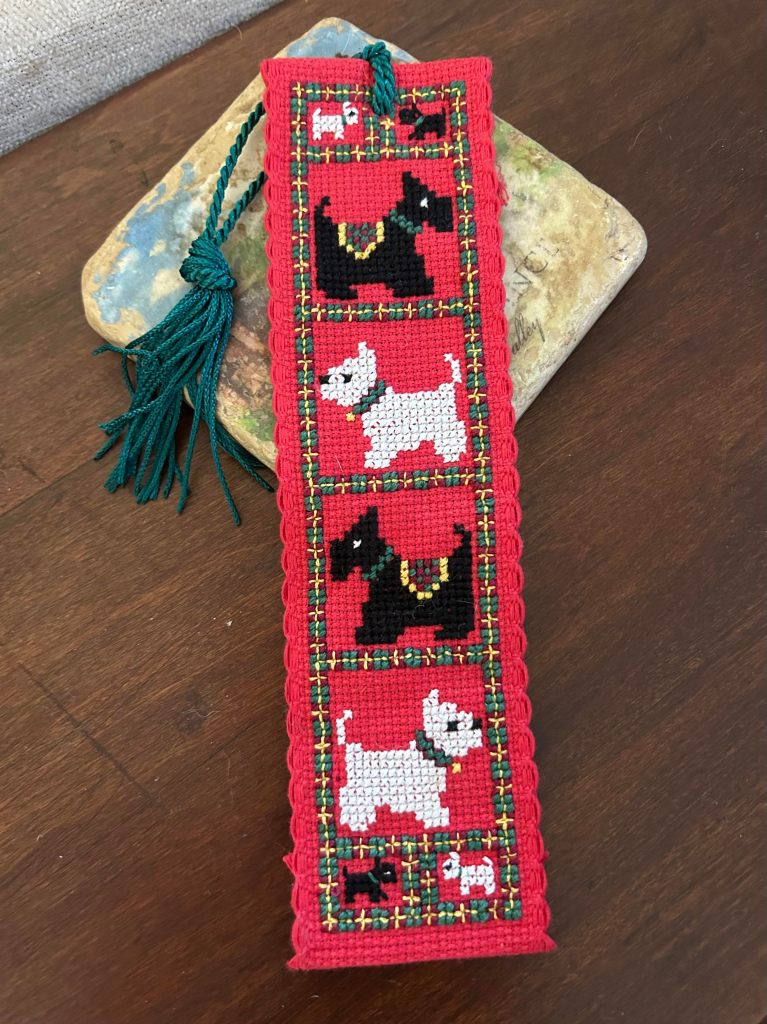
A final note, throughout the essay, I have referred to “we,” plural. In reality, Sarah provided Duncan’s end-of-life care and doctor visits. Reading this, she jokes about the so-called loyalty of Scotties, since when she entered my life, he adopted her as his person. He sat in her lap and asked for pets the day he met her–and continued to do so for the next 10 years. She reminds me that Duncan was in fact affectionate with her, if not so much with me. She was the only human whom he would allow to touch his feet. She made me the lovely Scottie bookmark in the picture, and I thank her for caring for us both.

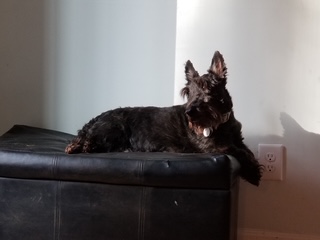
Image of Scottish Terrier named Duncan reclining regally on a settee
Duncan looking regal and thoughtful
Image of Ugena Whitlock holding Scottish Terrier Duncan while on vacation.
Duncan and Me
Image of red bookmark with green tassle that shows two large Scottish Terriers, two large white Scottish Terriers, two small black Scottish Terriers, and two small white Scottish Terriers.
Beautiful intricate Scottish Terrier bookmark by Sarah

Exciting News: A New Chapter for the Blog!

Image of Logo for Blog The Front Porch Professor with rocking chair, typewriter, and Mazda Miata..

Hello, friends! I’m thrilled to share that my blog is getting a fresh start under a new name: “The Front Porch Professor.” This new space will continue to feature the reflections, stories, and observations you’ve enjoyed, with a renewed focus on life, learning, and the journey ahead—all with a touch of Southern charm.

I’m currently working on exporting all my posts from Just Keep Swimming to the new blog, so nothing will be lost. If you’ve been following here, I hope you’ll join me on this new adventure! With any luck, your subscription will carry over seamlessly, but if not, I’ll share the link to the new blog soon so you can continue following along.

Thank you for your support and encouragement—stay tuned for updates and more from “The Front Porch Professor.”

Five Things as Prompted by the Management

Share five things you’re good at.

  1. Singing Alto
  2. I’m a good speller
  3. I can color-match clothes
  4. Cooking with grease
  5. Identifying good documentaries
  6. (Thinking of clever replies)