Formed by Certainty, Learning to Wait: An Advent I Didn’t Grow Up With

The Church Without a Christmas Tree

I grew up in the Church of Christ, a tradition shaped as much by its doctrine as by its careful adherence to what we understood as the inspired Word of Truth—New Testament scripture. Christmas—Christ Mass, after all—carried with it echoes of liturgy, ritual, and ecclesial authority that did more than make us uneasy; they were not supported by scripture. It felt too “Catholic.” Nativity scenes, Christmas trees in the sanctuary, pageants, and concerts all felt suspect, as if they edged too close to something we had worked hard to distinguish ourselves from.

Our doctrine emphasized Jesus’s death, resurrection, and promised second coming—the salvation story in its fullest and, to us, most biblically faithful form. That was where the weight belonged. Christmas, when it appeared at all in worship service, seemed secondary. There might be a sermon in December, but it was usually framed as a reminder not to let sentiment distract us from the real celebration: the cross, the empty tomb, and the anticipation of Christ’s return.

Beginning sometime in the 1980s, our monthly church fellowship included a “greedy Santa” party in the fellowship hall—an accommodation that felt almost humorous in its contradiction. At home, though, the birth of Christ was acknowledged and celebrated in quieter, more personal ways. Christmas existed, but it lived more in our houses than in our sanctuaries.

Wonder, Anyway

Even so, Christmas always carried a sense of wonder.

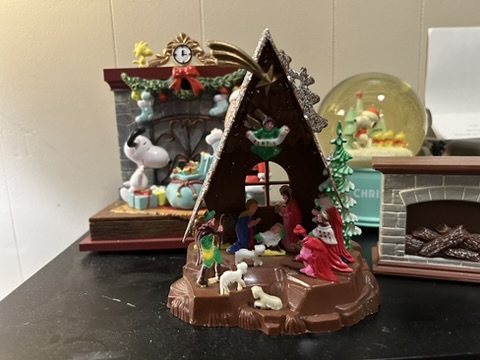
In my family, it was joyful and wonder-full. We celebrated the birth of Christ. We sang the songs, set out nativity scenes, and watched cartoons that made room for the baby Jesus alongside Rudolph and Frosty. I developed a passion for Little Debbie Christmas Tree Cakes that continues to this day. But Christmas was never treated as a central moment of worship. It was present and honored, but it did not occupy the same place in our worship as the cross and the resurrection.

Instead, Christmas lived easily among us. It shared space with Santa Claus and stockings, with family meals and laughter, with the ordinary magic of being together. Faith was there, woven into the fabric of the season rather than standing apart from it or asking to be the center of attention.

We sang Away in a Manger and Have Yourself a Merry Little Christmas with equal sincerity.
Some of my strongest Christmas memories are of going to town with my mother—just the two of us—walking down Main Street in Russellville, Alabama. We stopped at Elmore’s and White’s, always went to the bank, and did a bit of Christmas shopping. We also made our rounds to TG&Y and Bargain Town U.S.A. Going to town with Mother is one of the memories that has never faded. She loves Christmas. I suspect that is where I get it.
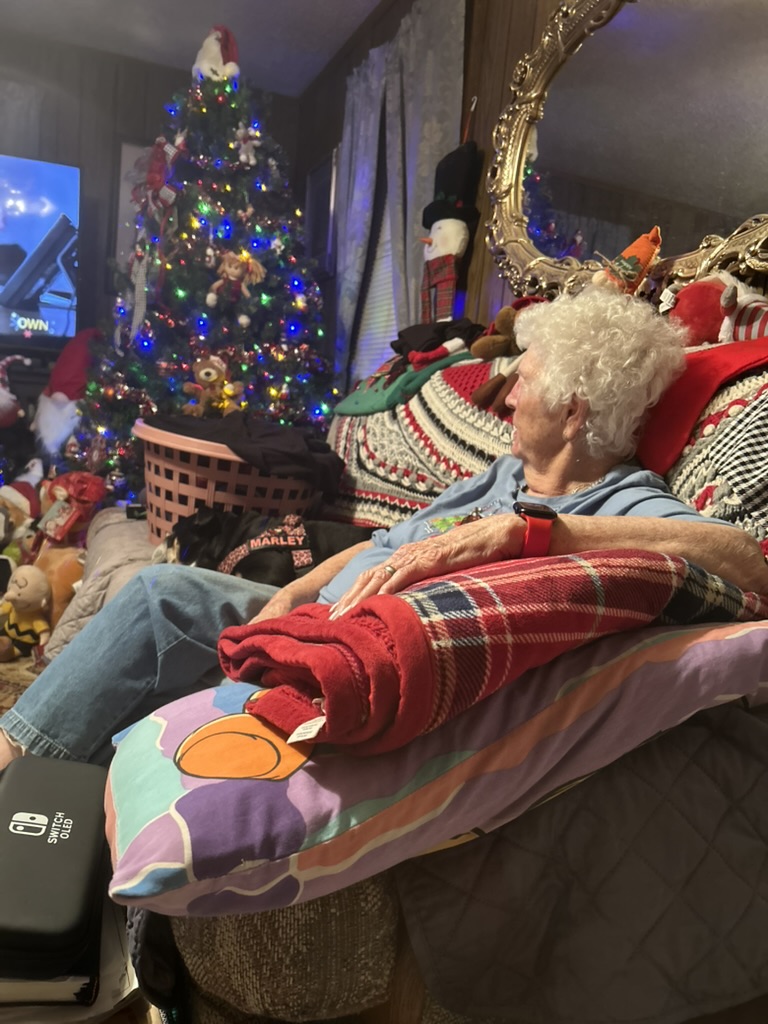
Perhaps the magic was not Christmas itself, but Mother making it all come together. Daddy—God bless him—was assembling bicycles late into the night, helping Santa Claus eat the cookies and drink the milk when no one was awake, and getting up early to turn on the heater before us kids stirred.
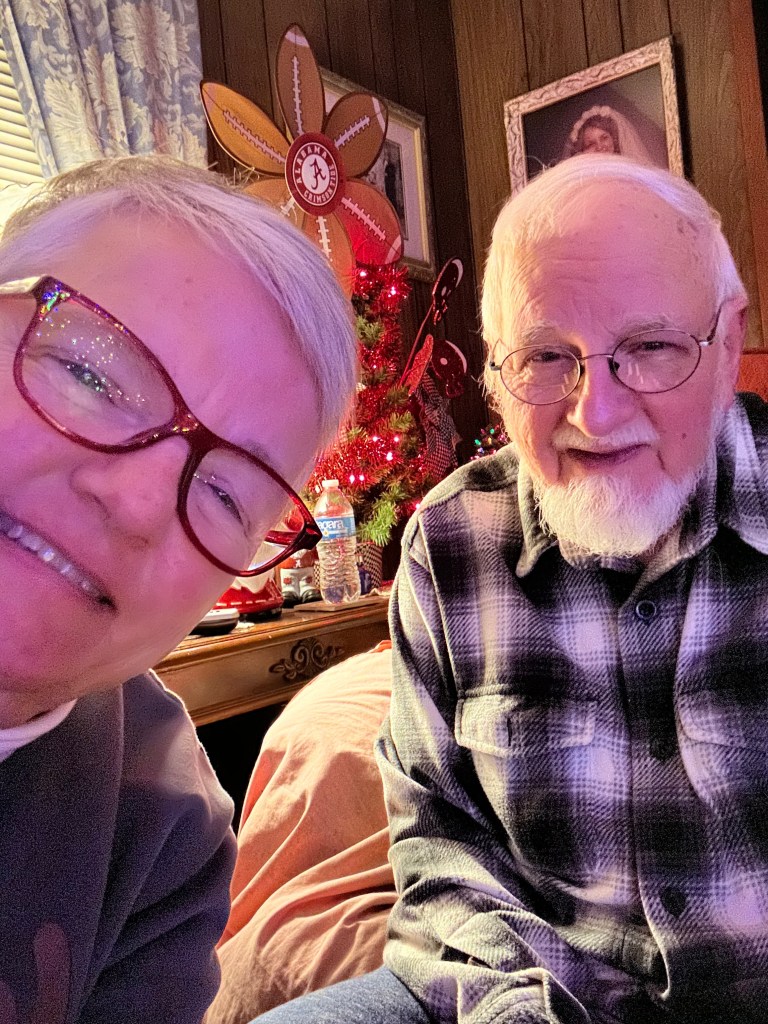
So Christmas has always carried for me the emotions and images of Advent: love, peace, and joy. Yet as I’ve grown older—and as I’ve celebrated Advent more intentionally in churches I joined later—I’ve come to realize something important was missing from my early experience, at least as I have come to understand it now.

Hope.

That missing note, I’ve learned, is at the very heart of Advent: not the anticipation of Christ’s return, but the radical, trembling hope of waiting for Him to come the first time.

Before I go any further, I want to be careful about how this contrast is read. I don’t mean to disparage the Church of Christ or its seriousness about salvation and the life to come. The emphasis on the afterlife was never meant to diminish this one; it was meant to anchor it. There is something steady, even bracing, about a faith formed around the cross and the resurrection, around the somber knowledge of what comes on Friday during Holy Week and the refusal to look away. That certainty shapes the tone. It is sober, resolved, and grounded in knowing how the story ends.

Advent, I am learning, asks for something different. It invites a looking forward that is almost visceral, a waiting marked by anticipation rather than knowledge. During Advent, we do not yet know what is coming, even though we think we do. Christmas and Easter are both joyous occasions, yes, but they are not the same kind of joy. Easter joy comes after suffering we already understand. Advent joy comes before anything has happened at all. It is hope without proof, expectation without resolution.

Perhaps that is why Advent feels so unfamiliar to me. I was formed in a tradition that lingered near the end of the story. Advent asks me to return to the beginning, to wait not with certainty, but with hope.

That difference between certainty and waiting is something I didn’t fully understand until I found myself, almost by accident, living Advent rather than merely knowing about it.

Learning Advent by Living It

Just recently, we joined a church that could not be more different from the one I grew up in.

Trinity United Methodist Church sits at the end of our driveway—practically in our neighborhood—and has been there for over a hundred years. We watched carefully last year as the United Methodist Church faced its painful and very public division. We waited to see whether Trinity would stay or go. They stayed. So we went.

Well—I went first.

Returning to church was part of my larger journey back to music. I wanted to sing again. I wanted a choir. So I showed up, and they welcomed me. Then Sarah came. I can say, without exaggeration, that I have never felt so genuinely welcomed in any congregation.

Of course, in a liturgical church, if you arrive in the fall, you don’t ease into Christmas—you begin preparing for Advent.

Trinity has all of it: the church calendar, the seasons, the art, the rhythm of the year itself. And it has a gifted music director, Ben Chumley. Music is not ornamental there; it is formative. Part of Trinity’s long tradition includes a concert series—bell ringers, piano recitals—and on the Sunday before Christmas, a full choir cantata, offered as a concert for the community.

I had never sung in an hour-long Christmas cantata before. It is exhausting—poignant and fulfilling, but exhausting.

At the same time, the sermon series centered on the coming of the Christ Child, and Sunday school was immersed in a deep study of Advent, framed by John Wesley’s theology. I knew what Advent was, of course, at least in name. I associated it with calendars and chocolate, with Advent functioning more as a reference point for Christmas than as a practice, something observed from the outside rather than lived. What I had not understood was Advent as a way of inhabiting time itself, a season that asks something of you slowly, deliberately, and in community.

Then one Sunday after service, Ben approached us and said, “I’m planning the lighting of the Advent candles this year, and I want to represent all kinds of families. I wondered if you and Sarah would like to light the first candle.”

So there we were—new members, still learning our way around the sanctuary—and suddenly we were the first family of Advent.

Our candle was peace.

You had better believe Trinity has a children’s Christmas pageant. There were painted backdrops of Bethlehem, shepherds with headgear slightly askew, stars projected onto the ceiling. Children of all ages belted out The First Noel at the top of their lungs. Candles glowed in the windows. The chancel was full.
From the choir loft, I expected—modern church attendance being what it is—that maybe two-thirds of the usual congregation would show up.

Instead, the church was full. This wasn’t novelty. This was a neighborhood showing up for something it clearly understood as theirs.

What struck me most, though, was how hope was being practiced, not merely preached. Alongside the music and liturgy, the church’s auditorium filled with donations for local children—gifts, necessities, abundance. Hope, in this space, was not about someday escaping the world. It was about showing up for it.

That was new for me.

Hope, in my religious formation, was almost always about heaven—and, implicitly, about avoiding hell. I didn’t have language yet for hope as active, communal, and embodied. Wesleyan theology was quietly teaching me something different: hope as something you do.

I should add that this wasn’t ignorance on my part. I had studied the church calendar before and even took a full course on it in seminary at McAfee. Sarah, who grew up in England, seems to have absorbed it almost by osmosis sometime in childhood. But knowing about liturgy and living inside it are not the same thing. What was happening at Trinity was not instruction; it was formation.

I haven’t left fundamentalism. I don’t think that’s possible, any more than it could ever leave me. It formed me. What I am learning now is not replacement, but expansion. This way of waiting, this attention to beginnings rather than endings, is becoming part of my formation too.

On the night of our final choir rehearsal before the cantata, I walked home through the neighborhood in silence. The street was lit only by Christmas lights and the moon, their glow softened by fog hanging in the air. We don’t get much snow here, but the light did the same work. Everything was hushed. All was calm. All was quiet.

I felt joy. Not only for the coming of the Christ Child, but for the possibility that the world could feel like this more often. That peace might be practiced, not just promised. And that, somehow, I could be part of it.


Embracing Late Career: Finding Purpose at 60

I began my career in higher education later in life. It was my second career after 14 years teaching in secondary schools. Transitioning from being a mid-career teacher to starting over as a university professor was both exciting and daunting. This kind of shift isn’t unusual, but for me, one important factor stood out: I entered it older. I became a brand-new assistant professor at age 40. Young by some measures, sure, but it meant that becoming established and reaching mid-career milestones happened in my 40s and 50s—not my 20s and 30s when ambition and energy seem limitless.

Career Stages and Life Stages

Sites like Indeed often categorize career stages neatly, like in the graphic below. Up until recently, I considered myself mid-career. But my academic career has never aligned well with life stages. This September, I’ll turn 62—an age when I can start drawing Social Security (though I’m not planning to just yet). The reality of this milestone makes it clear: I’m approaching retirement.

This period is commonly called the “Decline Stage” (a less-than-uplifting name, to say the least), which typically spans ages 55–65. By contrast, the “Late Career Stage” is defined as ages 45–55. For convenience, I’ve included descriptions of these stages from a cited resource below. Their cheery tone—especially the idea that late-career professionals don’t need to learn new things—makes me suspect the author might still be in the “Exploration Stage.”

When it fully sank in that:

I’m in my 60s, and
I’m officially in late career,
…my emotions ranged from shock to disbelief to sadness to resignation. I cycled through the stages of grief daily for awhile, but I usually landed at acceptance. When it comes to my career, though, I’ve found something better than acceptance. Let me explain.

A Shift in Perspective

Becoming an academic is thrilling, but being a good one takes work. Since entering the profession in 2005, I’ve poured myself into getting established: publishing, building networks, traveling to conferences, reviewing conference proposals, writing a book, editing another, editing a section in an academic journal, coordinating programs, organizing events, and even hosting visiting scholars. My mid-career years were spent in administration, serving as a department chair and, most recently, as a college dean.

Image of English Bulldog and stuffed bear
Bruno contemplates a change of perspective

Looking back, I realize my career trajectory and life stage were out of sync. I was a late-stage-aged professional in a mid-stage career role, and it took stepping away from administration to fully understand that. While this epiphany is deeply personal, perhaps others in similar positions can relate.

For the first time in decades, I don’t have a clear next rung on the career ladder. I don’t have a career path.

How odd this feels. And yet…

Kevin McAllister Energy

Remember in Home Alone when Kevin realizes he “made his family disappear”? That’s how I feel about transitioning from a career ladder to what I call “career presence.” I don’t have a career path, and surprisingly, I don’t mind.

Now, don’t misunderstand me: I’m not suggesting I can coast until retirement. That’s not what I’m feeling at all, and I would not want to coast if I could. What I feel is empowerment, self-determination, and—dare I say it—freedom. For the first time, I’m genuinely content with my job. I want to realize the gratifying–and hard–work that comes with being a professor, and I have no doubt this is within my grasp. This must be how people who are passionate about their work feel: happy, hopeful, mindful, and present.

Charting a New Path

Instead of focusing on what’s next on the ladder, I’m charting a meaningful professional presence. It feels a bit like starting over, like I did when I became an assistant professor 20 years ago. Only this time, I’m not climbing—I’m walking.

I originally planned to end this post with “Five Goals for My Late-Career Path,” but I realized they all boil down to one: Be fully present—with students, colleagues, family, friends, neighbors, pets, hobbies, prayer, study, or entertainment–with myself. Shouldn’t this be the goal at every stage of life and career? Probably. But for me, this epiphany comes with the clarity of late-stage-ness.

The truth is, I’m running out of stages. I want to revel in my work, to wake up before the alarm, excited about the day ahead. My new trajectory is joy, and I am in the exact stage I’m supposed to be. That feels mighty good.

Excerpt from From Exploration to Retirement: 5 Stages of Your Career Journey:

Late-career-Typical age range: 45-55 years old

After reaching the middle of your career, the late-career phase offers a chance for a less stressful job setting. In this stage, people can teach, guide others, and find and train someone to take their place. They no longer need to learn new things.

Older employees can find fulfillment in mentoring younger colleagues, even if there are fewer opportunities for career advancement. Job changes are less likely during this stage, with one’s reputation and standing serving as security for their position.

Retirement is a time to think about life and have more free time for fun activities instead of work.This is what contentment feels like. This is what people feel who are passionate about their work.

Decline-Typical age range: 55-65 years old

Upon completing a fulfilling career and dedicating several decades to the workforce, many individuals reach the point of retirement.

After you retire, you can take a break from your job. During this time, you can spend quality time with your loved ones and go on trips. Redirecting your skills and knowledge, you can rekindle past hobbies, cultivate new interests, or engage in volunteer work (Olde Raleigh Financial Group, https://www.olderaleighfinancial.com/orfg-resources/from-exploration-to-retirement-5-stages-of-your-career-journey).

My White Privilege: An Unexpected But Unsurprising Glimpse

privilege, white privilege, race, racism

This week I had to check my whiteness two times, first at the ONA Coalition National Gathering and then at the UCC General Synod. The lesson was reinforced for me that, even though I have more than one historically marginalized marker with which I identify (gender and sexuality), that does not mean I am enlightened or evolved in relation to other marginalized populations. It is no fun having to face this in real world situations, but it’s crucial to remember. It also teaches me that in discerning for the ministry, I have a lot to learn. It is God saying, “You’re not there yet.”

The first was during a talk given by a candidate on the slate for a UCC national office. Right after the UMC vote, I had been a little indignant about African delegates being the conservative votes that put the resolution against LGBTQ ordination over the top. Reverend Karen Georgia Thompson pointed out that the African delegates had been heavily lobbied and probably manipulated by conservative (probably Southern) delegates. Of course they had; it created the narrative that benefitted U.S. delegates while reinforcing the stereotype that Black bodies and Black churches were by nature “essentially” conservative. 

The second instance was personal. I had a roommate for Synod, a gifted African American chaplain I’ll call Susan. One night, we went to a late evening reception for Members in Discernment for ordination. It was late, so there weren’t many people in the large Hilton hotel suite. In the corner, engaged in conversation with a conference delegate, sat Reverend Traci Blackmon, a rock star minister, prophet, activist in the UCC. She came on the national scene in helping people from Ferguson, Missouri, respond to the Michael Brown murder in 2014. Naturally, we were both star struck. While helping ourselves to the snacks and wine, Rev. Blackmon walked over and began heating up her leftovers from Maggiano’s. The three of us struck up a conversation about a contentious topic in the last session. She was very gracious and seemed to me to be in the mood to talk. It seemed like she needed to unwind before calling the very long day a night. So the three of us sat down in the living room area of the spacious suite while she ate. Even though it was late, I was energized. Like those cop shows where they have to keep the caller on the line so they can trace the call,  I just wanted her to keep talking. She is a public theological intellectual, and like bell hooks, a treasure.

UCC, United Church of Christ, microaggression, white privilege, general synod, member in discernment

When we got back our room, I was revved up from the experience. “Traci Blackmon had a conversation with us,” I said. “Well,” said Susan, “she had a conversation with you. I think I may have made one statement.” Screeching halt. She was right. I, in my white academic privilege, had manipulated the conversation so that I could “own” an engagement with this person I admired. I knew how to guide conversation, to interview a subject, and that’s what I had done. My new friend was gracious, and to her great credit, she didn’t excuse or deny it to make me feel better. The irony is that throughout the conversation with Rev. Blackmon I kept telling myself that I was humbled to be in her presence. No I wasn’t; I was proud. Humility is what Susan exhibited, yet I was so blinded by my privilege I did not see it.

I am not suggesting Susan did not have voice–she did, and she could have called me out severely as we debriefed. What I realized was that in this space where justice and covenant were sacred ideals to be put into practice by all Christians, I had performed a microaggression from a place of privilege, so I am glad the space is also one of grace and mercy. Although, like the tools of privilege in my invisible backpack, I do not deserve them.

The Choice to Live Passionately

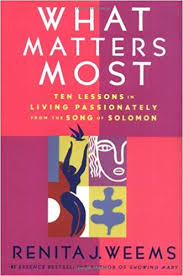
My Spiritual Formation this week is from What Matters Most: Ten Lessons in Living Passionately from the Song of Solomon by Renita Weems. She takes takes the “ten lessons” from the Shulammite woman’s fearless living and loving in the Song. Interestingly, I’ve heard the Song of Solomon called “The Porn Book of the Bible,” which reinforces masculine patriarchal dominance of Scripture. Weems allows the Shulammite woman to claim her identity through characteristics of liberation. Three quotations from this week’s reading on Choice stood out to me. Here they are with my reflections:
The Shulammite risked ridicule, criticism, challenge, failure, and embarrassment for the possibility of living a bigger life than the one society assigned to her as a woman (Kindle, p. 80).

Societal rules are powerful, so powerful that we internalize them and regulate ourselves. Growing up, I wanted to be a CIA agent or a lawyer. It was inconceivable to me, my parents, my friends—everyone who knew me—that I would not go to college on a scholarship straight out of high school. But gender role norms are deeply embedded in how we think and act and move about in the world. By my junior year I was “engaged,” in a relationship just like the other girls. I was married at age 18 and had a baby when I was 19. I look at those numbers and shudder—so young! I gave up my own bigger life.

Being passionate means living your life fearlessly. What if I make a mistake? What if something goes horribly wrong? What if I lose more than I gain? What if I make a fool of myself? (p. 83).

Before age 35, I had never lived outside of Alabama. That year, I got divorced, came out to myself, got a job at the Louisiana Department of Education, enrolled in a doctoral program at LSU, and moved to Louisiana. After escaping with my identity—which I had fought for 16 years to hold onto—I did not once ask myself these questions. Like the Shulammite, I was living fearlessly. However, and this is important, my communing with God was a one-way conversation. Although God was ever-present with me, I continued to press through under the delusion that I was accomplishing these things by myself. I give thanks now in retrospect.

But what if the path you’re about to take leads you off the beaten path and falls outside the norm of what others deem acceptable? (p. 87).

On the day I moved to Louisiana, my mother was seeing me off. It was a poignant moment. Two women whose love for one another most often went unspoken, said goodbye. “Mother,” I said, “I’m sorry. It’s hard. I just…” trailing off, not knowing how to speak the things that were in my heart about my life, about her, about all the years I felt I had lost. She thought for a minute, trying hard to blink back tears so that I would not see them—something I learned years later she had often done. “You go ahead. I know you need to. We always knew you’d leave one day.” The beaten path, my parents knew, was not for me, no matter how hard they had tried—through church, modeling, instructing, shaping—to guide me along it. That day, when the strongest women I have ever known blinked back tears and let me leave, was the day I began to live without a net, yes, but in vivid color.

What Matters Most: Ten Lessons in Living Passionately from the Song of Solomon


(An) Embodied Prayer

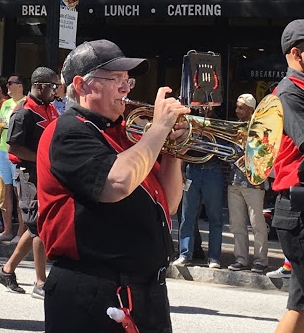
Marching with the AFB
Even though this is one of the happiest moments of my life, I never published this photo because of how I looked. Doing so now is an act of love, kindness, and prayer.

Two words concerning prayer life resonate with me this week: intention and attention. I sometimes fret about my prayer life, especially when I hear my fellow seminarians openly talking about theirs; I even have a professor outside of this class who returns our attention to prayer life. This week’s reading reminds us that naming our longing to be always in relationship with diving (intention) and by paying attention to where we see God in our daily life (attention) remind us of divine presence and grace.

Reflecting this week, I sought connections between my praying self and embodied self. I realized that an important connection is the esteem in which I hold my spiritual and physical being–or the regrettable lack thereof. So I would like now to discuss body issues and return to embodied praying.

I came across two pictures of myself a few months ago. The first was of myself on my wedding day, taken by my new husband. It was a snapshot, and I was looking at him over my shoulder. My first thought was how young and beautiful I was–and at the time I did not realize it. I was never not weight conscious. Realizing the many gaps of pertinent information here, I will say that my husband, who struggled with his sexuality throughout our marriage, had no words to express his inner turmoil; however, he did have words to turn his issues around toward me. One example: I never fixed a plate of food for myself in sixteen years that he did not look at and comment about my weight. As you can imagine, this affected me deeply. I have apologized to the girl in the first photo.

The second photo is of me at about age 37. I am bloated and look unhealthy. No longer married, working on my doctorate, in a new relationship, starting a great adventure in a new state–my body tells a deeper tale. It is one of insecurity, uncertainty, and a different kind of unhappiness. More gaps, I know, but I was struck by this picture in which I looked like a completely different person, one who was dancing–and apparently eating–as fast as she could. I apologized to the beautiful woman in that picture, too.

Reaching middle age–I am 55–has forced me to communicate with my body. I am aware of new aches and pains; it takes me a few seconds of walking before the muscles catch up (I call it having a “hitch in my getalong'”); and I am having to become acquainted with the grayed and wrinkling woman in the mirror. Thing is, I know this body has fewer days left than it has experienced, and that’s ok. When I do see that lady in the mirror, I assure her that she is beautiful and that I appreciate her–that face, that body. I promise her to live in such a way that I will mindfully value her now, in this moment, so that I never look back with regret at failing to do so.

This is what praying with my body feels like–gratefulness to God for my body as a presence in God’s divine creation–no fear of scales or mirrors or photos. Just thankfulness for this familiar likeness.

Coda: I read somewhere that 65% of women report that they have cancelled a doctor appointment because they do not want to step on the scale at check in. I myself have done this. Yes, read that again because it is in fact incredulous. Last week I had my check up. In I walked with the nurse who held my chart and directed me to the scale. “We have to do this,” she said, “but don’t worry, it’ll be over in a minute.” I boldly stepped up on the scale, keeping my shoes and jacket on this time. “It’s ok,” I replied, “I’m good.”

Thoughts on Prayer Following the Christchurch Massacre

As I write this, another heinous mass shooting has taken place by white supremacists, this time in New Zealand. Almost 50 of our Muslim neighbors were murdered and 20 seriously injured, killed while they were praying. This attack is on my mind and heart as I contemplate this week’s Core Forum on prayer. As one public figure tweeted this morning, “Whether it is antisemitism in Pittsburgh, racism in Charlottesville, or the xenophobia and Islamophobia to day, violent hate is on the march at home and abroad….Silence is complicity.” I include this because the connection is made to multiple groups that are targeted for no other reason than hatred of any particular difference. The city where this atrocity occurred is called, ironically or not, Christchurch.

I have a chaplet that has inspired my prayer this week. If any of you are like I was and do not know what a chaplet is, it is a kind of small rosary–a prayer object–that usually has a saint medallion/object attached to the beads. Mine has two medallions. The first is St. Francis, whose prayer I have always loved, and the other, newer one is Julian of Norwich, whose mystical experiences inspire me. Julian’s words also comfort me like a gentle voice and touch soothes a child: All shall be well, and all shall be well, and all manner of thing shall be well. I also made this quote my phone wallpaper–a postmodern engagement with the 15th century mystic. Still, when I see the words, I pray them. I’m thinking Fundamentalist Evangelicals do not a rule pray chaplets or contemplate icons in our prayer life. That’s unfortunate because for me it has deepened my prayers. Henri Nouwen says, “Icons…lead us into the inner room of prayer and bring us close to the heart of God” (p. 61). Whether icons are kinesthetic like mine, or natural, they open us to the Mystery of God’s presence.

The politician’s quote, above, suggests to us that the end to hatred and violence–peace–comes at a great price: our psychological, emotional, and embodied engagement. I am reminded that when the messages of MLK, JFK, and RFK turned from civil rights to peace, their lives were extinguished. The work of peace is a work of justice, and justice is the nature of God. Thoughts and prayers are not acts of peace in the world; prayer is that place of mystery where we might know that all will be well. Prayer is the interior castle (Teresa of Avila) where we are lost with and strengthened by our Beloved. Prayer is not what we do for the oppressed; prayer is what we do for ourselves so that we can have the strength to do the hard work of justice. God waits for us.

Coda: When John Lennon’s “Imagine” was released in 1971, it scared people–Christians who feared the new peaceful, global social order it suggested. In an interview with Playboy magazine, Lennon said that Dick Gregory had given Ono and him a Christian prayer book, which inspired the concept behind “Imagine.” A prayer book. He said,

The concept of positive prayer … If you can imagine a world at peace, with no denominations of religion – not without religion but without this my God-is-bigger-than-your-God thing – then it can be true … the World Church called me once and asked, “Can we use the lyrics to ‘Imagine’ and just change it to ‘Imagine one religion’?” That showed [me] they didn’t understand it at all. It would defeat the whole purpose of the song, the whole idea. (Wikipedia).

They were right to be scared, for it calls for an end of systems of domination, by definition the domain of the dominant culture. I wonder if we are any more willing to pray it today.

Imagine (a Prayer)

The lyrics are below.

Imagine there’s no heaven
It’s easy if you try
No hell below us
Above us only sky
Imagine all the people
Living for today (ah ah ah)
Imagine there’s no countries
It isn’t hard to do
Nothing to kill or die for
And no religion, too
Imagine all the people
Living life in peace
You may say that I’m a dreamer
But I’m not the only one
I hope someday you’ll join us
And the world will be as one
Imagine no possessions
I wonder if you can
No need for greed or hunger
A brotherhood of man
Imagine all the people
Sharing all the world
You may say that I’m a dreamer
But I’m not the only one
I hope someday you’ll join us
And the world will live as one

The Curious State of Being “Called”

Maybe at some point in your life you have been called by God for some purpose. If you have and you realize it, all I can say is wow. How did you know? Did you hear a voice? Did you have a feeling around your heart or stomach area? Was there only circumstantial evidence?

call is different from a calling. I’ve heard teachers and nurses say that that they felt a calling toward their profession; a calling is a strong urge toward a particular thing, usually a vocation. A call is a divine summons. Let that sink in.

I grew up in a church that did not believe in divine summons or of being led by the Spirit. We were fundamentalist Christians who believe that the Bible is literal, mostly, unless it isn’t. People who talked about being called by God to the ministry were obviously Jesus freaks, most likely Baptists. And then, again, God laughs. Yeah, I was called. I’m not sure if I can stress how hard it is to understand that a call is a call when you don’t believe in calls at all. I think I would compare it to a dog being leashed for a walk for the first time. At first, it’s like, “Hey, wow, what is this I’m feeling?” And then, “Wait a minute….what is this thing?” Next, is pulling back and tugging, followed by flailing around from side to side. Until finally, you’re completely worn out from fighting it. Then you’re ready to walk. This is the first part of a process that is known as discernment.

Have you ever felt like God was just putting things in your way? Not obstacles, more like lit up “Entrance” signs in strange dark rooms. In that situation, what are you going to do but go in? That’s what happened to me. It started when I read the liturgy at church one Sunday morning (nope, I’m not fundamentalist anymore, nor Baptist either). I felt that leash for the first time. I’ll just take a course on Progressive Christianity, I said. I like this course; I’ll see if I can find a really good online program. Then, if the M.A. in Christian Ministry is this rewarding, I want to pursue the twice-the-credit-hours Master of Divinity. What was God putting in the way? Time, opportunity, scholarship support, people who kept saying, “Oh! You’d be so great at ministry!”

So what about the pulling back and flailing around part of this walk? It’s pretty much been ongoing to this point. I mean, I have a job, a doctorate, and an established writing presence in my academic field. I’m at the place where people usually arrive, not where they jump off from. Luckily, the first class you take in seminary is called Spiritual Formation, where you learn that discernment is being still and listening for God. It’s ok not to know what to do, just don’t get tied up in knots over it, which is my default. When I got serious about listening to God, I settled down and started walking.

So here I am: MDiv student at the McAfee School of Theology. I’m still working full-time at a job that is truly not bad. I’ve put academic writing on pause until the next page is revealed to me, no pun intended. That’s the background of it, and I think it’s sufficient for now.


The Journey Begins

Thanks for joining me!
Good company in a journey makes the way seem shorter. — Izaak Walton
post This is a place for peaceful contemplation inspired by story. What is spiritual mindfulness? For me, it is remembering to feed my spirit. This blog is a spiritual practice~~storying the soul, if you will. Most sites I find on either one of these topics focuses on meditative and wellness practices. Maybe that’s what you are expecting here. I hope you’ll be pleasantly surprised as instead you find a narrative approach to exploring spirituality, mindful of the everyday. That’s what I do–I write. For almost two decades I dedicated my time and energies (a lot of mental energy, i.e. worry) to academic writing. Here’s how I did it: I would write my narrative essays about place, religion, gender, sexuality, white privilege, etc., and then cite the requisite sources (that’s the academic part). But a funny thing kept happening. People would approach me after a panel presentation and say, “You know, you really ought to write a book with just your stories.” Which is exactly what I wanted to be doing. The problem is, I am an academic; thus, the academic writing.  This is a period of discernment and transformation in my life. Of course, that’s part of what you’ll find here too. I started to seminary and had to make some life choices. One was to step back from academic writing and do the kind of writing I really do enjoy–and that’s what you are reading now. I invite you to come along on my journey as I nourish my own spirit through story telling, being mindful of every, every minute, as Emily in Our Town would say. It is my hope that my stories offer you nourishment of some kind too.  The writing here comes from observations that dawn on me as I go about living life with as much intentionality as I can muster. That’s the mindfulness part. What makes it spiritual? Well, that’s the part of me where the words come from—the part that hopes to connect us to, as Paul Tillich would put it, the ground of our being. One.

On (Not) Minding Mortality

Yesterday I was reminded by two different folks of my blog, which is the first item put on hold when life gets really busy. Blog writing–reflective essays, really–is my favorite kind of writing, and I always mean to do better about not neglecting it. If I could do this for a living, I believe I would. So here’s something for today.

When I opened the page to start an entry, I found the following two paragraphs that I had begun last year. Let me tell you, I was in a really different place then than I am now, so it is not the same entry I would do today. Still, as I read it, I thought it was important to show the contrast and reflect on that for a minute. The original title was Minding Mortality. I felt like that needed to change too, so I changed it slightly as you can see.

One unexpected realization of practicing mindfulness has been that I am more mindful now of my own mortality. That’s probably due to my coming to the practice at this particular age; I’m fifty-five. I used to tell people that weight, not age, was my worrisome number. There have seldom been days in my life when I did not think about how much I weigh. Still do. I am happy to report that with the discernment that has come with getting older–and with having a generous life-partner–I now have a more peace-full relationship with my body. I have healthier reasons for wanting there to be less of me. But, age. I didn’t mind turning 50; in fact, I was proud that I didn’t mind. I was traveling, meeting people, enjoying life. That year I had an extended episode of cognitive dissonance–a mid-life crisis, if you will–about the meaning of life. Not just “the meaning of life,” but the meaning of my life. That is why the title of this blog is so important to me. It indicates a moment at the crossroads when focused, deliberate thinking was imperative. I remember distinctly the day when I took a different path that led to here. I didn’t know then that it had to do with thinking about mortality, but I see now that it does. If I had been content that my life had been meaningfully well spent, the dissonance would have been a lot less jarring.

Three years later, at fifty-three, I began grappling with the awareness of not having as many years left as I have lived. I started expressing my consciousness of it in small ways at first~making joking references to being put in a nursing home by my kids as my parents had done. Confirming my beneficiaries. Then one day I told Sarah that I would really like to get a diy project done so that I could enjoy it before I was dead. And it wasn’t a figure of speech

So that was last year. Since then, some imbalances have righted themselves after a good deal of grieving, and I had a bit of re-adjusting to life to do. Once again, I felt like I was emerging from a cocoon to a new day of opportunity that beamed the question, Who do you want to be? Except this time, the question was not out there alone in the universe for me to orchestrate a response to it. The question that settled on me like a warm sweater is, Who does God want me to be? I gotta tell you–when a question like this is put in the way it was put to me–well, I commenced to find the answer. Trust me, I’ll work through more of it here; the way the path opened up is, at least to me, fascinating–sometimes a little scary.

What is a good ending for the post from a year ago? As with most things, age and one’s location on the continuum of birth-to-death depends on how you frame it. And for me, it’s the difference between the two questions, above. Lived for myself, each day, each week, each month would be “one less.” On the other hand, resting–existing, thriving, living–in what Marcus Borg might call the more-ness of God illuminates the moreness of life.

For Tracy. Remember:
Marty Robbins The Master’s Call

Lessons from My Face

Prompt from Mindfulness: A Journal (Price, 2016)
Make a list of ten everyday activities that you find relaxing or soothing–even those as small as calling a friend or making a cup of your favorite tea. Try it! Do one of the activities on your list and write about your experience. 

The List, in no particular order:
1. read–theology, queer theology, JFK assassination theories
2. watch television–documentaries, period pieces, docu-dramas, biographies
3. having my afternoon cup of espresso made with my luxury-item coffee maker
4. playing piano
5. tidying up
6. singing
7. listening to music, which kind of music depends on my mood
8. reverie, including porch time with close friends
9. meditating with my Calm app

I realize this is probably a sad little list for many people. I can’t even think of a last item offhand. But I think my simple list hints at my capacity for finding joy in the simplest of experiences, noticing a blue bird, for example. This capacity, in turn, points to my state of being generally, happy. I have, though, always had a facial expression that belies this inner state; I found out it has a name: bitchy- or angry-resting face.  Challenge enough, without the surly-resting face that Bells Palsy begat. These days I have to work to put my best face forward.

It has almost been a year since Bell’s Palsy took over the left side of my face. I’ve written about it~the depression and frustration and then hope-full-ness. So, after a year I realize that I have some important takeaways from the experience. The most important is when God wants to get your attention, God finds a way.

What else have I learned? Well first, people look instinctively at the face for a clue as to how any given interaction is going to go, whether it is saying hello or engaging in conversation. I have learned to flex my smile muscles when I’m walking down the hall or into someone’s office or into a meeting. Otherwise, I can see in their eyes that they’re bracing themselves. This is different than before the BP~~now I can actually feel the muscles pull when I try to look pleasant, or when I smile. If, as the author of The Surprising Psychology of Smiling, below, is correct and smiles tell you something important about the wearer, I must intentionally craft a message of authentic friendliness if I expect folks to tell my important thing!

The Surprising Psychology of Smiling

I don’t have a poker face; I cannot remain neutral whether I am pleased or aggravated. The other day I learned the term for this: microexpressions. A microexpression is an involuntary facial expression that occurs in around 1/25 of a second and exposes one’s true emotions. Wikipedia tells us that they occur when a person is trying to conceal all signs of how they feel about an interaction or situation. Microexpressions seem to be universal; everybody has them. People with good social skills learn how to recover from them faster than others. Still, I am not sure there is much “micro” about my expressions. They go directly to macro. Now I actively practice relaxing my face so that it can achieve a neutral expression, and I savor the feeling of the muscles at peace.

My face isn’t always doing what I think it is. This is particularly noticeable in the morning when my face is waking up with the rest of me. It takes a second of extra effort to raise my left eye completely. One morning I looked at myself in the mirror while I was singing. The sound was coming out as usual–I sounded like myself. But only one side of my face was animated and expressive; the left side was still lagging behind. My mouth looked more like a “D” than an “O.” I’ve really had to practice this one. During choir, I have to work those same smile muscles in both my mouth and my eye while singing. And while it feels from the inside like I have a pageant smile on my face, it’s actually forming my old singing face. This reminds me of how you have to exaggerate expressions and voice on the stage during a play. It may feel like over acting, but it comes out sounding natural.

I have learned to take cues from my face. When I become frustrated or irritated, I can feel the large muscle in my cheek–the one that runs from my eye to my mouth, which makes it a serendipitous mindfulness check. Stress almost certainly triggered the BP in the first place, so I use its manifestation to my advantage. And, I continue to search for a spiritual meaning in it all.  For example, one charge to Christians is to see the face of Christ in everyone we meet, which is another kind of mindfulness cue~~one toward compassionate service, of love. I like the thought of this, of seeing the face of Christ in ourselves and others, but Jesus’s expressions were not just happy ones. He suffered from emotional, psychological, and physical wounds. Jesus got mad; he too was under stress. I guess that is really an important lesson I had not thought of~~to accept my new natural face. If ultimately this is the most muscle control I ever recover, which I reckon to be around 87% (when I can whistle properly, I’ll round it up to 90%), then I must lovingly cherish my face, deliberately, as I have not had to do before. I mean, of course I used to wish that my nose were pointer and my smile bigger, but it was my face and I loved it. I am learning to love it again now, and in the process I am learning so much more.

Billy Joel “The Stranger”