Watershed: Three Questions and Mindfulness

There’s a line in the Indigo Girls song Watershed that goes, Every five years or so I look back on my life, and I have a good laugh. Absolutely worth pausing to enjoy:

The line reminds me of a therapy session I had a little less than a decade ago. I’m a firm believer in therapy. Every few years or so I look at my life, and decide that a little more therapy wouldn’t hurt. Anyway, after hearing me narrate my stories and give account of my life as I understood it, the therapist paused and suggested, Well,  you might ask yourself two questions: 1. what do you want? and 2. what do you need? Since then I’ve come to call these the two existential questions. Because when I come to crossroads in my life—when I take an assessment of it—I come back to these questions. Every time—what do I want, and what do I need. Considering them helps me clear away the clutter. And often, I find that clearing away the clutter, all the superfluous options, the unimportant details, all the non-options, all the false urgencies, all the manufactured drama~~ if I can do this, I can get a little clarity.

Now while at least temporarily I have only one good eye with which to look back upon my life, my timeline has been sped up. Thanks to the Bell’s Palsy I went ahead and turned to my existential questions early. As Sarah chauffeured me through Atlanta traffic~~a whole other kind of existential question, and that was pre-I-85 collapse!~~I expressed my hope that my two questions~~what do I want and what do I need~~might come in handy now to remind me to be mindful and set peace-full goals for my home and professional life. Sarah asked, Shouldn’t you also ask, What do you have? I mean, don’t you need to know what you have to start with?

And then I realized something: want and need are words that aim me toward the future. Have is grounded in the present. To be mindful of the present moment, in other words, my existential questions are literally getting me ahead of myself. I started making a mental note of when I continued a conversation with, Yeah, and I need to….or ok, and when we finish this, I want to… They really added up. To start with what I have indicates not only mindfulness but also gratitude for the present moment. It is not about possessions; rather, it is about being. For example, when we were house shopping two years ago, Sarah and I had very different ideas about what sort of home we wanted. I was looking for low maintenance, newish, bells-and-whistles, upgrades—I wanted as much house as we could afford. Sarah, on the other hand wanted a house that wanted our TLC, one that had projects that we could really dig into. She wanted us to live beneath our means in case I decided to stop being a department chair and bum around as a professor writing blogs and books all day.

I was not a project person. I’d rather read or travel. We ended up with a 1973 house that I call the Brady Bunch house. It has a basement that I call the Hot Tub Time Machine Basement—circa 1970s. We ended up with it because it makes her happy, and that makes me happy. She can see the possibilities it holds, and she can see the finished products of our DIY labors. I, on the other hand, approached—I raced through—the projects with a fury. Hurrying to get them done, shopping for new things to replace the old—as often as I could I would bring in a handyman to do them. Look at how great the mudding on the ceiling looks, honey. Yeah, and we need to…..This went on until on day, Sarah helped me understand that working on projects brings her relaxation and joy. That she looks at them as something we can do together. When I hire a handyman, it robs her of some of her joy. When I would looked at the house and saw only years of impossible work—and be not insignificantly depressed by it—I was rejecting opportunities for being—being together, being mindful, being grateful.

In the following jewel of mindfulness teaching, Thich Nhat Hanh, pretty much sums up my perpetual state of mind over the last 50 years:
If while washing dishes, we think only of the cup of tea that awaits us, thus hurrying to get the dishes out of the way as if they were a nuisance, then we are not “washing the dishes to wash the dishes.” What’s more, we are not alive during the time we are washing the dishes. In fact we are completely incapable of realizing the miracle of life while standing at the sink. If we can’t wash the dishes, the chances are we won’t be able to drink our tea either. While drinking the cup of tea, we will only be thinking of other things, barely aware of the cup in our hands. Thus we are sucked away into the future -and we are incapable of actually living one minute of life.
Thich Nhat Hanh, The Miracle of Mindfulness

When I have already moved on to the next activity, or item to purchase, or place to go, or meal—then I am not mindfully grateful for the blessing of being present. Life in the present is gratitude for the miracle of life while standing at the sink. I take on our projects now and work on them in the moment; stirring paint is stirring paint. When I’m sanding a desk, I feel the wood grain and the flecks of paint. When we demolish a portion of the porch, I do not panic to plan exact dates and details of when it will be put back together.

No doubt~~knowing me~~I will have to remind myself of this regularly. Old states of being are hard to move past. I like to have something to look forward to, a curiosity deserving of its own unpacking. But the old tools weren’t working; pushing forward was not working through. I have to work at it, at mindfulness, and it is so much more difficult than I thought. For example, I spent one whole day looking at web sites for mindfulness trainings and retreats–one was in IRELAND!~~I downloaded three mindfulness meditation apps on my phone. Found an online mindfulness course. I was obsessing over mindfulness, an irony Sarah kindly but pointedly noted with a grin. And when you’re learning to face the path at your pace, every choice is worth your while (Watershed). Every choice is the opportunity to actually live one minute of life at a time. And that’s jaw-droppingly incredible to me.


God Laughs, or Fun with Bell’s Palsy

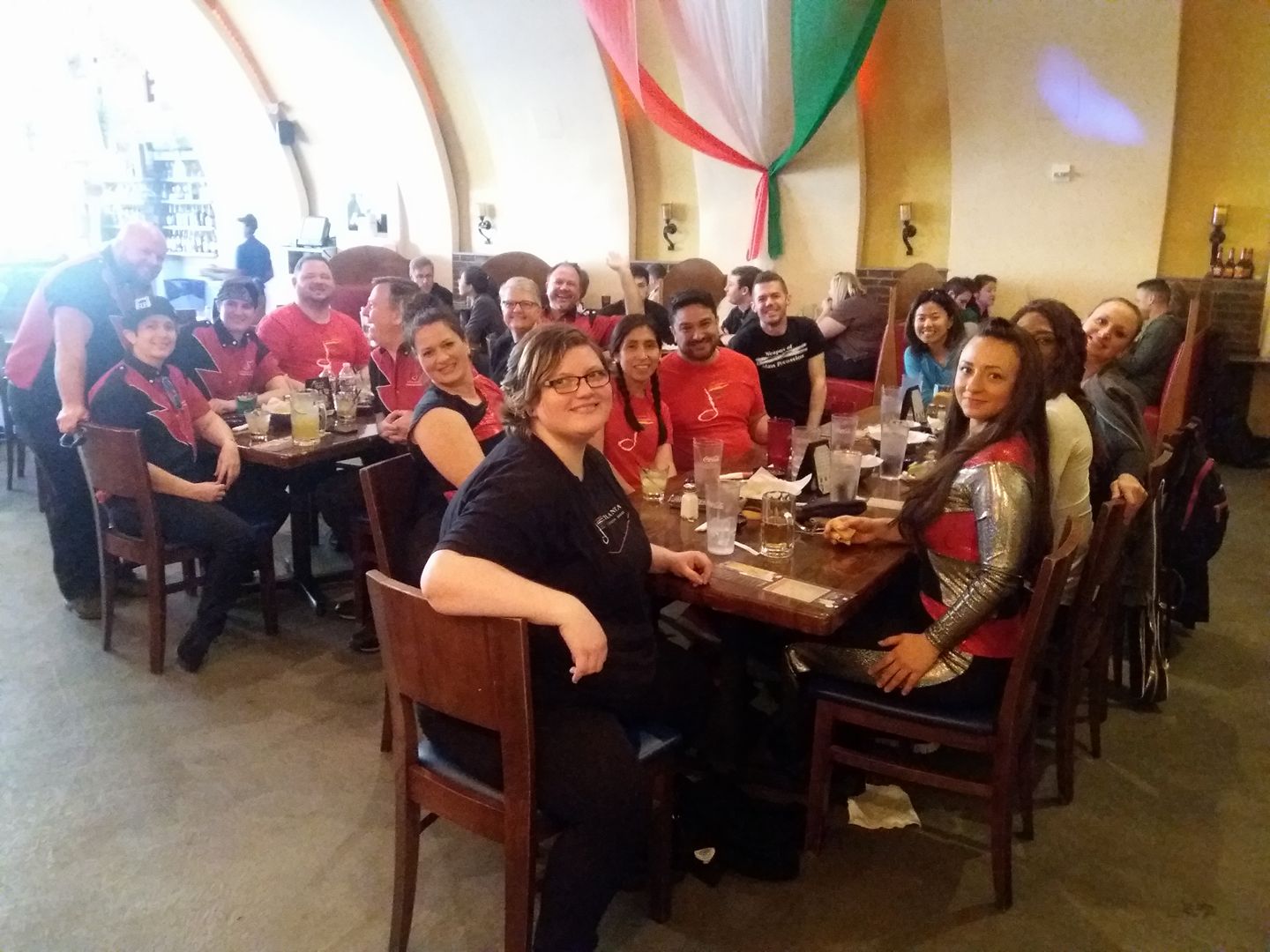
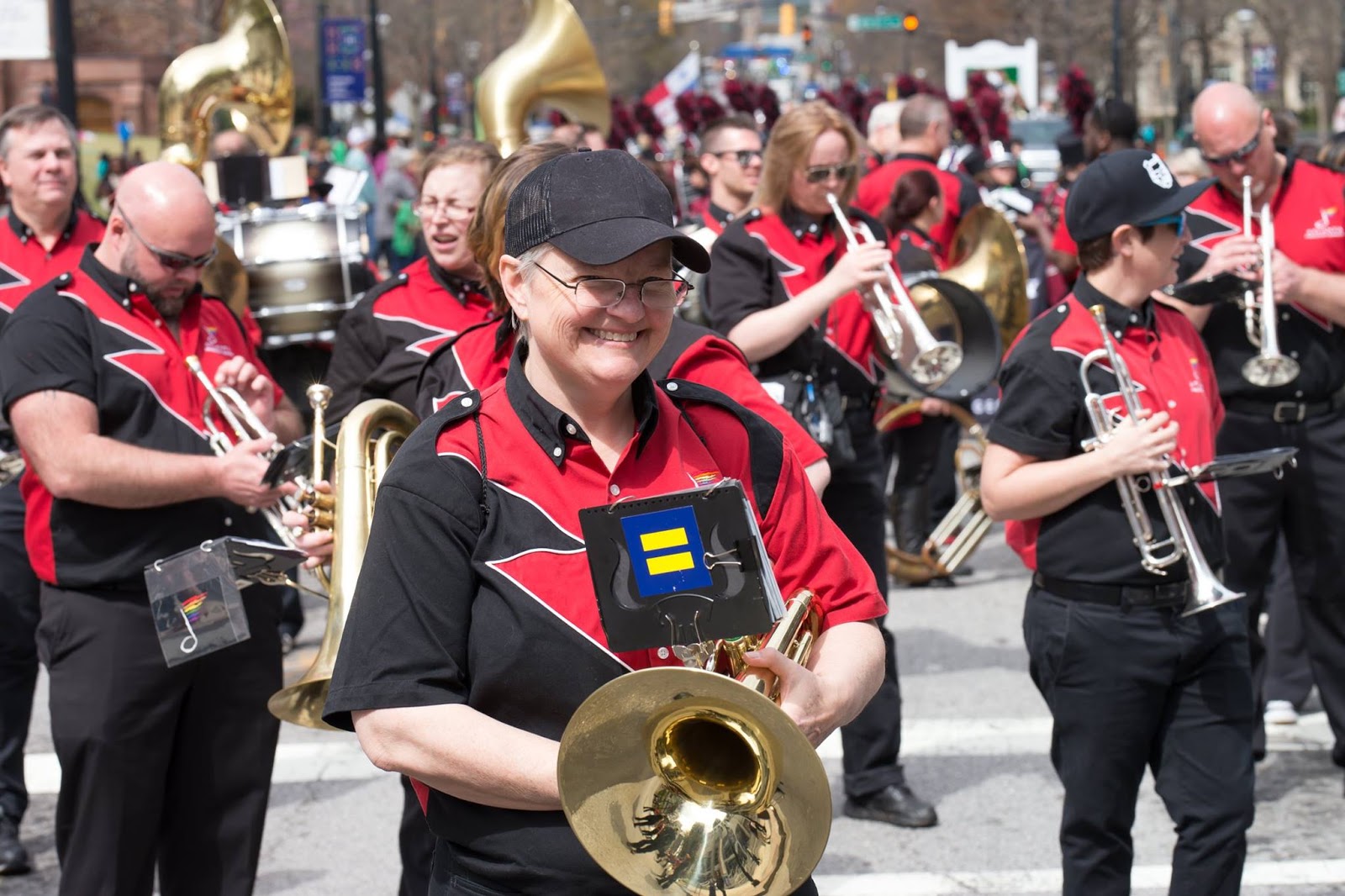
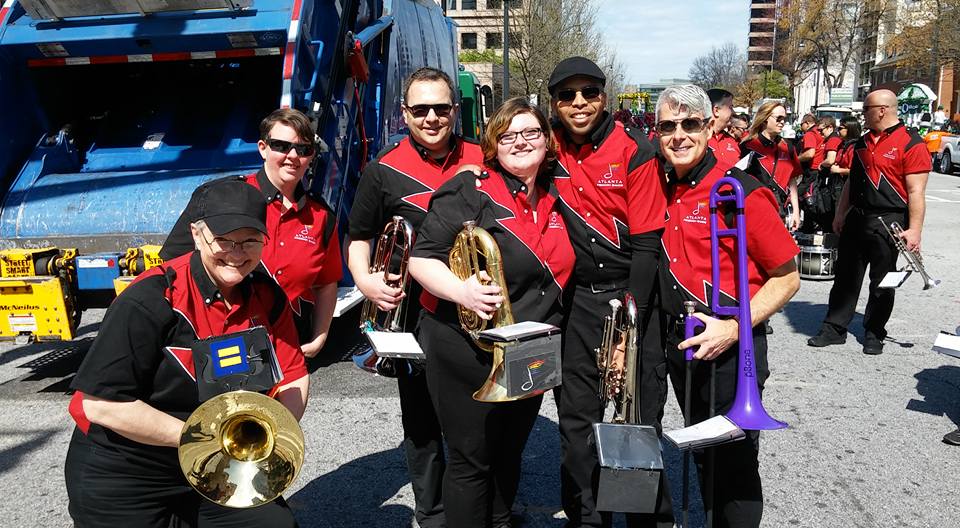
You make your plans, and God laughs. That’s what happened to me over the weekend. Let me go back, though, and start with discovering the Atlanta Freedom Bands, which I wrote about here in November 2014. I recollected how finding the band made me realize how much I had missed making music, marching in parades, performing in concerts. How after more than 30 years, finding the AFB was like discovering a new, yet long lost treasure. Last year, I marched my first season of parades in various Atlanta community festivals. It was wondrous. And at Christmas, I performed in my first concert playing French Horn in 35 years. Last Saturday morning, I marched mellophone with the AFB in the Atlanta St. Patrick’s Day parade. Afterwards, members of the band had lunch and drinks and fellowship at a local restaurant, which is the custom with this group.

Saturday night, kept waking up with what felt like a neck cramp. When I woke up early Sunday my speech was slurred, which I chalk up to needing a little more sleep, so I went back to bed. When I woke up again, I couldn’t blink my left eye. I ended up Sunday at the emergency room in Marietta. After they have ruled out a stroke, which was probably the best news I have ever received in my life, they told me I had a textbook case of Bell’s palsy. After a lot of googling I found out that it’s caused by virus, kind of like shingles. Likely because I had the flu, and that virus was in my system, it ended up attacking my facial nerve, causing it to be droopy and paralyzed. Like shingles, it was likely triggered by stress. In addition to facial paralysis–a word, like biopsy, fills me with terror–I have heightened ear sensitivity in my left ear, so loud noises, including my own sneezing, amplify like I’m standing in front of a Bose speaker. By all accounts, I will (should?) regain use of my facial muscles. Most well-wishers report success stories. It is totally unrelated to a stroke, and contracting it one time does not mean I will get it again. Those are the things I know. The worst part is that I can’t blink, so my eye gets dry and irritated. And that can lead to all kinds of trouble. I have to keep eye drops in it and wear a patch. Having only one eye affects depth perception and means I can’t drive. I can’t whistle or smile or buzz my lips. And buzzing one’s lips is essential to playing a horn.

Even though I realize I am very blessed in that this could’ve been so much worse, I’m still having to learn to deal with it. There are lots of adjustments I’m having to make pretty quickly. I’m learning how to have meals with straws and napkins. I’m learning how to turn my head in order to see better with an eyepatch. I’m learning to enunciate words using one side of my mouth. I’m learning how to encounter other people whose first response is to look away from me. I tried to go to the office yesterday, and by the end of the day I was exhausted from having to compensate physically in order to get from point A to point B, or participate in meetings. Talking and looking took a lot of energy that I had taken for granted. Part of the dealing with is going through my own stages of grief: denial, anger, bargaining, depression, and acceptance.

Sunday and Monday I was in denial. I jokingly made a list with Sarah of one eyed characters for costume parties. We go back and forth with one-eyed jokes. In case you didn’t know, there are many one-eyed one liners. Believing the doctors that taking the meds would speed up recovery by months, I thought, Well if I can’t play horn, I’ll just break out the old flute and play that! I tried for half an hour to form the embrasure to blow air across the mouthpiece.  I waited to blink at any minute. I planned to go to choir. Tuesday night begin my descent into anger. I kept a dinner engagement with some visitors to campus, old friends from my curriculum world. When I entered the restaurant, Marlows Tavern, which I had been to so many times over the past few years, the hostess looked at me and then looked away. Same thing happened when the waitress came to take my drink order. I realize now that I do the same thing automatically–probably most of us do.  The next day, I mentioned choir to Sarah, who slowly turned and looked at me and said, Honey, you’re not going to choir. When I looked back at her in one-eyed disbelief, she started singing a little bit of the Hallelujah Chorus, which we’ve been working on for a month. I thought my left ear would blow out. No, I wasn’t going to choir. When she dropped me at the office,  just walking from one building to the next took all my energy to keep my eye covered so it would not dry out. I had two meetings where it was very important that I be able to speak, and that was extra energy. My colleagues, wonderful people, tried very hard to look at me in a normal way–and for that I will forever be appreciative. Nevertheless, I feel different, I talk different, I look different. And that was psychological and emotional energy spent that I wasn’t used to spending.

I’ll let you know when I’ve moved from anger to bargaining. Till then, in order to work through some of that anger, in order that something generative and therapeutic might come from it, I decided to pick up the blog again. It’s always been my favorite, preferred mode of writing. Academic work is important, but it isn’t accessible, and it limits my flow of thinking since I have to measure my tone and phrasing as well as the thoughts themselves. Here, I can have a conversation, if only with myself. Plus, Sarah approves of it since it will help keep me out of trouble–like trying to do home-improvement projects with one eye that doesn’t need to get dust in it. Most important, this is all helping me put my life in perspective and put the parts of my life in priority. It isn’t an overnight revelation, but I realize that stress is counterproductive and can be harmful. I reaffirm that life is always already about the people in it. That being present and being mindful is living. I am intentionally choosing hope and happiness. Hope and happiness are not default properties, and being intentional about them makes a difference. As I think about it, coming to this place is a kind of bargaining. I will trade impatience for writing, frustration for processing, sight for insight.

Band friends at Sr. Patron’s
Mellophone


A mello-photo bomb