In 1973, Cliff Robertson starred in an ABC Movie of the Week production of Edward Everett Hale’s story, “The Man Without a Country.” In it, an American officer is being court martialed for consorting with Aaron Burr. He wanted to make a point about the disunity of the new country and so blurted out, “Damn the United States! I wish I may never hear of the United States again!” The judge took him at his word, and in a rather pissy move, sentenced Philip Nolan to spend the rest of his life sailing the seas on American warships without ever setting foot on or hearing any news about the U.S. again. It’s one of my favorite stories (and made for tv movies!). I have thought about it a lot over the last few weeks. I think–even though I get the point Nolan was making (kind of like Rev. Jeremiah Wright’s in 2007, see https://abcnews.go.com/Blotter/DemocraticDebate/story?id=4443788&page=1), my wistful call would be, “Bless the United States! I sure would like to live in ‘United’ States again.”
I took a break from blogging regularly over the last four years to go to seminary. In fact, the election of 2016 was a big reason I decided to go to seminary. I had a low, sick feeling more and more people would be hurting, and I wanted to be able to offer spiritual care. If you want to say I had a call, that was it. And that was before Covid-19, kids in cages, Russia and Ukraine, Charlottesville, Black Lives Matter, George Floyd, corporate deregulations, revocation of environmental protections, withdrawals from the Iran Deal and Paris Climate Agreement, Jeff Sessions, William Barr, Brett Kavanaugh, insurrection, embracing of dictators, Kenosha, Cruz & Hawley, QAnon, Seattle, Jeffrey Epstein, Harvey Weinstein, The Big Lie, The Year 2020–and more that I could name, like these, off the top of my head. And oh yeah, did I mention Covid-19?
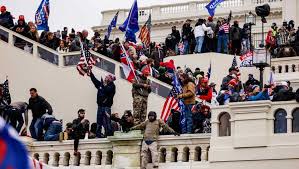
It is not hard to see, as all major news outlets and commentators are reporting, how every day of the last four years led directly to here. Radical insurrectionists planned for months to descend upon Washington, D.C. to be directed by the President of the United States to storm the U.S. Capital while Congress was in session. The President and members of Congress–bolstered by Republican led state legislatures–actually expected and attempted to overturn legally certified (by Republican legislatures) election results. Both Democrat Congresspersons and Republicans who voted to approve the Electoral College results–including the Vice President of the United States–are afraid they will be hurt or killed. By their congressional colleagues and their supporters. Some members have been attacked in airports; others are switching up their daily routines to throw would be attackers off. Representative Alexandria Ocasio-Cortez posted on Instagram she was afraid her colleagues would help the insurrectionists kill her. Let that sink in. https://www.nbcnews.com/video/alexandria-ocasio-cortez-tells-instagram-i-thought-i-was-going-to-die-during-capitol-riot-99380293747
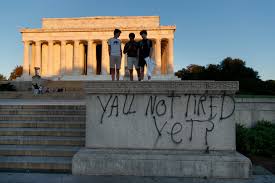
(Not a Civil War era picture)
I am still trying to form coherent thoughts about our United States at the end of a four-year dumpster fire. I am trying to see, as I have begun to do since seminary, where God is in all of it. Here is a ramdom list of (what I think are) relevant thoughts on the country on the eve of Joe Biden’s inauguration. Really random.
For about one day I was able to feel a lightness of spirit as Georgia, the state I live in now, replaced two Republican senators with two Democrats, one, the first Black Georgia Senator ever. That was on January 5.
Black people and white people do not live in the same country. Where White people are angry, fearful, frustrated, and shocked at the events over the last four years, Black people are shaking their heads saying, “We tried to tell y’all.” This is how it feels. As activist Kimberly Jones said, “Be glad Black people aren’t seeking revenge” (https://www.youtube.com/watch?reload=9&v=YPfeg6E52nA). To reiterate: Black people AREN’T seeking revenge.
Related: White people, People of Color are going to outnumber us in a couple of decades–in our lifetime. Start living now like that is a fact.
Related: If you are worried about a “way of life,” or “American values,” or “The American Way” going away, you are resisting the above fact.
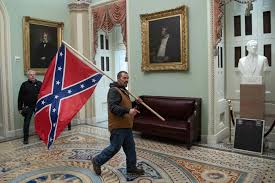
A Confederate flag was paraded through the United States Capital on January 6, 2020. Even Robert E. Lee was not able to do this.
Related: A gallows with an expert looking noose was set up on Capital grounds on the same day.
Gallows & Noose, U.S. Capital
It is looking more and more like the insurrectionists were led on recon tours by Congresspersons and Congressional Staff.
The President is not The Godfather. He cannot call up and strong arm Secretaries of State or State Legislators to find votes that simply were not there. Everybody knew, including him, that they were not there. He and the radicals just wished they were.
Concealed Carry is not a good idea. I don’t see how anybody could say it was ever a good idea. People voted for it anyway. Same with Campus Carry. Nineteen year olds with weapons. Again, who thinks that is a good idea?
Related: Nobody is coming for your (hunting, social, skeet, toy, cigarette lighter, BB) guns.
The President is using Christians. Christians please realize this.
Hillary Clinton’s statement about “The Deplorables,” taken out of context, helped lose her the election. Donald Trump looked at his supporters and called them low class. Please be insulted by that, too.
I knew the day Tommy Tuberville announced he was running for U.S. Senate he would be elected by the good people of Alabama. Even Alabama Fans (Roll Tide!) voted for the former Auburn football coach.
Coach Senator Tuberville stated the three Constitutionally established branches of government are the House, the Senate, and the Executive. They aren’t. (Legislative, Executive, Judicial). If there are tests to become teachers, lawyers, accountants, doctors, airplane pilots, and drivers, we might think about having one for members of Congress. It wouldn’t have to be that hard.
Between Tuberville, Congressman Mo Brooks, and Jeff Sessions, Alabama has done enough for the country for awhile.
There did not have to be 400,000 deaths from Covid-19 in the U.S.
Related: There are places in this country where if your last chance to live is in an ambulance. If you can’t be revived there, you die. ERs are full.
Science and God are not at odds with one another. Science and religion are.
“My individual rights and my Freedom of Religion” should not be used as excuses or weapons for not doing what you want. See above about Christians being used.
Radical Far-Right Extremism is the biggest threat to this country right now. They were hiding and secretive about their destruction until Donald Trump validated their voice and they came out into the open.
Far-Right Extremism is White Supremacy is Far-Right Extremism.
Read the above again.
Fear of liberals and Democrats and Republicans and progressives is irrational. Fear of extremists is not. Decent people can become radicalized to not see this.
Related: I have written before that MAGA people are angry. Maybe not all of them are, but some are, and they are also strategic.
They were there too.
Those Senators and Congressmen must really love their jobs (power, privilege, status) if they are willing to make excuses for Donald Trump and not get rid of him when they had the chance. I don’t know how it is a question as to whether to vote to ban him from running for office again.
Related: If they don’t vote to ban Donald Trump for running for office again, NONE OF THEM will have a chance at a 2024 presidential run.
Related: Donald Trump is far from finished in his influence over conservative Americans.
It only took 4 years for near-total devastation of capitalist-based democracy to almost colapse on January 6. Some Republicans condescendingly said asked after the November election, “What can it hurt to humor the President for these last few weeks?” See January 6. Now you know.
Indellible image of insurrectionists storming the Capital on January 6, 2021
That’s enough for now. I’ll be back with more. Looking over my list, I realize my hunch in 2016 was right. People are hurting–and are hurting each other. I believe that love is the answer. That we scoff at that thought as empty, powerless, and trite, is part of the problem. It says a lot about how so very necessary love is. More on this later.
As part of my UCC Sacred Conversations to End Racism (SC2ER) class, I collected these resources from online sources. Although I blatantly lifted them, I have cited the source links. It’s a lot~~so keep scrolling for the hot links!
Van Sertima, Ivan, They Came Before Columbus: The African Presence in Ancient America, (New York, NY: Random House, 1976).
Ortiz, Paul. An African American and Latinx History of the United States. (Boston, MA: Beacon Press, 2018).
Higginbotham, Leon A., Jr., Shades of Freedom: Racial Politics and Presumptions of the American Legal Process, (New York, NY: Oxford Press, 1996).
Morrison, Toni, The Origins of Others, (Cambridge, MA: Harvard University Press, 2017).
Boesak, Allan Aubrey, Curtiss DeYoung, Radical Reconciliation: Beyond Political Pietism and Christian Quietism, (Maryknoll, NY: Orbis Book, 2012).
DiAngelo, Robin, What Does It Mean To Be White? Developing White Racial Literacy, (Peter Lang Publishing, 2012). ________ White Fragility: Why It’s So Hard For White People to Talk About Racism, (Boston, MA: Beacon Press, 2018).
Resmaa, Menakem, My Grandmother’s Hands: Racialized Trauma and the Pathway to Mending Our Hearts and Bodies, (Central Recovery Press: Las Vegas, NV, 2017).
Mills, Charles, The Racial Contract, (Ithaca, NY: Cornell University Press, 1997).
Baptist, Edward E., The Half Has Never Been Told: Slavery and the Making of American Capitalism, (New York, NY: Basic Books, 2014).
Introducing Womanist Theology – Stephanie Y. Mitchem
An Introduction to Womanist Biblical Interpretation – Nyasha Junior
Sisters in the Wilderness: The Challenges to Womanist God-Talk – Delores S. Williams
Enfleshing Freedom, body, race, and being, — M. Shawn Copeland
Embracing the Spirit: Womanist Perspectives on Hope, Salvation & Transformation – Emile M. Townes
Women Race and Class – Angela Davis Freedom is a Constant Struggle: Ferguson, Palestine and the Foundations of a Movement
The James Cone Collection
For My People: Black Theology and the Black Church: Black Theology and the Life of the Church (Bishop Henry McNeal Turner Studies in North American Black Book
Said I Wasn’t Gonna Tell Nobody: The Making of a Black Theologian
A Black Theology of Liberation – Fourtieth Anniversary Edition
Black Theology and Black Power
God of the Oppressed
Latinx and Mujerista Resources
Mujerista Theology – A Theology for the Twenty-First Century, Ada Maria Isasi-Diaz
A Reader in Latina Feminist Theology: Religion and Justice, Maria Pilar Aquino
Decolonizing Biblical Studies: A View from the Margins, A Postcolonial Commentary on the New Testament, Fernando F. Sergovia
Racism and God-Talk: A Latino/A Perspective – Ruben Rosario Rodriguez
The Ties That Bind: African American and Hispanic American/Latino/a Theologies in Dialogue – Anthony B. Pinn and Benjamin Valentin
Harvest of Empire: A History of Latinos in America – Juan Gonzalez
Asian and Asian American Resources
Heart of the Cross: A Postcolonial Christology, Anne Joh
Making Paper Cranes: Toward an Asian American Feminist Theology, Mihee Kim-Kort
Prophetic Lament: A Call for Justice in Troubled Times, Soong Chan Rah
Off the Menu: Asian and Asian North American Women’s Religion and Theology, Rita Brock
Postcolonial Bible (Bible and Postcolonial), R.S. Sugirtharajah
Voices from the Margins, R.S Sugirtharajah
The Myth of the Model Minority: Asian Americans Facing Racism, Rosalind S. Chou and Joe Feagin
For more Racial Justice Resources and information contact Rev. Dr. Velda Love Lovev@ucc.org
Anti-Racist Reading List from Ibram X. Kendi
By: R Rattusnorvegicus Chicago Public Library Community-created list
“This anti-racist syllabus is for people realizing they were never taught how to be anti-racist. How to treat all the racial groups as equals. How to look at the racial inequity all around and look for the racist policies producing it, and the racist ideas veiling it. This list is for people beginning their anti-racist journey ..” Ibram X. Kendi (author of “How to Be an Antiracist”)
Fatal Invention How Science, Politics, and Big Business Re-create Race in the Twenty-first Century by Roberts, Dorothy
Stamped From the Beginning: The Definitive History of Racist Ideas in America by Kendi, Ibram X.
White Fragility: Why It’s So Hard for White People to Talk About Racism by DiAngelo, Robin J.
Locking up Our Own: Crime and Punishment in Black America by Forman, James
I Know Why the Caged Bird Sings by Angelou, Maya
The Autobiography of Malcolm X by X, Malcolm
Redefining Realness: My Path to Womanhood, Identity, Love & So Much More by Mock, Janet
Eloquent Rage: A Black Feminist Discovers Her Superpower by Cooper, Brittney C.
Heavy: An American Memoir by Laymon, Kiese
The Fire Next Time by Baldwin, James
Sister Outsider: Essays and Speeches by Lorde, Audre
Between the World and Me by Coates, Ta-Nehisi
The Fire This Time by Kenan, Randall
The Half Has Never Been Told: Slavery and the Making of American Capitalism
The Price for Their Pound of Flesh: The Value of the Enslaved, From Womb to Grave, in the Building of A Nation by Berry, Daina Ramey
Reconstruction: America’s Unfinished Revolution, 1863-1877 by Foner, Eric
Slavery by Another Name: The Re-enslavement of of Black Americans From the Civil War to World War II by Blackmon, Douglas A.
The New Jim Crow: Mass Incarceration in the Age of Colorblindness by Alexander, Michelle
The Condemnation of Blackness: Race, Crime, and the Making of Modern Urban America by Muhammad, Khalil Gibran
The Color of Law: A Forgotten History of How Our Government Segregated America by Rothstein, Richard
The Origins of the Urban Crisis: Race and Inequality in Postwar Detroit by Sugrue, Thomas J.
The Warmth of Other Suns: The Epic Story of America’s Great Migration by Wilkerson, Isabel
A More Beautiful and Terrible History: The Uses and Misuses of Civil Rights History by Theoharis, Jeanne
Cold War Civil Rights: Race and the Image of American Democracy by Dudziak, Mary L.
Too Heavy A Load: Black Women in Defense of Themselves, 1894-1994 by White, Deborah G.
When and Where I Enter: The Impact of Black Women on Race and Sex in America by Giddings, Paula
From the War on Poverty to the War on Crime: The Making of Mass Incarceration in America by Hinton, Elizabeth Kai
Are Prisons Obsolete? by Davis, Angela Y.
Just Mercy: A Story of Justice and Redemption by Stevenson, Bryan
Roots by Haley, Alex
North of Slavery: The Negro in the Free States, 1790-1860 by Litwack, Leon F.
They Can’t Kill Us All: Ferguson, Baltimore, and A New Era in America’s Racial Justice Movement by Lowery, Wesley
From #BlackLivesMatter to Black Liberation by Taylor, Keeanga-Yamahtta
Give Us the Ballot: The Modern Struggle for Voting Rights in America by Berman, Ari
One Person, No Vote: How Voter Suppression Is Destroying Our Democracy by Anderson, Carol
Antiracism: An Introduction by Zamalin, Alex
How To Be An Antiracist by Kendi, Ibram X.
The Racial Healing Handbook: Practical Activities to Help You Challenge Privilege, Confront Systemic Racism & Engage in Collective Healing by Singh, Anneliese A.
The Wellbeing Handbook for Overcoming Everyday Racism: How to Be Resilient in the Face of Discrimination and Microagressions by Cousins, Susan
The Inner Work of Racial Justice: Healing Ourselves and Transforming Our Communities Through Mindfulness by Magee, Rhonda V.
The Black and the Blue: A Cop Reveals the Crimes, Racism, and Injustice in America’s Law Enforcement by Horace, Matthew
Chokehold: Policing Black Men by Butler, Paul
Citizen: An American Lyric by Rankine, Claudia
Democracy in Black: How Race Still Enslaves the American Soul by Glaude, Eddie S.
Eloquent Rage: A Black Feminist Discovers Her Superpower by Cooper, Brittney C.
Fire Shut up in My Bones: A Memoir by Blow, Charles M.
I’m Still Here: Black Dignity in A World Made for Whiteness by Brown, Austin Channing
Me and White Supremacy: Combat Racism, Change the World, and Become A Good Ancestor by Saad, Layla F
My Midnight Years: Surviving Jon Burge’s Police Torture Ring and Death Row by Kitchen, Ronald
No Ashes in the Fire: Coming of Age Black & Free in America by Moore, Darnell L.
On the Other Side of Freedom: The Case for Hope by Mckesson, DeRay
Solitary: Unbroken by Four Decades in Solitary Confinement : My Storory of Transformation and Hope by Woodfox, Albert
So You Want to Talk About Race by Oluo, Ijeoma
Tears We Cannot Stop: A Sermon to White America by Dyson, Michael Eric
Things That Make White People Uncomfortable by Bennett, Michael
This Will Be My Undoing: Living at the Intersection of Black, Female, and Feminist in (white) America by Jerkins, Morgan
What Doesn’t Kill You Makes You Blacker: A Memoir in Essays by Young, Damon
When They Call You A Terrorist: A Black Lives Matter Memoir by Khan-Cullors, Patrisse
Why Are All the Black Kids Sitting Together in the Cafeteria? And Other Conversations About Race by Tatum, Beverly Daniel
Healing Racial Trauma: The Road to Resilience by Rowe, Sheila Wise
This Book Is Anti-racist by Jewell, Tiffany
I Am Not your Negro: A Major Motion Picture Directed by Raoul Peck by Baldwin, James
Begin Again: James Baldwin’s America and Its Urgent Lessons for Our Own by Glaude, Eddie S.
An Antiracist Reading List NY Times, compiled by Ibram X. Kendi
BIOLOGY
FATAL INVENTION: How Science, Politics, and Big Business Re-create Race in the Twenty-First Century By Dorothy Roberts
No book destabilized my fraught notions of racial distinction and hierarchy — the belief that each race had different genes, diseases and natural abilities — more than this vigorous critique of the “biopolitics of race.” Roberts, a professor at the University of Pennsylvania, shows unequivocally that all people are indeed created equal, despite political and economic special interests that keep trying to persuade us otherwise. New Press, 2011
ETHNICITY
WEST INDIAN IMMIGRANTS: A Black Success Story? By Suzanne Model
Some of the same forces have led Americans to believe that the recent success of black immigrants from the Caribbean proves either that racism does not exist or that the gap between African-Americans and other groups in income and wealth is their own fault. But Model’s meticulous study, emphasizing the self-selecting nature of the West Indians who emigrate to the United States, argues otherwise, showing me, a native of racially diverse New York City, how such notions — the foundation of ethnic racism — are unsupported by the facts. Russell Sage Foundation, 2008
BODY
THE CONDEMNATION OF BLACKNESS: Race, Crime, and the Making of Modern Urban America By Khalil Gibran Muhammad
“Black” and “criminal” are as wedded in America as “star” and “spangled.” Muhammad’s book traces these ideas to the late 19th century, when racist policies led to the disproportionate arrest and incarceration of blacks, igniting urban whites’ fears and bequeathing tenaciously racist stereotypes. Harvard University, 2010
CULTURE
THEIR EYES WERE WATCHING GOD By Zora Neale Hurston
Of course, the black body exists within a wider black culture — one Hurston portrayed with grace and insight in this seminal novel. She defies racist Americans who would standardize the cultures of white people or sanitize, eroticize, erase or assimilate those of blacks. 1937
BEHAVIOR
THE NEGRO ARTIST AND THE RACIAL MOUNTAIN By Langston Hughes
“We younger Negro artists who create now intend to express our individual dark-skinned selves without fear or shame,” Hughes wrote nearly 100 years ago. “We know we are beautiful. And ugly too.” We are all imperfectly human, and these imperfections are also markers of human equality. The Nation, June 23, 1926
COLOR
THE BLUEST EYE By Toni Morrison
THE BLACKER THE BERRY By Wallace Thurman
Beautiful and hard-working black people come in all shades. If dark people have less it is not because they are less, a moral eloquently conveyed in these two classic novels, stirring explorations of colorism. 1970 | 1929
WHITENESS
THE AUTOBIOGRAPHY OF MALCOLM X By Malcolm X and Alex Haley
DYING OF WHITENESS: How the Politics of Racial Resentment Is Killing America’s Heartland By Jonathan M. Metzl
Malcolm X began by adoring whiteness, grew to hate white people and, ultimately, despised the false concept of white superiority — a killer of people of color. And not only them: low- and middle-income white people too, as Metzl’s timely book shows, with its look at Trump-era policies that have unraveled the Affordable Care Act and contributed to rising gun suicide rates and lowered life expectancies. 1965 | Basic Books, 2019
BLACKNESS
LOCKING UP OUR OWN: Crime and Punishment in Black America By James Forman Jr.
Just as Metzl explains how seemingly pro-white policies are killing whites, Forman explains how blacks themselves abetted the mass incarceration of other blacks, beginning in the 1970s. Amid rising crime rates, black mayors, judges, prosecutors and police chiefs embraced tough-on-crime policies that they promoted as pro-black with tragic consequences for black America. Farrar, Straus & Giroux, 2017 (Read the review.)
CLASS
BLACK MARXISM: The Making of the Black Radical Tradition By Cedric J. Robinson
Black America has been economically devastated by what Robinson calls racial capitalism. He chastises white Marxists (and black capitalists) for failing to acknowledge capitalism’s racial character, and for embracing as sufficient an interpretation of history founded on a European vision of class struggle. Zed Press, 1983
SPACES
WAITING ’TIL THE MIDNIGHT HOUR: A Narrative History of Black Power in America By Peniel E. Joseph
As racial capitalism deprives black communities of resources, assimilationists ignore or gentrify these same spaces in the name of “development” and “integration.” To be antiracist is not only to promote equity among racial groups, but also among their spaces, something the black power movement of the 1960s and 1970s understood well, as Joseph’s chronicle makes clear. Holt, 2006
GENDER
HOW WE GET FREE: Black Feminism and the Combahee River Collective Edited by Keeanga-Yamahtta Taylor
WELL-READ BLACK GIRL: Finding Our Stories, Discovering Ourselves Edited by Glory Edim
I began my career studying, and too often admiring, activists who demanded black (male) power over black communities, including over black women, whom they placed on pedestals and under their feet. Black feminist literature, including these anthologies, helps us recognize black women “as human, levelly human,” as the Combahee River Collective demanded to be seen in 1977.
SEXUALITY
REDEFINING REALNESS: My Path to Womanhood, Identity, Love & So Much More by Janet Mock
I grew up in a Christian household thinking there was something abnormal and immoral about queer blacks. My racialized transphobia made Mock’s memoir an agonizing read — just as my racialized homophobia made Lorde’s essays and speeches a challenge. But pain often precedes healing.
Atria, 2014 | Crossing Press, 1984
By not running from the books that pain us, we can allow them to transform us. I ran from antiracist books most of my life. But now I can’t stop running after them — scrutinizing myself and my society, and in the process changing both. Ibram X. Kendi
Miss Juneteenth, a new movie about a former beauty queen and single mom preparing her rebellious teenage daughter for the “Miss Juneteenth” pageant in Texas
“The Death of George Floyd, In Context,” by Jelani Cobb of The New Yorker
“Of Course There Are Protests. The State Is Failing Black People,” by Keeanga-Yamahtta Taylor for the New York Times
“This Is How Loved Ones Want Us To Remember George Floyd,” by Alisha Ebrahimji for CNN.
The New York Times Magazine’s award-winning The 1619 Project is as important as ever. Take some time to read (or re-read) the entire thing, particularly this essay by Nikole Hannah-Jones
“You shouldn’t need a Harvard degree to survive birdwatching while black,” by Samuel Getachew, a 17-year-old and the 2019 Oakland youth poet laureate, for the Washington Post
“It’s exhausting. How many hashtags will it take for all of America to see Black people as more than their skin color?” by Rita Omokha for Elle
Hear To Slay, “the black feminist podcast of your dreams,” with Roxane Gay and Tressie McMillan Cottom
Pod Save The People, organizer and activist DeRay Mckesson explores news, culture, social justice, and politics with analysis from fellow activists Brittany Packnett, Sam Sinyangwe, and writer Dr. Clint Smith III
The Appeal, a podcast on criminal justice reform hosted by Adam Johnson
Justice In America, a podcast by Josie Duffy Rice and Clint Smith on criminal justice reform
It’s time for white people to check our thinking. Right now.
What are we thinking? I don’t mean, as in, What are we THINKING?? No, I mean, as in, what are we as white people actually thinking right now as the U.S. moves into week two of protests and month three of social distancing? What are we thinking about race, the president, Covid-19, about anything?
As a teacher, I often found that my white college students, who were studying to become teachers in public schools, were uncomfortable talking about race. They did not want to say the “wrong” thing and get called out or challenged. That’s the trade off, though, for talking openly and honestly about race. We get to talk, but we will get things wrong, and we might–will no doubt–have that pointed out. Dont worry, this is a judgement free zone–the point is to think about what we are thinking.
Here is an important point: we must think about what we are thinking so that we can know who we are, and what we support or oppose. To start with, I have a lot of faith in people. I give us credit for generally wanting to do the right thing, to get along with each other, to help each other, and to be able to see injustice and be offended by it.
So I’m going to throw some random thoughts that some of us may or may not be having these days, as we watch FOX or CNN or MSNBC, or even Lifetime. I’m wondering if we’re thinking some of the same things.
Covid-19 is easing up, so we can go out to eat. Or to church. Or to a ballgame.
Football should start on time in the fall. Especially college football.
The cities are on fire. What we need is some law and order. It was necessary for the military to be called up to protect….(fill in the blank).
There do seem to be quite a few cops killing Black people, but….(fill in blank with your reason).
Covid-19 was spread from a Chinese laboratory. Or a Chinese bat. Either way, it was Chinese.
Sure black lives matter. All lives matter.
These protesters are all radicals.
Since Martin Luther King, Blacks have equal rights.
It’s embarrassing to wear a mask. People will look me strange, maybe even smirk.
If people don’t wear masks, we will build up herd immunity to Covid-19.
I feel guilty about race issues. Sometimes this turns to anger.
It feels like the U.S. is split right now on just about any and every issue.
Cops would not kill if they weren’t provoked by thugs and criminals.
President Trump….(fill in the blank with what you think about the president).
I’m worried this country won’t be the same as it was six months ago, but I hope it does.
Why aren’t Black people more grateful and appreciative that that I am not a racist?
I do not have white privilege because I’ve worked hard for anything I have.
I want to do something to support the protesters, but what?
Again, no judgement or moralizing here. I just think we ought to be clear about where we stand and how we feel about events going on around us. Maybe you are open to new ways of thinking. Maybe you are trying hard to empathize with others. Maybe not. For myself, I feel as though I come up short with being informed and being an ally to people….what do I think I should write here….people fighting for their rights?….fighting to breathe?…people whose cause I agree with? I am weighing out which group of people I want to offend least by speaking my own truth. Maybe you also think these things.
So, IF you are like me, wondering what you can do, wondering how you can be an ally, wondering how you can find out more information on Covid–trying to figure out anything at all, I have some links to share. And finally, if you find yourself feeling a certain way that I have the audacity to write this kind of thing at all, see if you can figure out what is prompting those feelings.
What People of Color Want from White Allies “Respect us”
“Listen to us” “Find out about us”
“Don’t make assumptions” “Don’t take over”
“Stand by my side” “Provide information”
“Don’t assume you know what’s best for me” “Resources”
“Money” “Take risks”
“Make mistakes” “Don’t take it personally”
“Honesty” “Understanding”
“Talk to other white people” “Teach your children about “Interrupt jokes and comments” racism” “Speak up”
“Don’t ask me to speak for my people” “Your body on the line”
“Persevere daily”
Here is another link, White Anti-Racism: Living the Legacy, from Teaching Tolerance.org https://www.tolerance.org/professional-development/white-antiracism-living-the-legacy Here’s an excerpt from that site on guilt: Guilt allows white people to maintain the status quo. Guilt creates paralysis. Guilt transfers the responsibility to people of color. Guilt continues the aspect of racism wherein white people put people of color in a situation of taking care of us.
Here’s a list of 17 Books On Racism Every White Person Needs To Read from a cite called WhiteAllyToolkit.com
And finally, Here’s a Covid-19 link from Cedars-Sinai, Reliable Sources for Covid-19 Info https://www.cedars-sinai.org/newsroom/reliable-sources-for-coronavirus-info/. You can also look at your local and state health departments, but in my opinion if you really want to get a good read on the situation, dig into how your local nursing homes are doing and scan your local newspapers.
I believe it is justifiably hopeful given the theory, theology, and practical parts of the topics. If I were going to teach a Sunday School class, or even present a lesson in a college education class, I would begin by scouring literature and web sites. I would, in the style of Worthington and Lederach, turn to case studies and current events. Much like these blog posts, the organization of a brief curriculum would be somewhat as follows:
Introduction, Definition of Terms, Participant Questions
Deeper Understandings: Contexts, Benefits, Limits
The Scope of Forgiving and Reconciling: Interpersonal, Local, Global
Putting It All Together, Where Do We Go From Here, Revisit Initial Questions
I have included below Revisiting the 10 Practices of Just Peacemaking Theory by David P. Gushee (2019) from EthicsDaily.com. Developed by the late ethicist Glen Stassen. Although the practices reference peacemaking (which I use interchangeably with reconciliation, knowing there are differences) at the global setting, I believe they can be modified to allow us to act upon them locally.
Support nonviolent direct action.
Nonviolent direct action occurs when citizens confront injustice through peaceful public protests and other resistance strategies, including boycotts and strategic noncooperation. Practiced effectively by Mohandas Gandhi and Martin Luther King Jr.
Take independent initiatives to reduce threat.
Use cooperative conflict resolution. These skills train adversaries to see each other as human beings with dignity and legitimate needs rather than as sub-humans whose every negotiating demand is illegitimate just because of how evil they are.
Acknowledge responsibility for conflict and injustice; seek repentance and forgiveness.
Promote democracy, human rights and religious liberty.
Foster just and sustainable economic development. Hungry people easily become desperate and violent, and, when they rebel, their need is at least temporarily exacerbated.
Work with emerging cooperative forces in the international system.It stands to reason that the more nations are involved in these webs of interaction, the less likely they are to make war.
Strengthen the United Nations and international organizations.
Reduce offensive weapons and weapons trade.
Encourage grassroots peacemaking groups and voluntary associations. Everybody needs somebody looking over their shoulders to keep them in check. See the full article here
Peace, justice, dignity, equity, voice, and the resolution of conflict are the basis of reconciliation. What about forgiveness? Psychology Today states, “Forgiveness is the release of resentment or anger.” It does not mean reconciliation–no person or entity has to return to a harmful relationship. “Forgiveness is vitally important for the mental health of those who have been victimized. It propels people forward rather than keeping them emotionally engaged in an injustice or trauma.” It has physical, emotional, and psychological benefits, and has been shown to “elevate mood, enhance optimism, and guard against anger, stress, anxiety, and depression.” Forgiveness and Reconciliation are like a suit: you can wear the jacket and pants separately, but they also go together. Maintaining the distinction acknowledges the offended party (I am avoiding the word victim here). If this complicated process is worked prayerfully and diligently, there are situations where both are possible outcomes. Link to Psychology Today: Forgiveness
The following is the beginnings of a collection of resources that I will add to over time.
I have heard horror stories of people in abusive relationships who have sought spiritual advise from their church leaders, only to be told that they should forgive their partners–forgive the verbal, psychological, physical abuse and/or infidelity, for example. They are told to forgive as God forgives (remember the theological model I mentioned in my last post?) The Mystery of Forgiveness & Reconciliation, part 1 People who have escaped relationships of abuse are even sometimes counseled to reconcile. Many years ago, I was divorced, and for years I had recurring nightmares that I was being forced to reconcile with my husband.
Forgiving and reconciling have limits that are dependent upon circumstances and injustice. I learned from my own experience that I forgive so that I can move forward, but nobody–not in dreams or consciousness–can make me reconcile.
Every kind of relationship includes relations of power, privilege, and politics–and these must be acknowledged. In The Politics of Apology and Forgiveness, Joretta Marshall identifies five connections between power and forgiveness that I think are important. 1. The misuse of power invites power into a relationship. 2. The person who has the power to cause harm does not have equal power to require forgiveness—only to apologize and ask for forgiveness. 3. The giving or receiving of forgiveness, like an apology, cannot be coerced. 4. There is a dance between power and vulnerability in the forgiveness process. 5. Forgiveness emerges through the shifting of power in relationship. Forgiveness has its own subversive power in its potential for transformation.
In The Limits of Forgiveness, Norlock and Rumsey unpack the costs and limits of forgiveness, which are to be found in situations where “radical evil” exists. They argue that social and political recognition, including punishment of offenders and provisions for the economic and physical safety of victims, are requisite conditions” (p. 119). The authors demand that we critically analyze what we ask of those we expect to forgive offenders. What is that about? Forgiveness is fraught with complexity, and the existence of radical evil does not allow us the luxury of taking the process for granted.
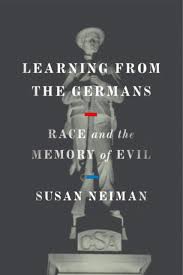
I also discovered the book, Learning from the Germans: Race and the Memory of Evil, by Susan Neiman. This text, which is the kind of reading I do for fun (me = nerd), examines the intentional efforts at “working through the past” by the German people—individually and collectively—in the wake of the Nazi Reich. She argues that the United States—White Southerners, in particular—can learn and take cues from the Germans, although the evil of slavery and Jim Crow is a different kind of evil than Nazism. She explicitly states that this is not a suggestion of comparative suffering or oppression, but one of comparative reconciliation. Thomas Jefferson, the embodiment of questions Americans must ask of ourselves, said, “I tremble for my country when I reflect that God is just and that his mercy cannot last forever.” When I think about forgiveness and reconciliation, radical evil and sin, power and privilege—and how these fit in the Kingdom of God, I tremble too.
So whether we are talking about relationships at the personal or global level–or anything in between–power relations are maintained and reproduced that are paramount to the nature of the relationship. They also affect the approach, expectations, and limitations in the process of forgiveness and reconciliation. Social categories such as race, ethnicity, class, gender, sexuality, religion, ability, and cultural background also have great bearing on the process, particularly since these categories are socially constructed, fluid, and flexible.
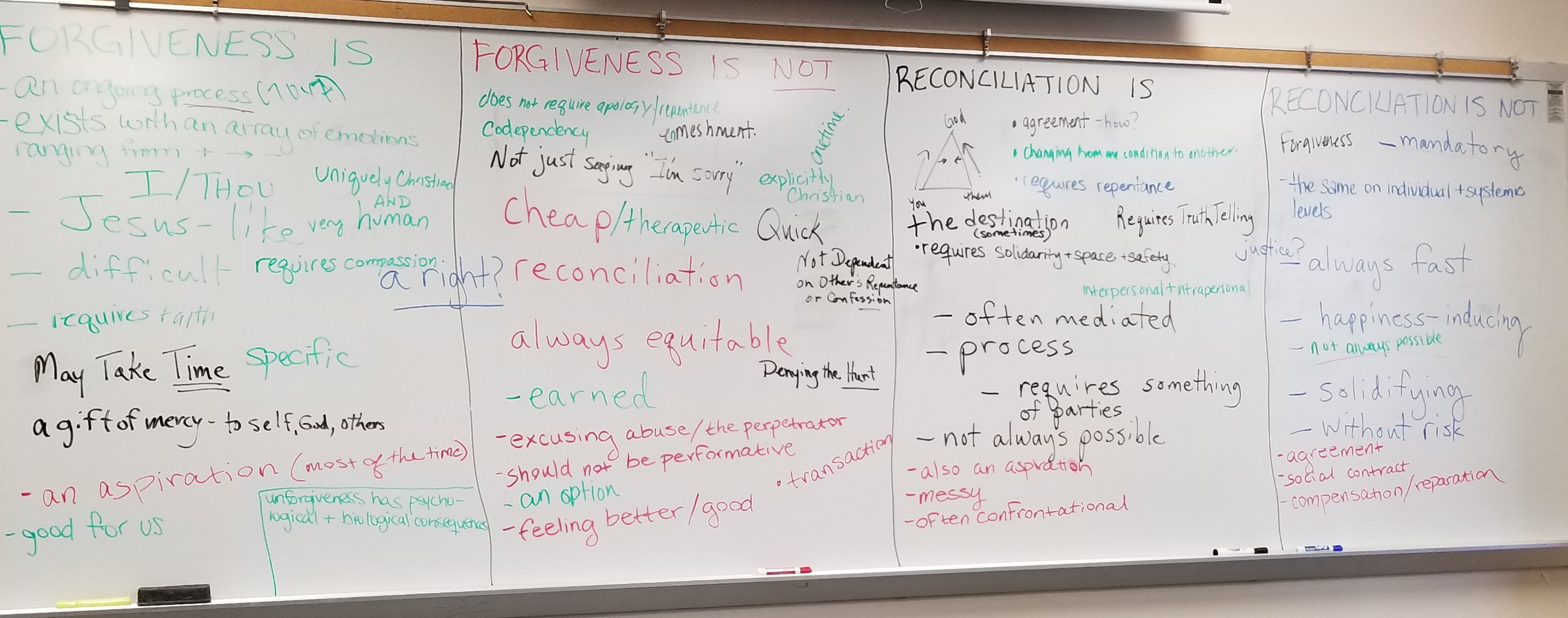
On our last day together, our F&R class organized our thinking around F&R on the board (see below). These are our findings:
Forgiveness is…
an ongoing process, as illustrated by Jesus’s metaphor of 70 X 7
an array of both positive and negative emotions
effective in an “I/Thou” relationship, such as that believers have with God
Jesus like
difficult and takes time
requires faith
a gift of mercy–to self, God, others
an aspiration (most of the time)
good for us
Note: “unforgiveness” has psychological and biological consequences
Forgiveness is not…
the same as reconciliation
requiring of an apology or repentance
enmeshment or codependency
cheap or therapeutic
just saying “I’m sorry”
explicitly Christian
always equitable
a denial of hurt
earned
excusing abuse or the perpetrator
performative
an option
transactional
a feel good fix
Reconciliation is…
contextual
requiring of repentance
requiring of truth telling
requiring of solidarity, space, and safety
interpersonal and intrapersonal
often mediated by a third party
a process that requires something of the parties
an aspirational
messy
often confrontational
dependent upon justice
not always possible
Reconciliation is not…
the same as forgiveness
mandatory
the same on individual and systemic levels
always fast
happiness-inducing
solidifying
without risk
agreement
a social contract
accompanied by compensation or reparation
always possible
I will add that reconciliation is part of the peacemaking process. In my next post, I will share 10 Practices of Just Peacemaking Theory from EthicsDaily.com.
I really love my seminary, the McAfee School of Theology, Mercer University. Faculty and staff there are committed to issues of justice and spiritual growth. It is also a place where only about 45% of the students are white. I want to support a place like that and more important, learn from the variety of perspectives and experiences of my classmates. It is a place where I can focus on issues important to me, like being a good ally by attending to my white privilege. I am convinced that my anti-racist work as a white Southern academic should also include theological and religious frameworks. I needed to get in touch with my Jesus.
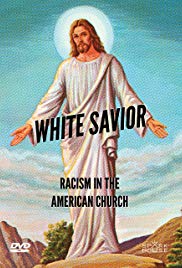
White Savior Movie
Part of the institution’s commitment to spiritual formation is the annual faculty, staff, and student weekend retreat, which the founding faculty built into the design of the programs. We just recently had one at the Pinnacle Center in the North Georgia mountains, where we spend two days worshiping together and getting to know one another. We build deeper relationships as classmates at a setting like this, where we pray and take communion together. This year, the dean announced he had been working with friends in Union Point, Georgia, to plan a work day at a historic cemetery near the original location of Mercer University. Here’s what he said:
This summer I learned of a neglected African American cemetery located nearby the Penfield cemetery. I have partnered with African American activists and other leaders to help them with a clean-up effort on October 26. I would very much appreciate it if you would join me as we honor this sacred space and practice remembrance.
He noted that enslaved persons were buried there.
Here is what I wish I had thought: Does it make a difference that the dean is a straight, white, cis-male? Were faculty invited to discuss this topic, welcoming voices from faculty of color? Could groundwork have been laid so that the announcement would have had context for the benefit of the students, most of whom were African American?What is motivating me to want to participate?
What I actually did, though, was volunteer to clean up the cemetery.
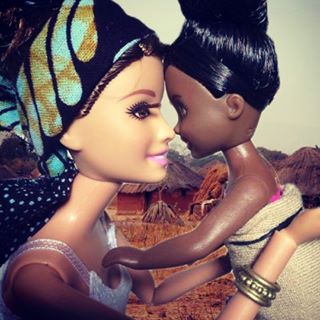
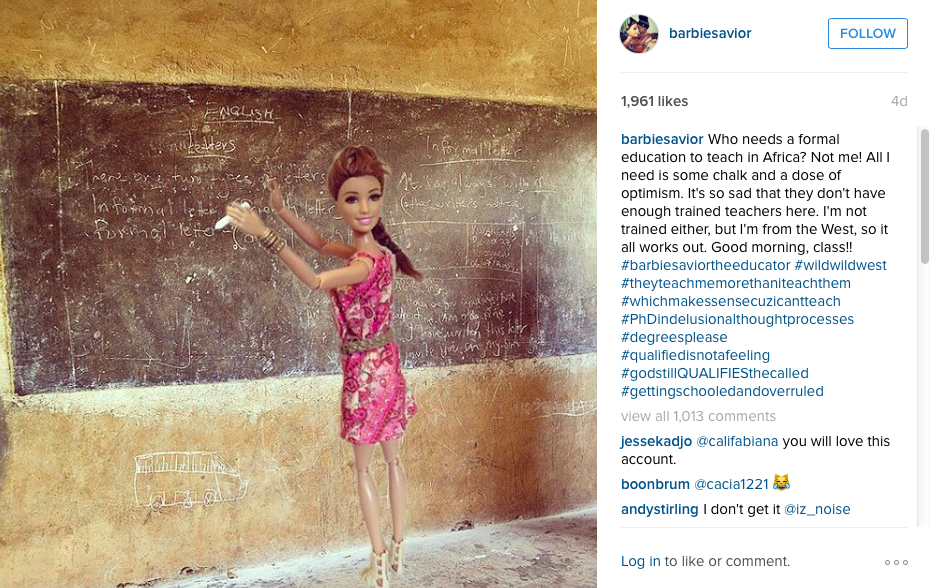
A few days later, the dean sent a reminder and included additional information that a filmmaker friend and seminary grad would be filming for a documentary. A few days after that, I learned that a group of African American students had submitted a letter to the dean to express concerns about the project. I have not seen this letter, but the seminary grapevine is real. That was the day I discovered the “Savior Barbie” Instagram account. If you haven’t heard about it, below is a Huff Post article, along with 2 examples of Barbie’s posts.
White Savior Barbie pokes fun at people who suffer from “White Savior Complex,” the term used to describe the white Westerners who travel to third world countries and make the entire affair an exercise in self-congratulatory sacrifice. (Huff Post). The account owners, who remain anonymous, point out, “We have both struggled with our own realizations and are definitely not claiming innocence here.” “Barbie Savior, we hope, is an entertaining jumping off point for some very real discussions, debates, and resolves.” It isn’t that there is anything inherently wrong with doing volunteer work to help people. WSB targets the idea that Africa needs saving from itself and white people are the ones who can do it. Barbie Savior is there for a photo op, the ultimate selfie. This kind of thinking supported colonialism, conquest, and slavery. It is white supremacy.
Let me be clear: I am not suggesting for a minute that the McAfee dean is in error. I have no idea until and unless he discusses it what the process was for bringing this opportunity to the students. For all I know, he brought it to the faculty first for them to unpack together. The letter from students is said to contain references to a diversity strategic plan, which I imagine calls for voice and conversation and inclusion in initiative planning. I have no doubt he is prayerfully and profoundly considering what they have written and will respond appropriately. This is not about him; it is about my own complicity in maintaining racist systems in which the White Savior Complex operates.
So just what was I thinking? My first thought was what a great service project! As a Southern Christian who knows what “Decoration Day” is, I have cleaned old cemeteries for as long as I can remember. My second thought was about the historical significance of the place, for yes, I was in part motivated by it being a very, very old African American cemetery that was the final resting place of former enslaved persons.
My third thought was about my friend Edeltress in Baton Rouge, who had taken me on a detour to her ancestral cemetery one day while we were on a school visit for work. “Do you mind?” she asked me. “It’s been so long since I’ve been here. I was a little girl and my parents brought me.” So we drove to a countryside in Louisiana that I couldn’t find today if I had to. “Here it is,” she said. But looking around, I couldn’t see a graveyard. Just what looked like woods, undergrowth, weeds–way back, about a hundred feet off the side of the road. Edeltress laughed. “Oh, you’re looking for a white cemetery. This is how our cemeteries look.” We tramped around the site, being careful not to step on the graves, and on the way home, she told me stories about her father, who had driven an old broken-down truck so that his white neighbors would not recognize him for a landowner and successful farmer. My people were dangerous. So that is the image I got in my head when the dean asked for volunteers. I thought of paying tribute, in this small way, to my friend.
That is why I am going to acknowledge my white privilege, acknowledge the concerns of my classmates–for they hold us accountable for thinking of and processing these issues before complying–and then go clean up a grave yard. But you won’t see it on Facebook or Twitter. I will not take a selfie with a tombstone. Does this make me admirable? Is this sufficient acknowledgement, or am I assuaging my conscience? Am I asking the right questions? I don’t know, but it gives me something to ponder as I pull weeds.
White supremacy can look like skin heads carrying swastikas; it can look like angry white people wearing red hats. It can be masked by well intentioned white people who secretly voted for Trump. And it can be a white seminary student who fails to do the work of problematizing a workday over the graves of enslaved persons. There is another White Savior resource I find relevant here. White Savior: Racism in the American Church (2019). The film “explores the historic relationship between racism and American Christianity, the ongoing segregation of the church in the US, and the complexities of racial reconciliation” (imdb). I recommend it. The film closes with an African American minister from the Bronx discussing being an ally. “Being an ally,” he said, “means asking ‘What do you need? and sometimes that means just shut up and listen.”
At the end of the day, I believe in a place like McAfee. It exemplifies the complexity of racial reconciling and justice. The messiness of it. It is a place where we can make all the mistakes–and there are many–and learn that the sky doesn’t fall when we make them. It is a place where, sometimes, we can just shut up and listen.
Last weekend, I attended the National Gathering of the Southeast Conference of the United Church of Christ, a denomination with a history of social justice advocacy that dates back to colonial New England. The UCC has always, to my knowledge, ordained women ministers, and it is a space where I feel welcome to offer and develop my gifts of leadership. One evening at dinner, I gravitated to a woman dining alone and asked if I could join her. I didn’t join her because she was alone; I joined her because I had been in a previous session with her and heard some of her story. I remember she had said: I was in Alabama during the Civil Rights years, and the League of Women Voters kept me sane. I wanted to hear more.
Her name is Jenny Nixon, and she is a resident of the Uplands Retirement Community in Pleasant Hill, Tennessee, which, if you ask me, is one of the best kept secrets in retirement living. Jenny was hard to miss all weekend because of her booming voice, head of solid gray hair, piercing blue eyes, and the shape her body has decided to take as she got older, which required her to use a walker. Yes, I’d appreciate your company, she told me. I eat more slowly than most people these days. I fetched us a couple of pieces of strawberry short cake for us and sat down.
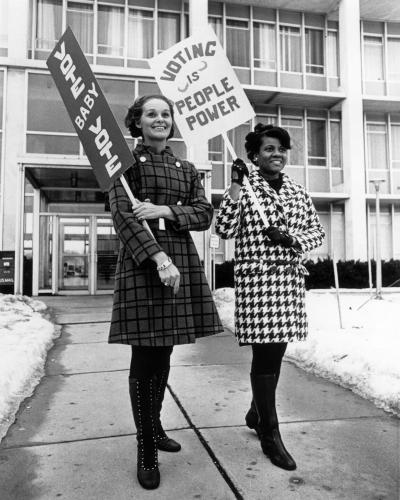
League of Women Voters, 1970’s
Jenny was born in Oregon in 1933 but had gone to college in California and lived for some time in Washington State. I’m a Westerner, she told me with a glint in her eye. What attracted me to her was that she had been a women’s rights activist in the 1960s and 1970s. It isn’t too often that I get to meet a feminist–a real feminist–from the “women’s lib” era. But that wasn’t the only reason I wanted to hear more of her story; our stories, as it turns out, had something in common: Alabama. Will you tell me more about your time in Alabama? I asked her. I think it’s important, and I know it’s interesting! That’s all it took. I will recreate her narrative here with only minimal interruptions of my interjections and comments.
My first husband was an aerospace engineer, and “Mr. Boeing” sent him to Huntsville, Alabama, where he worked on the rocket that sent us to the moon. It was 1964. Kennedy had been assassinated, but worked progressed on the space program. We lived in South Huntsville. Our kids eventually went to Chaffee Elementary School, White Middle, and Grissom High~~all named after the astronauts killed in the Apollo 1 fire at Cape Canaveral in 1967. Of course, that was my first husband. The only things we had in common were our kids–and bridge. We were an unbeatable bridge team! I am very proud that I always spoke well of him to my children. That was very important to me, that they kept a relationship with him. He was a good father.
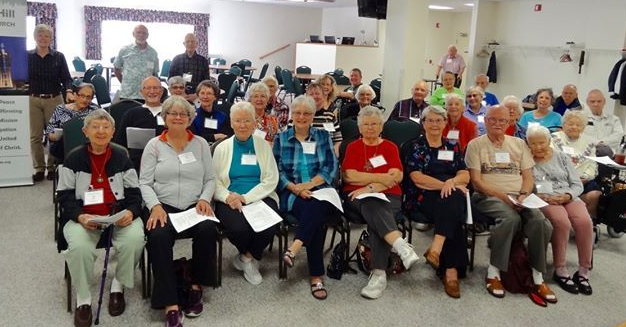
I searched for a photo of Jenny, and I believe she is seated just to the left of the column.
In those days, the senior engineers had a choice of moving or not, and most of them chose not to. So there were communities of young families with young children. Before Boeing, before NASA, Huntsville was a cotton town; once we got there, it was a city of 20- and 30-somethings. I had young children, my husband was an engineer, I was college educated. I needed something to do because I couldn’t just stay at home. The League of Women Voters really did keep me sane. My husband didn’t really approve of the amount of time I spent working, but I did it anyway. I was president of the local chapter. In those days I could mimeograph flyers at my house. We met at my house over the years.
I was in Huntsville the year the President signed the Civil Rights Act and the Voting Rights Act. We worked hard. One of our projects was a weekly bi-racial lunch, where we went to lunch as a group of Black women and white women–together–to a restaurant. In Alabama in the 1960s that was a radical act. You just didn’t do it. My husband’s job was integrated because it was the federal government, so they hired Black engineers. George Wallace was governor during that time, and it was not easy.
I used to tell my friends in the West that not everybody in Alabama was racist, that there were people there who worked for civil rights. I tried to bring my children up that way; of course, sometimes the teachers reported that they were being disrespectful. They didn’t say “ma’am.” But they turned out fine. Eventually, more of the women went to work outside the home, so there were fewer of us who could do volunteer work with the League. When my husband was transferred to Washington State, that was the end of my Alabama years.
By that time, we were finished with our shortcake. I’m keeping you, I said. Yes, I’d just as soon go home now, she replied mater-of-factly, as she asked me to dial her current husband George on my cell phone. George, this is Jenny. You can come and pick me up now in front of the cafeteria. Five minutes, yes. Goodbye. Spoken like a Westerner.
This morning, an opinion piece from the New York Times popped up in my news feed called Where Are the Socially Conservative Women in This Fight? The American family needs defending and right now men are leading the charge. Written by Helen Andrews of the conservative Washington Examiner, a central them was a critique of the “Two Income Trap,” a term coined by Senator Elizabeth Warren in her book by the same name. Andrews opines:
Marriage simply no longer offers the financial security it once did. The consumer goods that singles buy have gotten cheaper, but the things that middle-aged parents spend the most money on — houses, education, health care — have gotten more expensive, while wages have stagnated. It has become difficult for a family with one breadwinner to afford a middle-class standard of living. “Mom’s paycheck has been pumped directly into the basic costs of keeping the children in the middle class,” Ms. Warren’s book “The Two-Income Trap” explained. The mass entry of women into the work force is one reason for this financial insecurity.
Look at that last sentence again. It’s important, as Andrews turns her argument for the emergence of conservative women toward women’s desire for marriageable men. She references the now-viral quote by Fox’s Tucker Carlson: “Study after study has shown that when men make less than women, women generally don’t want to marry them. Maybe they should want to marry them, but they don’t.” Andrews expounds:
As it happens, there is an abundance of data on Mr. Carlson’s side. Wendy Wang is the director of research at the Institute for Family Studies, and before that she worked at the Pew Research Center, where she co-wrote a report about unmarried Americans. “The number of employed men per 100 women dropped from 139 in 1960 to 91 in 2012” among never-married Americans 25 to 34, her report found. “In other words, if all never-married young women in 2012 wanted to find a young employed man who had also never been married, 9 percent of them would fail, simply because there are not enough men in the target group.”
Poor white men. No one wants to marry them. And why not? Because women have taken their jobs!
Here’s another jewel from Andrews, citing an MIT study: When women’s wages went down relative to men’s, marriage and fertility actually went up. I do not have to paint the phallic imagery here, do I?
So, rather than build an economy built on sustainable infrastructures, living wages, affordable health care and child care, paid leave for parents of all genders, tax payer funded college tuition, and jobs in a 21st century world–Alabama leads the rest of the country in this ignoble approach to economics, which, make no doubt about it, it is. Abortion legislation is not about morality or religion or the salvation of Alabama souls. It is political, for it will keep the good Christian people voting Republican–against their own financial and reproductive interests. And this, friends, will keep the Republican coffers full.
The Alabama bill, along with Andrews’s call for conservative women to take up the call to put women back at home rearing children while their men go off to work, is dangerous. Under the guise of fighting for our “right” to stay home and raise children–and do the majority of domestic labor without pay as part of the contractual obligation to which their marriageable men are entitled–women will be demanding to have our rights revoked. Rights that people like Jenny Nixon worked–from her home, while her children were at school–to make available to us. And, women like Governor Kay Ivey, who have the facade of power, do the bidding of male legislators. If you want to see what the world will look like when this retro-vision is enacted, look no further than the Alabama legislature. Or the list of Fortune 500 CEOs, or the U.S. Senate.
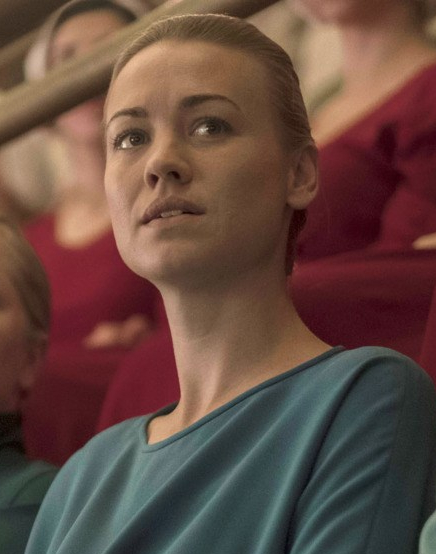
There’s another place you can look. Watch The Handmaids Tale, Seasons 1 & 2. It was not Commander Waterford who was the architect of Gilead. Rather, it was his wife, Serena Joy, who was the power and talent of the movement. In one chilling scene, which I’ve included below, Serena uses her charismatic speaking talent to turn a group of college student protesters to her conservative vision. Keep watching, though, to see how it turns out for her after she cedes her power. See how she lives in Gilead. The cost of equity and equality is high–we continue to pay it. But there is also a cost to maintain our liberty, and part of that cost is vigilance. Margaret Atwood noted in her book the wages of inattentiveness. Nothing changes instantaneously: in a gradually heating bathtub you’d be boiled to death before you knew it.
Have you written your story down, recorded it somewhere, I asked Jenny. No, she said. I thought about it but haven’t. I still remember it, though. I pray that we will all remember, before we boil in a bathtub of our own making.