The Playlist of me: Forgotten iPod, Rediscovered Self (Power of Music, Part 1)

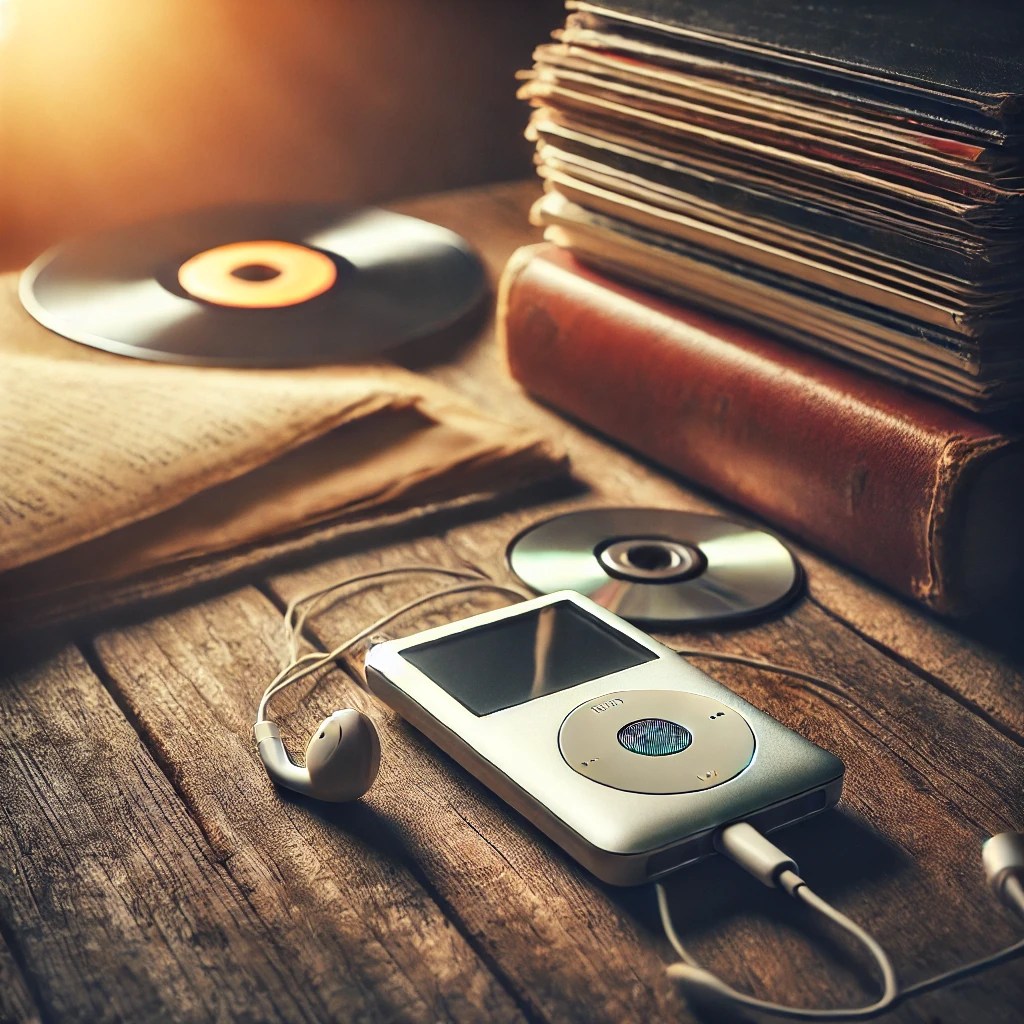
A warm, nostalgic scene featuring a vintage iPod with earbuds resting on a wooden table. Surrounding the iPod are a stack of old CDs and vinyl records, symbolizing a love for music across different eras. Soft, ambient lighting creates a cozy and reflective atmosphere, with a hint of a worn journal and handwritten notes in the background, evoking a sense of personal rediscovery and connection through music.

I Found My iPod: Rediscovering Happiness Through Music, Part 1

Last year, I completed an End of Life (Death) Doula program with INELDA, the International End of Life Doula Association. The experience itself deserves its own post, but one lesson from the program keeps coming back to me: the role of music in creating peace during life’s final moments.

Image of International End of Life Doula Association, INELDA, logo

As the person in our care begins their end-of-life journey, we were advised not to play their favorite songs as background music. At first, this advice seemed strange to me. After all, wouldn’t a familiar melody bring comfort? It sure does for me! But then it was explained: favorite songs are deeply personal and emotionally charged. They can evoke strong memories, longings, or attachments that might not be conducive to a peaceful transition. Instead, we were taught to choose ambient tones or tranquil soundscapes to foster an atmosphere of calm and rest.

Not being a doula or having experienced end-of-life caregiving firsthand, this suggestion went against my intuition. The more I thought about it, though, the more sense it made. If it were me, I could imagine holding off my own passing just to hear my favorite song finish! The idea stayed with me: music is powerful, not just for its personal connections but for its ability to transcend memory and emotion, helping us navigate transitions when we need it most.

This thought was still on my mind when I stumbled across something I hadn’t seen in years—my old iPod.

From Records to iPods: A Musical Journey

As a Generation Jones Boomer, I’ve collected music in just about every format imaginable. I started with records and CDs, eventually amassing hundreds of them. Many of my favorite records were handed down from my parents when they got rid of their stereo. I didn’t have a record player either by then, but I kept the albums for the memories. Over time, I replaced many of those records with CDs, though I had to replace some of those twice after accidentally leaving my CD holder in a car I sold.

Then came the 2000s and the rise of digital music. When Apple introduced the iPod in 2001, I thought it was the pinnacle of technological advancement. I was as excited about it then as I am about AI now–granted for different reasons. I finally got one in 2005, and that summer, I spent two weeks downloading every CD I owned onto it. I painstakingly created playlists for every mood and occasion, collecting songs I thought I’d never hear again.
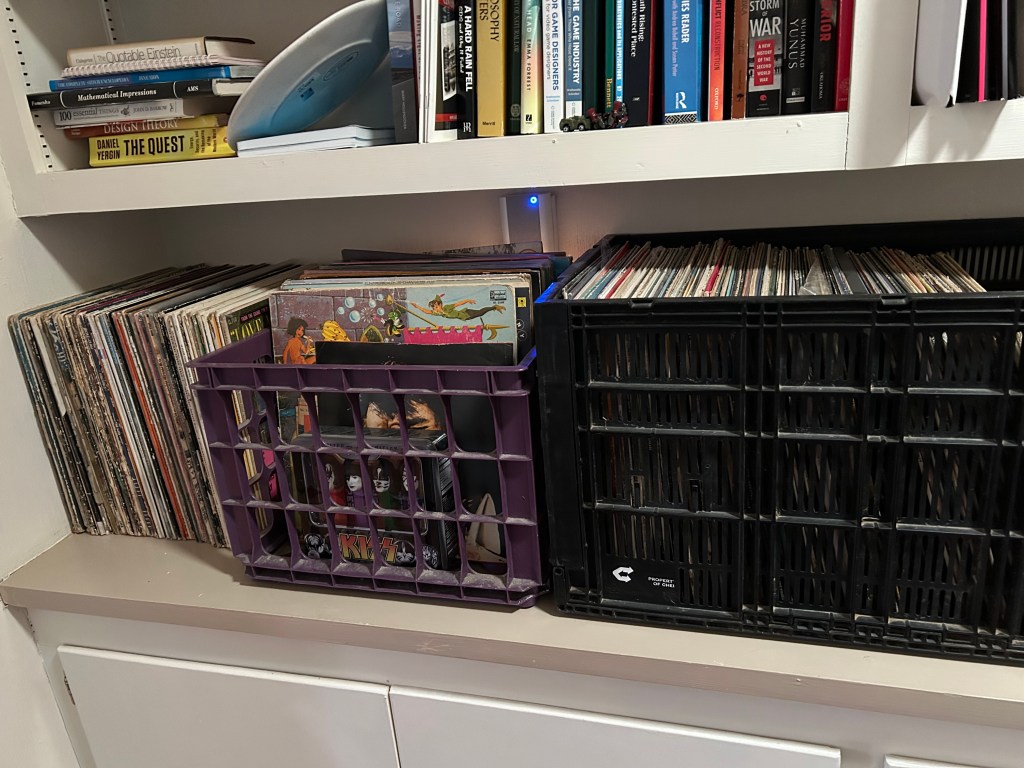
Image of record albums in crates. Disney's Merriest Melodies album.
My record album collection

By 2012, I had curated over 3,000 songs. I refused to sync my iPod with updated iTunes software because it wouldn’t preserve my playlists exactly as I had arranged them. They were perfect, and I wasn’t about to mess with perfection.

But as MP3s, smartphones, and streaming services like Spotify and SiriusXM gained popularity, iPods started to feel outdated. I used mine occasionally for chores around the house, but even that became less frequent. By 2022, Apple officially discontinued the iPod, and mine had long since stopped holding a charge. Eventually, it wouldn’t turn on at all. But I couldn’t bring myself to discard it permanently—it still held my songs.

Rediscovering My iPod

Last week, while searching for batteries in a drawer, I came across my old iPod again. Out of habit, I plugged it in, hoping for the best. The Apple logo flickered to life for a moment, and then… nothing. “Ugena,” Sarah said, “we live two minutes from a computer repair shop. Take it over there and see if they can fix it.”

The tech guy at the shop popped the back plate off, took one look, and said, “It’s your battery. See how it’s puffed up like a pillow? It should be flat. That’s an easy fix.” I was overjoyed.
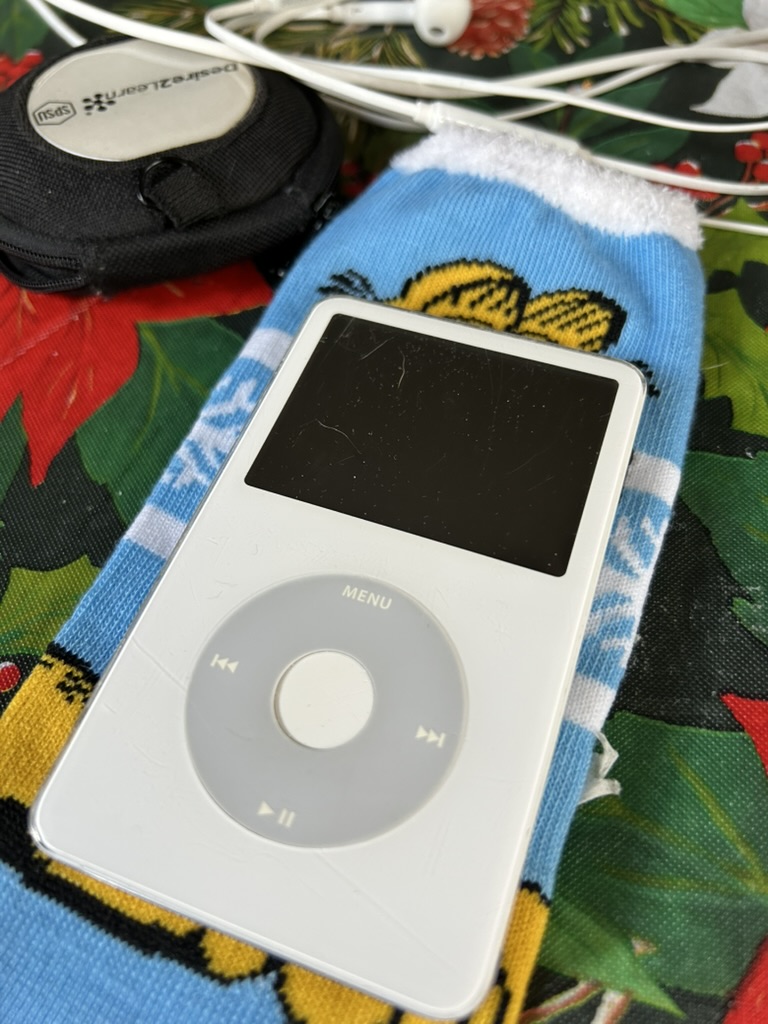
Image of iPod Classic 5.5 gen laying on a Garfield cartoon sock.
My iPod

When I picked it up a week later, I could hardly contain my excitement. After nearly a decade, I saw my playlists on the screen again. I navigated the wheel (nothing like the sound of those clicks as it turns!) to find the perfect song for the moment, and when “Love Grows (Where My Rosemary Goes)” by Edison Lighthouse began to play, I felt an overwhelming sense of contentment. I was home.

More Than Memories

For me, music isn’t just about nostalgia. While certain songs remind me of people or moments—like Elvis always bringing my mom to mind—it’s the music itself that moves me. The key changes, the minor chords, the walls of sound (a la Phil Spector) all stir something in me that feels bigger than words.

And yet, sometimes it is the words. A perfectly turned phrase can be so compelling, so beautifully crafted, that it draws me in completely. It stirs a visceral reaction, and I can’t help but sing along. And yes I do grab a hairbrush for a makeshift microphone. At that moment, the three of us–mind, body, and spirit–are in sync with the melody and words. During my free concerts, whether in the shower, the car, or empty house, my old romantic self rises to the surface, caught up in the sheer power of the lyrics.

This emotional connection reminds me of Howard Gardner’s theory of Multiple Intelligences from his 1983 book Frames of Mind. One of these intelligences, musical intelligence, refers to the ability to recognize, create, and emotionally connect with music. Though the theory is considered pseudoscience by some, it resonates with me. It helps me explain feelings that go far beyond simply liking music. What I feel is deeper, more profound—something that connects to the core of who I am.

Rediscovering my iPod wasn’t just about finding old favorites. It was about reconnecting with a part of myself—a good and strong piece of myself that, during my distractions with job advancement and the trappings of success, had been suppressed. During those times, I was lost, adrift, unaware of how much I had let go of what truly anchored me. But when the music is back in my life, it’s as if I’ve found my way home—a reminder of who I am and what brings me joy. In the words of the old song, “Was blind, but now I see.”

The last 5 random songs played on my iPod while I’m writing this:

  1. Bad Romance, Lady Gaga
  2. My Heart Skips a Beat, Buck Owens
  3. Silver Wings, Merle Haggard
  4. On the Street Where You Live, Bill Shirley dubbed for My Fair Lady
  5. Livin’ in the Sunlight, Lovin’ in the Moonlight, Tiny Tim (from Spongebob Movie)https://youtu.be/hERIZmJpwTI?si=JSKnB7XR5_rwbiHq
A warm, nostalgic scene featuring a vintage iPod with earbuds resting on a wooden table. Surrounding the iPod are a stack of old CDs and vinyl records, symbolizing a love for music across different eras. Soft, ambient lighting creates a cozy and reflective atmosphere, with a hint of a worn journal and handwritten notes in the background, evoking a sense of personal rediscovery and connection through music.

Music and Me, Part 1

The blessing and curse of being an academic is that whenever I come across any really interesting “thing”–whether it is an experience, a news story, situation, work of art, or take on the human condition–my first thought is, “Wow, that would make a great paper!” I wonder if my other egghead friends do that. It isn’t all bad; the blessing is that clearly there will never be a shortage of topics to write about. The curse is that everything around me becomes a potential scholarly topic. And I start planning out where to begin the search of existing literature before I finish feeling and experiencing whatever it is. A case in point is divinity school. For the first two weeks of being at Candler (School of Theology at Emory University), I felt like a researcher doing an ethnography of seminary. I still think that’s a pretty doggone good idea! It took almost a month before I began to feel the experience as something other than a research project. What’s so bad about that? Well, this world is best experienced by feeling our feelings every single minute we are going through it. I’m sure there is research to support that claim. 

It happened to me again yesterday, but luckily I caught myself. I was at the kitchen counter finishing up my annual review and listening to Elvis on the Sirius radio I had managed to hook up to my home stereo speakers, the coolest thing ever invented. Back in the fall, it had taken me a whole day to figure out how to make my old dvd player into a tuner through which to conduct music into the speakers (Is my technical language impressing you?). Because I had a home kit, the Sirius radio was easy. But figuring out how to hook up the Apple devices was less intuitive. Yesterday, though, as I looked from the kitchen to the system in the living room, the obvious solution just came to me, kind of like how I can think of things the minute or two as I am waking up in the morning that I cannot think of during the day (That happened this morning; I was able to think of the song title, Shine On Us, that the choir had sung Wednesday night. Yes, I did forget the title of a song between Wednesday night and Friday morning. That’s not the point….). So, I disconnected a wire from the radio, plugged it into my iPod, and viola: my music! 

I’m going to try here to explain what I feel when I listen to music. It’s harder than it may sound. I am inspired to do this after having countless conversations with one of my friends who loves music so much she moved across the country to be able to hear live music every night of the week–something, interestingly, one can’t necessarily do in Atlanta. I was also inspired to try to express what music feels like to me after reading my friend Alan’s book, Symphony #1 in a Minor Key: A Meditation on Time and Place. I don’t have it in front of me to quote (I’m at Starbucks) or I would share some of the beautiful imagery and language he uses to portray the importance of music to him as an embodied and emotional experience. That’s what it is like for folks like us, it picks us up and does something to us and puts us back down while something electric courses through us. Yeah, we like music. 

I confess I am not current on music. Whenever I meet someone who is, they have to catch me up some if they want me to be able to talk about it with them. I like it, but there is something about the old songs, the old groups. New music that sounds like it was old. I do like that, but it’s kind of cheating. As I scrolled down through the almost 3,000 songs on my iPod to test out the speakers, that is the kind I chose. A new (well, fairly) new song with a 60s Phil Specter beat: Doin That Thing You Do. And I was not playing around. I turned the volume up on 35 to see what those speakers would do. Drums. I am a sucker for music that features drums. Sixties rock beat. Refrain that shifts to a slightly minor key. The Wall of Sound. Here is where I wish I had the language to describe musically what was happening. I can’t, so you should play the song to hear what I’m talking about. 

You should know I cannot dance, but I don’t think about that when I hear music that moves me. Elvis felt it; he said so when asked about his “gyrations.” He said he didn’t know anything about gyrations–he just felt the music and couldn’t help but move. That’s how it is. I was standing in the middle of my lovely little bungalow yesterday with music blaring, me singing at the top of my lungs and, yes, dancing. I played that song five times. Then I scrolled to the Stars and Stripes Forever and played that five times while I directed it. Listen to it sometime: wait till the very last stanza of it, when Souza puts all the parts together–piccolo, percussion, AND those wonderful loud, blasting TROMBONES. You know how your heart can swell till you cry like mine does when I hear the national anthem at the olympics, or Just As I Am during the altar call? The last thirty seconds of Stars and Stripes Forever goes to my core and comes out something spectacular. Then I scrolled to Martina McBride singing Hank Williams and played You Win Again three times. I don’t have to tell you what Hank’s words sung by a woman in my vocal range can do to me. 

I will confess something: I am fifty years old, and I have one of my brother’s old microphones in my closet. I cut off the cord, and on days like yesterday I take it out and have a concert. So, to recap. I felt a surge of sun-shiny happiness that made me want to move like Elvis–which I did (sort of). I danced, sang, waved my arms in the air (in my mind I looked like one of the Chiffons), conducted a concert band, and sang torch songs deep and loud. Think about anything that can make you move, any physical sensation. Heat or cold, a shock, rain, fear, joy. When we feel these things, our bodies move because we can’t help it. That is how I am when I hear music that moves me–it literally does. I feel happy and strong. Sometimes my eyes tear up, and sometimes my stomach lurches like it does when I see someone beloved to me. 

Why was it important to write this down? For one thing, it means so much to have music–loud magical music–in my life again after I had lost it for so long. More on this later. I’ll tell you one thing. I won’t lose it again because now I let myself feel it. And, it would make a great topic for a paper. 

Elvis and Me

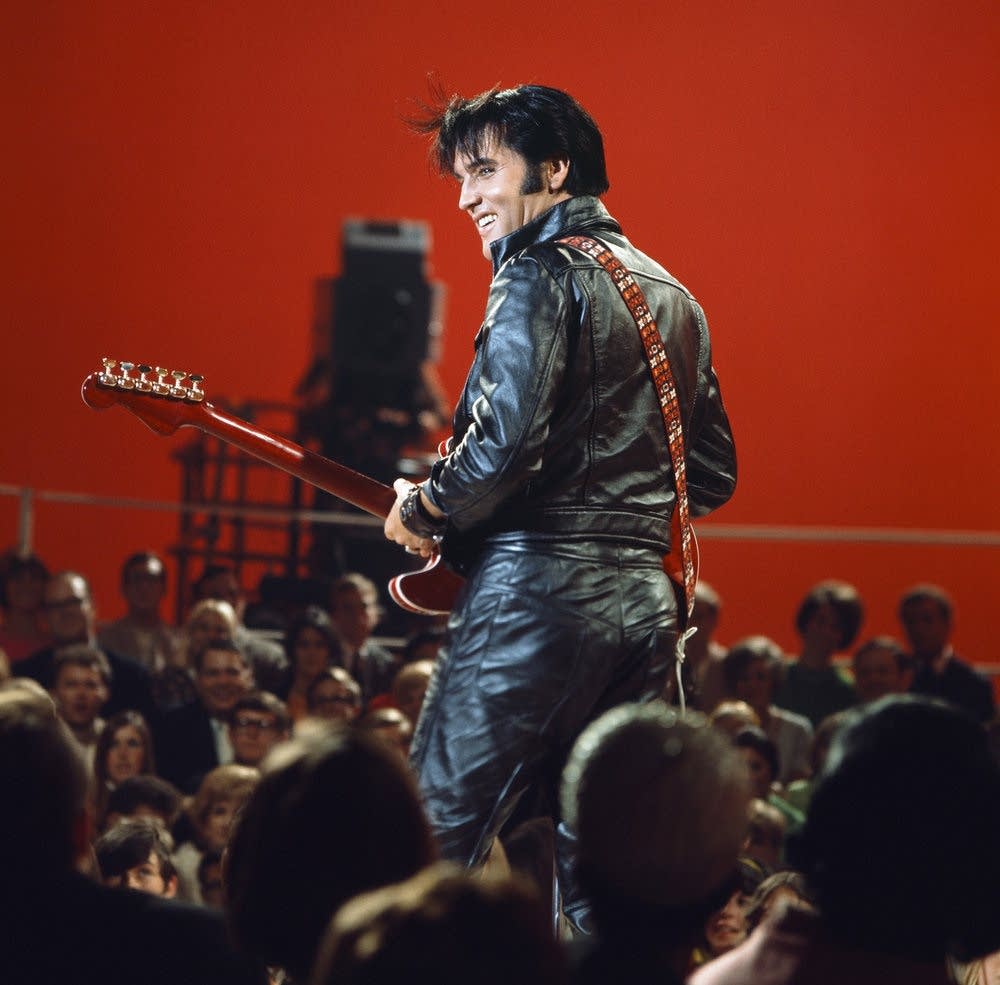
Today, January 8, is Elvis’s birthday. He would have been 79 years old, which seems astonishing to me. So on this day, I will offer some random thoughts about Elvis and me. Because of those various threads that run through one’s life from age to age, stage to stage, place to place, Elvis runs through mine. 

I saw Elvis in 1975 when he came to the new civic center in Huntsville, Alabama. My parents, who have never been to a concert before or since, sent away through the mail for tickets. It’s really remarkable to look back that it ever happened at all–but we went. I, nerd that I am, was having a little temper tantrum because I was having to miss the last day of my 5th grade class. That didn’t last long. My parents remind me that I commandeered the one set of opera glasses they bought and saw Elvis magnified throughout the concert. As I have done since then whenever conversations turn to how his body became ravaged and bloated from drugs, I can testify here that in 1975, Elvis looked good. He was in shape physically and vocally; he was on his game in Huntsville. Of all the things I have done in my life, I am glad I saw Elvis Presley in concert. I am glad my parents sent off for those tickets. 

But let me back up. Elvis was a fixture in our house my whole life. My mother owned several original 45 records, and I think eventually she collected every album he ever recorded. I have listed elsewhere all my mother’s Elvis collectibles, so I won’t do it again here. Those records were treasures. The tacit understanding among us was that Elvis was different from the other singers from the 50s they had listened to as teenagers. Even now in my mind there is Elvis and there is Everyone Else. And, as I have also written before, as a good Southern boy, he was ours. 

I am listening to the Elvis station on Sirius radio as I write this, a rare live recording of Doncha Think It’s Time. His voice is familiar and comforting. I know all the retorts, have heard them all. Elvis stole black music. He didn’t write his own songs. He was just a performer. He let himself go physically. He split his pants and busted notes on stage. He shot out tvs and caroused with the Memphis Mafia. He did drugs. He mad b-a-a-a-d movies. He posed for a picture with Nixon. And you know what? I’m at the point in my own life to where I say, “So?” 

Finally, then, what of Elvis and me? Elvis knew who and what he was. He used his gifts. He had fun and worked hard. He loved his mama and his daddy. He gave back. He never stopped seeking (the last book he was reading was called The Scientific Search for the Face of Jesus). And he sang. I’ve decided not to make any more excuse for Elvis. Or me. He is what he is, was what he was. Coming back to this blogging space, I will confess something. When I started it, I was very careful not to reveal anything really personal about myself. As a result, there were chunks of explanation–and really good stuff–that would have been through lines to tie the anecdotes together, making it palpably uninspired.  So, like the open casket picture the Enquirer touched up from Elvis’s funeral, I’m writing this for myself, but you are invited to view. 

More on this later. 

For your listening pleasure, here is Elvis singing the best song ever recorded. 

http://youtu.be/yWgprZu4Hk4