Formed by Certainty, Learning to Wait: An Advent I Didn’t Grow Up With

The Church Without a Christmas Tree

I grew up in the Church of Christ, a tradition shaped as much by its doctrine as by its careful adherence to what we understood as the inspired Word of Truth—New Testament scripture. Christmas—Christ Mass, after all—carried with it echoes of liturgy, ritual, and ecclesial authority that did more than make us uneasy; they were not supported by scripture. It felt too “Catholic.” Nativity scenes, Christmas trees in the sanctuary, pageants, and concerts all felt suspect, as if they edged too close to something we had worked hard to distinguish ourselves from.

Our doctrine emphasized Jesus’s death, resurrection, and promised second coming—the salvation story in its fullest and, to us, most biblically faithful form. That was where the weight belonged. Christmas, when it appeared at all in worship service, seemed secondary. There might be a sermon in December, but it was usually framed as a reminder not to let sentiment distract us from the real celebration: the cross, the empty tomb, and the anticipation of Christ’s return.

Beginning sometime in the 1980s, our monthly church fellowship included a “greedy Santa” party in the fellowship hall—an accommodation that felt almost humorous in its contradiction. At home, though, the birth of Christ was acknowledged and celebrated in quieter, more personal ways. Christmas existed, but it lived more in our houses than in our sanctuaries.

Wonder, Anyway

Even so, Christmas always carried a sense of wonder.

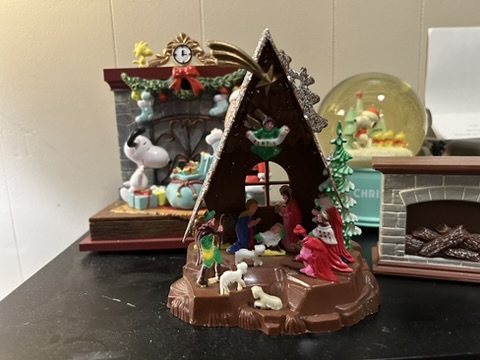
In my family, it was joyful and wonder-full. We celebrated the birth of Christ. We sang the songs, set out nativity scenes, and watched cartoons that made room for the baby Jesus alongside Rudolph and Frosty. I developed a passion for Little Debbie Christmas Tree Cakes that continues to this day. But Christmas was never treated as a central moment of worship. It was present and honored, but it did not occupy the same place in our worship as the cross and the resurrection.

Instead, Christmas lived easily among us. It shared space with Santa Claus and stockings, with family meals and laughter, with the ordinary magic of being together. Faith was there, woven into the fabric of the season rather than standing apart from it or asking to be the center of attention.

We sang Away in a Manger and Have Yourself a Merry Little Christmas with equal sincerity.
Some of my strongest Christmas memories are of going to town with my mother—just the two of us—walking down Main Street in Russellville, Alabama. We stopped at Elmore’s and White’s, always went to the bank, and did a bit of Christmas shopping. We also made our rounds to TG&Y and Bargain Town U.S.A. Going to town with Mother is one of the memories that has never faded. She loves Christmas. I suspect that is where I get it.
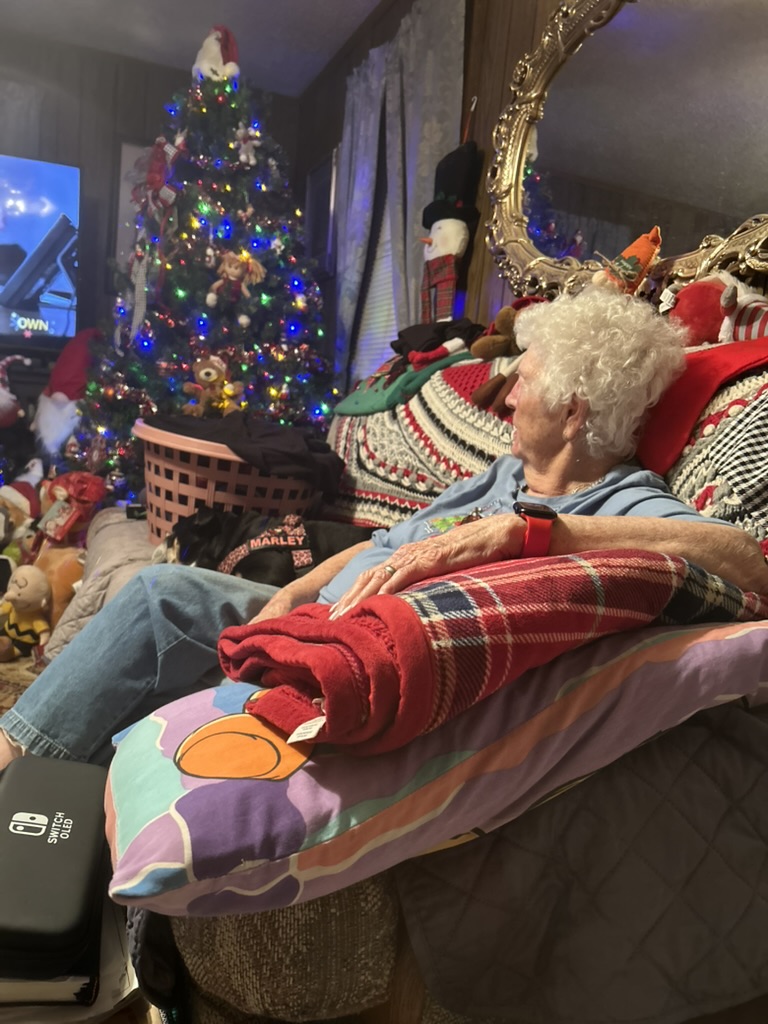
Perhaps the magic was not Christmas itself, but Mother making it all come together. Daddy—God bless him—was assembling bicycles late into the night, helping Santa Claus eat the cookies and drink the milk when no one was awake, and getting up early to turn on the heater before us kids stirred.
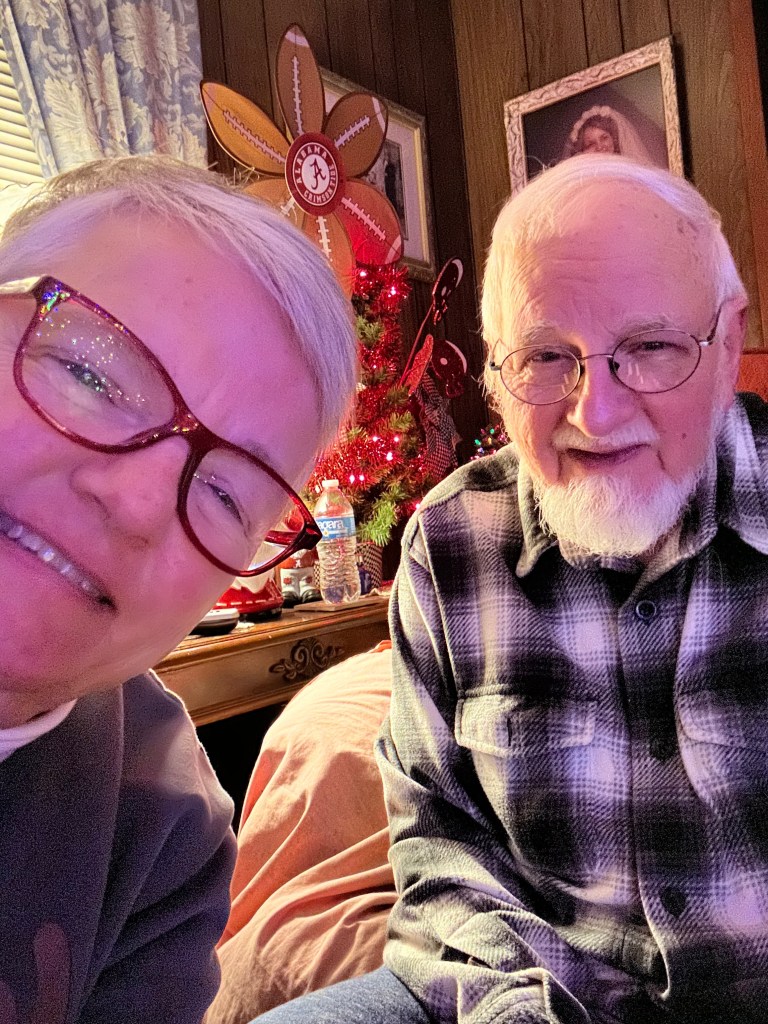
So Christmas has always carried for me the emotions and images of Advent: love, peace, and joy. Yet as I’ve grown older—and as I’ve celebrated Advent more intentionally in churches I joined later—I’ve come to realize something important was missing from my early experience, at least as I have come to understand it now.

Hope.

That missing note, I’ve learned, is at the very heart of Advent: not the anticipation of Christ’s return, but the radical, trembling hope of waiting for Him to come the first time.

Before I go any further, I want to be careful about how this contrast is read. I don’t mean to disparage the Church of Christ or its seriousness about salvation and the life to come. The emphasis on the afterlife was never meant to diminish this one; it was meant to anchor it. There is something steady, even bracing, about a faith formed around the cross and the resurrection, around the somber knowledge of what comes on Friday during Holy Week and the refusal to look away. That certainty shapes the tone. It is sober, resolved, and grounded in knowing how the story ends.

Advent, I am learning, asks for something different. It invites a looking forward that is almost visceral, a waiting marked by anticipation rather than knowledge. During Advent, we do not yet know what is coming, even though we think we do. Christmas and Easter are both joyous occasions, yes, but they are not the same kind of joy. Easter joy comes after suffering we already understand. Advent joy comes before anything has happened at all. It is hope without proof, expectation without resolution.

Perhaps that is why Advent feels so unfamiliar to me. I was formed in a tradition that lingered near the end of the story. Advent asks me to return to the beginning, to wait not with certainty, but with hope.

That difference between certainty and waiting is something I didn’t fully understand until I found myself, almost by accident, living Advent rather than merely knowing about it.

Learning Advent by Living It

Just recently, we joined a church that could not be more different from the one I grew up in.

Trinity United Methodist Church sits at the end of our driveway—practically in our neighborhood—and has been there for over a hundred years. We watched carefully last year as the United Methodist Church faced its painful and very public division. We waited to see whether Trinity would stay or go. They stayed. So we went.

Well—I went first.

Returning to church was part of my larger journey back to music. I wanted to sing again. I wanted a choir. So I showed up, and they welcomed me. Then Sarah came. I can say, without exaggeration, that I have never felt so genuinely welcomed in any congregation.

Of course, in a liturgical church, if you arrive in the fall, you don’t ease into Christmas—you begin preparing for Advent.

Trinity has all of it: the church calendar, the seasons, the art, the rhythm of the year itself. And it has a gifted music director, Ben Chumley. Music is not ornamental there; it is formative. Part of Trinity’s long tradition includes a concert series—bell ringers, piano recitals—and on the Sunday before Christmas, a full choir cantata, offered as a concert for the community.

I had never sung in an hour-long Christmas cantata before. It is exhausting—poignant and fulfilling, but exhausting.

At the same time, the sermon series centered on the coming of the Christ Child, and Sunday school was immersed in a deep study of Advent, framed by John Wesley’s theology. I knew what Advent was, of course, at least in name. I associated it with calendars and chocolate, with Advent functioning more as a reference point for Christmas than as a practice, something observed from the outside rather than lived. What I had not understood was Advent as a way of inhabiting time itself, a season that asks something of you slowly, deliberately, and in community.

Then one Sunday after service, Ben approached us and said, “I’m planning the lighting of the Advent candles this year, and I want to represent all kinds of families. I wondered if you and Sarah would like to light the first candle.”

So there we were—new members, still learning our way around the sanctuary—and suddenly we were the first family of Advent.

Our candle was peace.

You had better believe Trinity has a children’s Christmas pageant. There were painted backdrops of Bethlehem, shepherds with headgear slightly askew, stars projected onto the ceiling. Children of all ages belted out The First Noel at the top of their lungs. Candles glowed in the windows. The chancel was full.

From the choir loft, I expected—modern church attendance being what it is—that maybe two-thirds of the usual congregation would show up.

Instead, the church was full. This wasn’t novelty. This was a neighborhood showing up for something it clearly understood as theirs.

What struck me most, though, was how hope was being practiced, not merely preached. Alongside the music and liturgy, the church’s auditorium filled with donations for local children—gifts, necessities, abundance. Hope, in this space, was not about someday escaping the world. It was about showing up for it.

That was new for me.

Hope, in my religious formation, was almost always about heaven—and, implicitly, about avoiding hell. I didn’t have language yet for hope as active, communal, and embodied. Wesleyan theology was quietly teaching me something different: hope as something you do.

I should add that this wasn’t ignorance on my part. I had studied the church calendar before and even took a full course on it in seminary at McAfee. Sarah, who grew up in England, seems to have absorbed it almost by osmosis sometime in childhood. But knowing about liturgy and living inside it are not the same thing. What was happening at Trinity was not instruction; it was formation.

I haven’t left fundamentalism. I don’t think that’s possible, any more than it could ever leave me. It formed me. What I am learning now is not replacement, but expansion. This way of waiting, this attention to beginnings rather than endings, is becoming part of my formation too.

On the night of our final choir rehearsal before the cantata, I walked home through the neighborhood in silence. The street was lit only by Christmas lights and the moon, their glow softened by fog hanging in the air. We don’t get much snow here, but the light did the same work. Everything was hushed. All was calm. All was quiet.

I felt joy. Not only for the coming of the Christ Child, but for the possibility that the world could feel like this more often. That peace might be practiced, not just promised. And that, somehow, I could be part of it.


Gratitude, Anyway: A Christmas Message for Finding Happiness

Image of Little Debbie Christmas Tree Cakes, one standing and one cross section showing cake icing.

I got stuck while writing this post. I knew I wanted to write about being grateful for my life and everything and everybody in it. I knew I wanted to frame it around having gratitude when those blessings might be blurred by shiny objects, such as ambition and wanderlust. I had most of it completed, but I couldn’t decided how to wrap it up without it having a rosy, yet empty, ending. Not too much as seen from the front porch is rosy; there are cobwebs and dust on my front porch. Then I took a walk on a frosty December night and the ending found me.

Does this ever happen to you? You come up with a brilliant idea—something you think is groundbreaking—only to find someone else has already beaten you to it. I suspect it happens to most writers. A blog idea I thought would be perfect was already taken. I began exploring memoir writing, only to discover someone else has already captured the same experiences with the same folksy charm! I have thought of an ideas for a book, and as I begin doing research for it, there it is–already published by somebody else! Even academic journal articles I’ve envisioned writing often already exist, in forms eerily close to what I had in mind. And every time it happens, it stings. These aren’t rare occurrences—they’ve happened more than just once or twice in my life. Here’s one that happened today: A very fine post by Jim Wallis called “Singing the Lord’s Song in a Strange Land” discusses thoughts I’ve had as an Armchair Quarterback for years—even before the election. It’s title even sounds like something I would have thought of. It’s beautiful. You should read it. Dang it. Singing the Lord’s Song in a Strange Land.

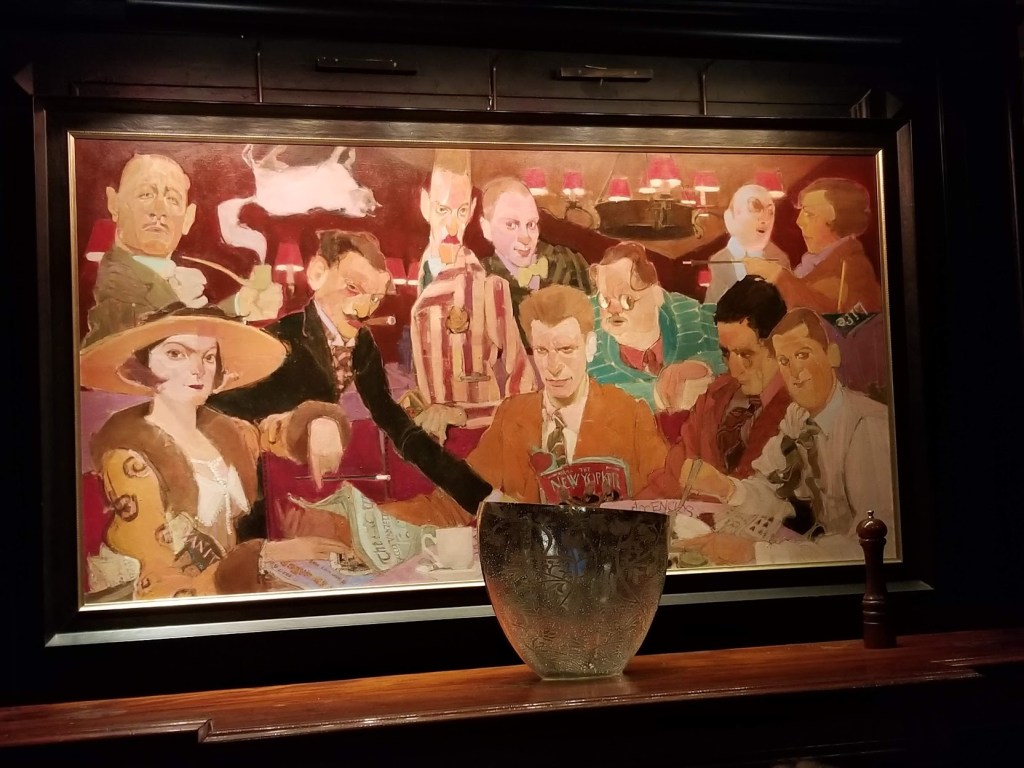
Image of painting of the Round Table at the Algonquin Hotel in New York City
The Round Table at the Algonquin Hotel

And then there’s the yearning. I can’t deny feeling a twinge of envy when I see friends and colleagues celebrating their achievements on Facebook. It’s a humbling reminder of my own aspirations and the work I still want to accomplish. A dear friend recently mentioned seeing several plays on a trip to New York City. She misses New York very deeply, and I’m happy that she makes regular visits; it does her soul good. Now, I’ve been fortunate to see my share of Broadway musicals—I even saw Bette Midler in Hello, Dolly!—an experience I still count as one of the best of my life. But life changes, as it always does, and I don’t have those same opportunities now. Sarah prefers camping with the dogs, and while I finally convinced her to upgrade tent to a pop-up camper, our adventures now involve hoisting Bruno the Bulldog up the steps to his bed.

Image of English Bulldog and stuffed bear.
Bruno and Snugs Baby

I don’t want to be a globetrotter, and I don’t long for the lifestyle of the rich and famous. I admit, though, when I’m out in the woods at midnight with a flashlight, waiting for Bruno to finish his business, it can feel like a bit of a step down from the lights on Broadway. Travel, especially to historically rich locales, thrills me. I relish every minute of it. I soak up the salty air and sea breezes of beaches from New England to Miami. And yes, theater makes me breathless. Euphoria has its place, and I appreciate it when I have it.

But adventures are the in-between spaces. The wholeness of life, for me, is found in simple joys. The whole fabric of life takes place in Spartanburg, feeding the dogs and cats—and in Alabama at my childhood homeplace. Whether tending to dogs and cats or listening to the stories my mother tells about pictures and treasures we sort through-both of us aware of time pressing down upon us—these are the things I am fiercely grateful for.

I think back to how I grew up, a child of hardworking people in Alabama. My parents taught me to be proud of where I came from, to appreciate the simple joys of home and family. They have always begun and ended every prayer by giving thanks to God. Even now, my heart remains etched with gratitude that I learned from them. I look around and see a life I love—a cozy old house in a picturesque neighborhood, my quirky cars in the driveway, my family within a few hours’ drive, and my pets curled up with Sarah and me on the couch. I’m comfortable in my own skin, grateful for work that fulfills me, and thankful for the profound blessing of having stability in my life. I’m blessed not to face food or housing insecurity, unlike so many others on this earth. I do a quick check and confirm that the reason I blog in the first place is to find joy and fulfillment–which I do.

Here’s the thing I’ve noticed: life is full of moments like these. No matter what you achieve or experience, there will always be someone smarter, more accomplished, more traveled, or more adventurous. It’s easy to let envy creep in or to feel like I’ve missed out. But at this stage in my life, I’ve learned to lean into a different perspective: gratitude, anyway. Choosing gratitude is a practice, and I have to practice it. Being grateful is as simple as the adage: It’s not having what you want but wanting what you have. I didn’t say it was an easy practice.

Image of actor Nathan Lane leaving Broadway theater after the play Angels in America
Nathan Lane Leaving Theater After Angels in America

Yes, I would really like an occasional New York weekend getaway. I’d love to see my name on the cover of a groundbreaking book or a memoir about a girl from a working-class family in the South–kind of like “The View from Rural Missouri by Jess Piper, which is a terrific collection by a Renaissance Woman from Missouri, at https://jesspiper.substack.com/. Dang it. But I also find happiness in where I am, not just in those imagined greener pastures. There’s a profound joy and relief in realizing that life isn’t a race or competition. I take satisfaction in setting my own goals and working toward them at my own pace—leaving room for reflection and leisure along the way. I will get where I get when I get there. I wonder why it has taken me so long to be at peace with this. I am grateful that I am.

Image of the Statue of Liberty
Statue of Liberty

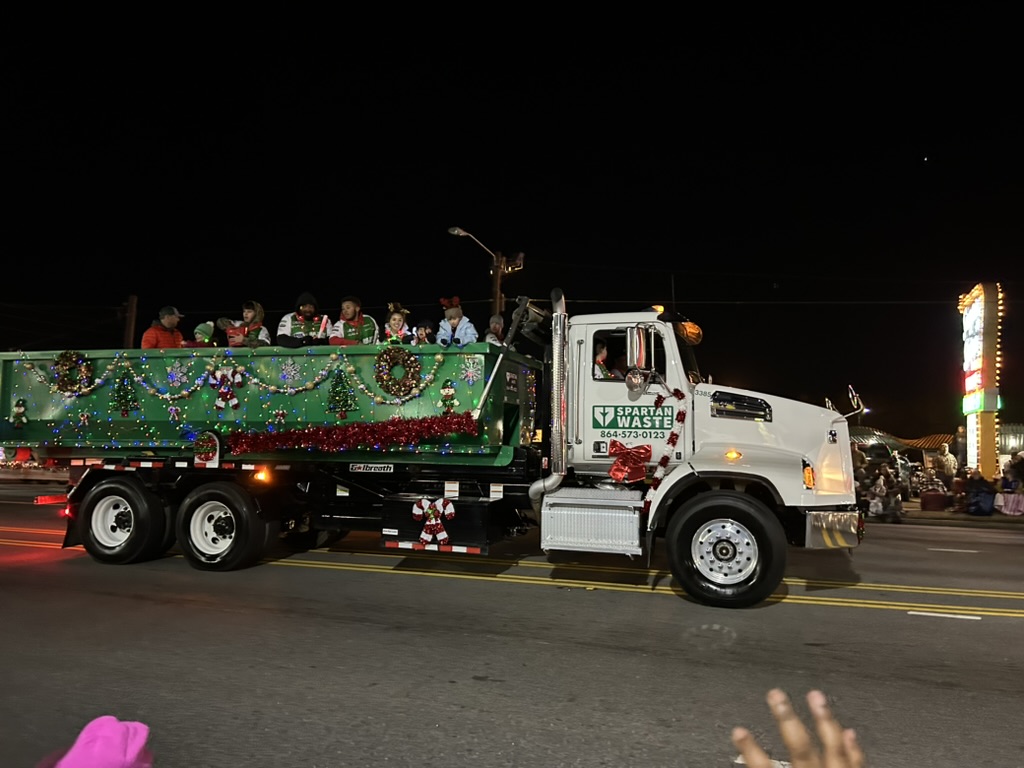
Here is where I had trouble sticking the ending. So I set it aside and went to the Spartanburg Christmas Parade. We live in a neighborhood that looks like Bedford Falls in It’s A Wonderful Life, and we can walk the two blocks to the parade route. We walked arm-in-arm to Main Street, got hot chocolate, and found a spot among the crowd to watch the parade. If you’ve ever been to a hometown Christmas parade, you know exactly what it was like. There were fire engines driven by Grinches, lights strung from cars and trucks and tractors, local beauty queens wearing Santa hats instead of tiaras, and marching bands. Oh, the marching bands. One of my most wonderful experiences was marching in my high school band. Memories of it fill me with happiness and exhilaration. As soon as I heard the drum cadence marking the band’s approach, I felt that feeling again. Then they began to play. It was at that moment the meaning of what I had been trying to capture in my writing became physically real to me. I began to cry as they marched by, joyful in the present and in jubilant memories. This, I knew, was gratitude.

Image of parade float and parade walkers in Spartanburg Christmas Parade.
Spartanburg Christmas Parade Float

While I’ve been struggling with disappointment at the parade passing me by, I just needed the reminder that parades don’t pass a person by—we experience them, marching right alongside. So, I’ll keep dreaming and working toward new goals, and I’ll keep finding happiness right here, in this moment. Gratitude, I understand, is not to be approached as “anyway.” Gratitude is an attitude–a mindset of unwavering, ongoing appreciation, regardless of the circumstance. Although I won’t always be successful, and although some days will be easier than others, I choose Gratitude, always.

Image of Spartanburg School for the Deaf and Blind Bus in Spartanburg Christmas Parade
Spartanburg School for the Deaf and Blind Bus in Spartanburg Christmas Parade
Image of Spartanburg Waste Truck in Christmas Parade
Spartanburg Waste Co. Truck in Christmas Parade

Remembering Sri Lanka on Earth Day 2019: A Lament Psalm

Update: CBS News confirmed that an Islamist extremist group claims responsibility as retaliation for the NZ Christchurch bombing. Seems ISIS and the locals are vying for top spot. So my musing is this: if “Islamic Extremist Groups” are terrorists, then are white nationalists who wear red MAGA hats also? They’re playing with and off each other right now. Endgame is the same.

Earth Day 2019
Warrior God. God of the victor David. It is with humble defiance I approach you, calling in my part of the covenant you have with your people~~all of us. Yesterday, at the moment 31% of the inhabitants of this planet shouted Hallelujah, Christ is Risen!, 290 souls on a tiny speck of it were blown up as they worshipped you. Five hundred more were wounded in this execution, 2,000 years after the one we remember. Terrorists, the news tells us. A local Sri Lankan group who couldn’t figure out how to coordinate and carry out a mass murder were provided resources by an international group who made suicide bombers out of them. The local attackers learned well; Sri Lankans know terror today—right at this moment—terror in the dreadful feeling, in the knowing, that it might not be over. Terror leads to terror and death to death. The story is familiar.

Enough, enough.

Loving God. David’s Good Shepherd. In the cruelest irony, today is Earth Day. This is the day that activists and poets alike remind us that we are destroying the very ground we live on, the very air we breathe. We are indiscriminate in our destruction, though, for we also kill each other. Christ is risen, indeed. So I will repeat the words of the prophet, How long, LORD, must I call for help, but you do not listen? Or cry out to you, “Violence!” but you do not save? (Hab 1:2). And I ask all of us who praised the Cosmic Easter Bunny yesterday, just what in the world has Christ risen for? Grant us peace on earth, or at least grant that we may want to want it, for peace leads to peace and love to love. I trust you from the depth of my soul. When it comes to this, I do not really have a choice. Amen.

See Thoughts on Prayer Following the Christchurch Massacre

BBC Report on Sri Lanka Bombings

On the Couch With Bill O’Reilly

Last night after our traditional family Christmas drama, daddy referred to something I had mentioned in passing–that I see a therapist. The second he asked about it, I regretted it. Actually, I thought he knew; my mom has known for months, so I assumed they had talked. No. So, he asked me about it. He asked me why I’m going to a therapist. “What are you going for?” he asked. Two things here: If I knew why I was going to therapy, I wouldn’t need to go. And also, it’s none of his business why. I thought everybody in the world knew to have enough tact not to aske this question. It is right up there with age and weight. But my daddy does not mind asking questions.

So, despite spending the previous hour processing Xmas drama by using tools from the past year’s work, I knew I might as well give him some sort of reasonable sounding answer. He asked me specifically if it was for anger, which gives me pause because I don’t put that reason high on the list despite being asked about it by 3 other people including the therapist. Maybe I’ll bump it up. Anyway, I talked about needing confidence and tools to trust my decision making ability. I said I wanted to be more productive and explore why I avoided writing, when it is something I really want to do. And, I said–which is the highest actual reason on the list–that I wanted to explore what it was about me that had made me succeptible to losing myself as a young woman in a marriage that I just barely escaped. I still have dreams that I haven’t yet, and it terrifies me. Whatever I said, daddy nodded, but I could see the situation was just beginning to gel in his mind. This was not going to be the end of the matter. He asked me whether it was loneliness. “Would living closer to family help?” I had to restrain myself not to say “GOD no!” He kept looking for the “Big Issue.” There isn’t always a “big issue.” When my voice started to quiver because I was breaking up in spite of myself, we turned our attention to anything else.

Tonight, while reading Bill O’Reilly’s book on Lincoln, he said, “Hey, talkin’ about your therapy, is your therapist, a Christian or a athiest, or do you know? I’m just reading here, you know Lincoln got down during the war and he said the Bible was his best solace and counsel. Of course, I don’t understand.” I know what it is. Daddy is afraid I’m searching for something. Happiness. The Meaning of the Universe. What’s It All About, Alfie. So I told him; I’m not. And, I don’t exactly need a moral compass or spiritual strength. I am really truly a Bible believer. Already. So I told him my therapist suggested prayer and the Psalms, which seemed to be enough for tonight.

A year ago when I told Mother I was seeing my therapist, she thought about it and then over coffee one day said, “If you’d just get back in church you wouldn’t need a therapist.” I didn’t have a good reply to that either. But then, 6 months ago, she had reconsidered. We were talking, like we do, about nothing in particular and everything all at once. I said that I always felt like they didn’t know quite what to do with me. And she said something I will never forget; it cut right to it. “No, we never did know what to do for you.” That kind of changed everything. Then she ended with, “I want you to keep on going to that therapy.” I’m thinking back on this, now that I am coming out to my daddy as a therapy patient.

I know Lincoln fought his demons, which is how I consider depression and meloncholy. Lincoln was a quipper, and he had a public persona and a private self and he was expert at keeping them separate, most likely even from Mary. Or maybe especially from her. Yet, he spoke–and I think really believed in–the better angels of our nature. I like this very much. Faith and hope that came from somewhere very deep. When Bill Clinton was physically moving into the White House, he said he was going to set about doing what every new president must: “get in touch with his Lincoln.” I’ve been doing that a little too. But all of this I cannot express to Daddy.
More on this later.

A Long Way from Starbucks

Littleville, Alabama, doesn’t have a Starbucks. In fact, from the time I leave my apartment, conveniently located behind my local Starbucks, until I arrive at my parents’ house, I don’t even pass one. That’s 250 miles with no Starbucks. That must be the longest stretch in the country without one.

That got me thinking. It’s a long way from Starbucks in more ways than one. My daddy told me once–and I agreed with him–that it took me a few days of being home to get back to my old self. I started thinking about what my old self vs. my new self must look like. He meant it takes me that long to relax, to let go of “city life” and the stresses it brings. I think it is something different.

I think it takes me a few days to become accustomed to people again. I don’t often appear that way to causual observers and acquaintances, but I am a solitary person. I myself didn’t even know I am an introvert for a long time. I was grown when I found out. It’s quite a shock to go around for 30 years thinking you are an extrovert only to take some inventory and find out otherwise.

I like living alone, just me and Duncan. And he’s a quiet little guy. I don’t prefer to be alone, but I am mostly really content when I’m by myself. Starbucks living suits me fine. There I can be with people and still be alone. In fact, that may very well be the secret of Starbucks: bustling solitude. It’s comforting and makes me happy. There’s a verse in the Bible that begins: “be still and know…” I like that, being still. So, even though I live in the Metro Atlanta area and am a professor and travel all over giving presentations or seeing this or that attraction, I can get in balance in my daily life. But, there aren’t any family members in it.

That is what it takes me a few days to remember in Littleville. People are sometimes messy and noisy. People require tact and patience and compromise. People will ask you questions. And note, when you are by yourself a great deal of the time, it’s amazing how you get used to not answering questions. It’s a little thing, but think about it. I also have to get used to being in another place, to sleeping in another bed. This is an odd adjustment because for so many years, this house in Littleville was home to me. It was home when my heart needed a home.

To end, what I am not saying is that I become aware that I need people and to reconnect and feel love. “People who need people are the luckiest people in the world.” I know already that I do and that I will and that I feel it. It is the awareness, the adjusting of my self. The sharing of my self with other people, with family, that I learn to do again after a day or two in Littleville. That, and accepting the sharing of others. I can note that now without nostalgia or homesickness. I’ll try to nudge the process along a little. There’s nothing to lose.

Over River Through Woods

As happy as I was puttering around my new place, it’s two days before Christmas, so I had to pack up the car and go to Alabama. Being directionally impaired to the point of anxiety and not being a fan of interstate highways, I set the TomTom to find me a new backroads shortcut. Took me 6 years to learn the shortcut from my old place–that’s how bad I am. But TomTom–for whom my motto is TomTom: We Get You Close–kept planning routes that involved I-75, one of Georgia’s busiest and most crowded interstates. Barely out of my apartment complex’s entrance, I pulled over and searched Google Maps on my phone. The shortest route, as I knew in my heart, was a path through the lakes and mountains of my home state.

So, I proceed through unchartered (for me) territory, manually scrolling through directions on my phone and leaving TomTom on to catch up. This he did after two hours of replanning the route every half mile. “Turn around when possible. Turn around when possible.” Why do I put up with this from TomTom? Because, once adjusted, he is a rather pleasant and comforting travel buddy. Somewhere past Rome, Georgia, he gave up trying to route me along the interstate through Chattanooga (yes, Tennessee to get to Alabama from Georgia) and accepted that I was taking the backroads. With him on board, I breathed a little and sat back to enjoy the ride.

I started trying to remember a Christmas visit home when the sky was not dreary. It was today. A dreary sky over brown fields makes everything have a gray cast to it. It makes industrial stretches hewn into sides of mountains look more isolated and lonely looking. I passed historic marker signs pointing me to “historic downtown” Cartersville, then Rome, then Centre (“Crappie Capital of the World”), and I worried a little less about the grayness when I realized that the pretty little quaint signs of life were just off my backroads. Past Centre, near Weiss Lake, I noticed the flat farmland give way to huge bluffs around the lake and couldn’t help thinking this place with its water source and ready-dwelling places had been inhabited by the Cherokee people. The first people to fish from these waters had been collected and led along this very road on what we now know as the Trail of Tears. Another historical marker informs me. There is more to my Alabama than meets the eye.

Whenever I go home, I make a point to chat up (gab, we call it in Alabama) a chashier at a local gas station. No station in particular, no town in particular; in fact, I like to vary it up some. I do this because I like to hear what we sound like. When I talk to the woman who has just sold me gas and a Diet Mt. Dew, I catch the drawl again and keep going. Sometimes, I look around the store pretending to shop for sardines and crackers so that I can hear her gab with local men on their lunch break buying lunches so greasy that the white bags are spotted with the oil seeping through. Today she told one young fellow, “I know y’all ready to be gettin’ home. You have a merry Christmas.” Of course I can’t capture the resonant lilt of her voice. Can’t capture how it sounded like a smokey bell ringing out.

More on this later.

Two and a Half Days Till Christmas

I was in a PowerPoint frenzy at Starbucks. Outside, the storm was raging, and not unexpectedly, the store began to fill. Now, if you stay any place long enough, you see many people come and go. I think of that stop-action photography in the movies. For hours there was a quiet lull, then when I had finally gotten into the work, a young child, a girl around 5 years old, asked the man working beside me in the long half-booth if she could have his chair. He said sure, and she dragged it across the floor. Then she came to me and asked me if she could have my chair. I said sure, and off she went. It was then I began looking to see who was going to sit in all these chairs. Two families were gathering to have a mini-Christmas get-together at Starbucks. Three kids were decked out in Christmas outfits–two girls with iridescent dresses and gold shoes and a boy with a christmas vest. The adults were also dressed more for a party than a rainy evening at a coffee shop. I thought it was odd. 


As soon as all the adults had their specially brewed beverage, they broke out coloring books for the kids. They were the kind of parents who make a show of making their kids be polite and say “please” to them a lot in the process. They were the kind of parents whose kids don’t bother me nearly as much as they do. The kids spent half an hour tearing all of the paper off all of the crayons and leaving it in a big pile on the floor under the table. Adults still talking, the kids got up and began running back and forth from the table to the pastry case–which amounted to the entire length of the store. Finally, one of the employees yelled–very politely, I thought–PLEASE DON”T RUN! Then, the “can-you-say-thank-you-Sally dad jumped up declaring it was time to go. 


I can tell you not one scrap of paper was picked up and not one chair was put back in its place. On the way out, I overheard one of the mom’s say, “Maybe I”ll see you tomorrow if I get tired of being cooped up in the house with kids.” I read today in the Huffington Post about a family getting kicked off an airplane from NC to Chicago for having too many young children. I bet those people on the plane were glad. I know I was, but I was really aggravated at the crayon paper.


Knowing full well how cantankerous (old) I sound here, I wish there were more kid-restricted places. Restaurants. Coffee shops. Why would you bring your kids and have a get together in a coffee shop where, if you look around you will see people reading, studying, writing (one hopes), or chatting quietly. There are no tvs on the wall. No tapes of Dora the Explorer playing in a loop. No toy boxes. No legos. 


Perhaps the AARP could take this on as a new project. 


More on this later. I had to write it down before I forgot it.
RUW

Three Days Before Christmas

Don’t think I’m romanticizing SBX. Plenty has already been written about why people come here. Most of us have perfectly good living room chairs or desks where we could work. But still we come. We come alone and with people. There is something simple and anonymous and inviting about a coffee shop. If I come here i have something to do: chat, visit, eat a cup of oatmeal, or like today: design a PowerPoint for a course I’m about to teach. If I’m at home, I will spring from the recliner to do anything to keep from working on a task. And that includes cleaning out sock drawers or toilets. Or just looking up and becoming entranced at the television; something profound, like Tabitha’s Salon Takeover. And in the event there is a marathon, I’m done for the day. Of course, creating a blog about the ordinary is definitely not the same as designing a PowerPoint. But, in the world of an academic, nothing is not related…


On Saturday the cable guy came to hook up my digital, hd box (just in time for the Tabitha marathon!). Sometimes I”m in the mood to talk; sometimes I’m not, but that night I was. The cable guy was a talker, so it didn’t take much. I mentioned that after 30 years, I have found my career path: I want to write. So, Paul (the cable guy) started sharing his expertise on blogging and tweeting and getting one’s work out there but more important–getting down to work writing! Now, I am a master at making excuses for not writing: too much school work I’m behind on, too tired, meetings, toilets to clean…My excuse for not blogging–for I had tried it before–was that it seemed such a waste of time when there was so much other writing to do (for which there was also an excuse; notice the cycle). But in this case, Paul the cable guy was right. Blogging isn’t academic. It doesn’t even have to be cutting edge about politics or celebrities or music or anything in particular. It doesn’t even have to be read


So, this is my small, ordinary start. Whatever else I can say about today, I can say that I have been writing. And that feels doggone good. My posts are not intended to be as profound as Huffington’s. In fact, if they are profound at all, it will be in the ordinariness, daily life-ness of them. I am really, really good with that. 
And I have just enough battery left to make a dent in a PowerPoint. 
RUW