The Playlist of me: Forgotten iPod, Rediscovered Self (Power of Music, Part 1)

A warm, nostalgic scene featuring a vintage iPod with earbuds resting on a wooden table. Surrounding the iPod are a stack of old CDs and vinyl records, symbolizing a love for music across different eras. Soft, ambient lighting creates a cozy and reflective atmosphere, with a hint of a worn journal and handwritten notes in the background, evoking a sense of personal rediscovery and connection through music.

I Found My iPod: Rediscovering Happiness Through Music, Part 1

Last year, I completed an End of Life (Death) Doula program with INELDA, the International End of Life Doula Association. The experience itself deserves its own post, but one lesson from the program keeps coming back to me: the role of music in creating peace during life’s final moments.

Image of International End of Life Doula Association, INELDA, logo

As the person in our care begins their end-of-life journey, we were advised not to play their favorite songs as background music. At first, this advice seemed strange to me. After all, wouldn’t a familiar melody bring comfort? It sure does for me! But then it was explained: favorite songs are deeply personal and emotionally charged. They can evoke strong memories, longings, or attachments that might not be conducive to a peaceful transition. Instead, we were taught to choose ambient tones or tranquil soundscapes to foster an atmosphere of calm and rest.

Not being a doula or having experienced end-of-life caregiving firsthand, this suggestion went against my intuition. The more I thought about it, though, the more sense it made. If it were me, I could imagine holding off my own passing just to hear my favorite song finish! The idea stayed with me: music is powerful, not just for its personal connections but for its ability to transcend memory and emotion, helping us navigate transitions when we need it most.

This thought was still on my mind when I stumbled across something I hadn’t seen in years—my old iPod.

From Records to iPods: A Musical Journey

As a Generation Jones Boomer, I’ve collected music in just about every format imaginable. I started with records and CDs, eventually amassing hundreds of them. Many of my favorite records were handed down from my parents when they got rid of their stereo. I didn’t have a record player either by then, but I kept the albums for the memories. Over time, I replaced many of those records with CDs, though I had to replace some of those twice after accidentally leaving my CD holder in a car I sold.

Then came the 2000s and the rise of digital music. When Apple introduced the iPod in 2001, I thought it was the pinnacle of technological advancement. I was as excited about it then as I am about AI now–granted for different reasons. I finally got one in 2005, and that summer, I spent two weeks downloading every CD I owned onto it. I painstakingly created playlists for every mood and occasion, collecting songs I thought I’d never hear again.
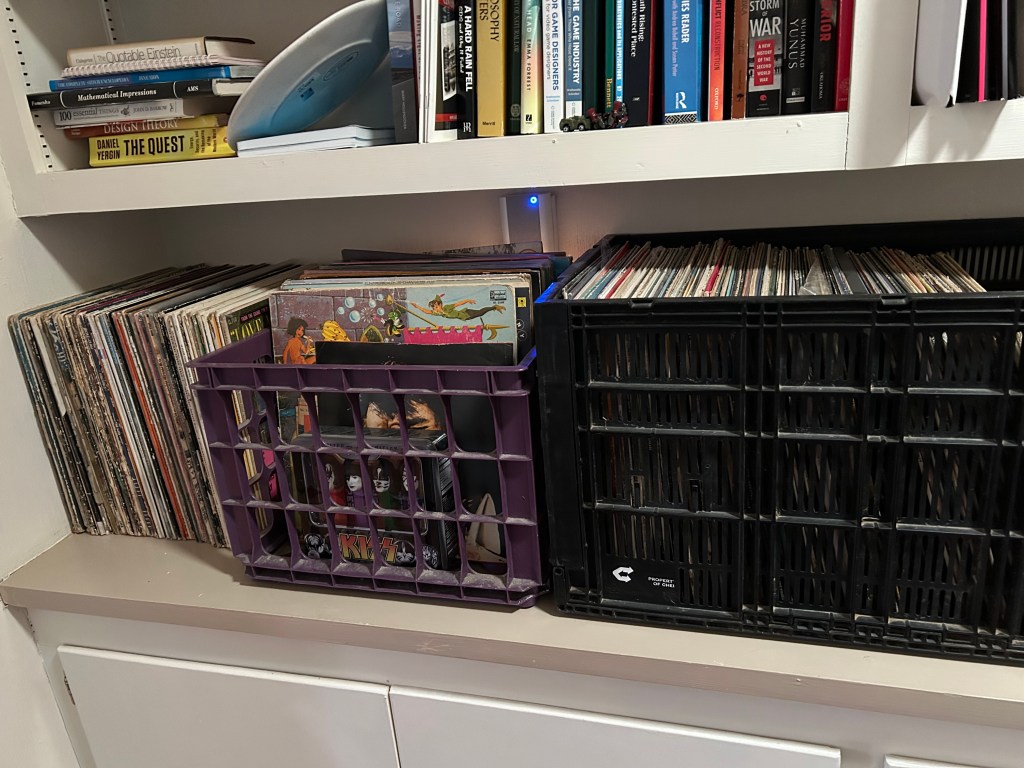
Image of record albums in crates. Disney's Merriest Melodies album.
My record album collection

By 2012, I had curated over 3,000 songs. I refused to sync my iPod with updated iTunes software because it wouldn’t preserve my playlists exactly as I had arranged them. They were perfect, and I wasn’t about to mess with perfection.

But as MP3s, smartphones, and streaming services like Spotify and SiriusXM gained popularity, iPods started to feel outdated. I used mine occasionally for chores around the house, but even that became less frequent. By 2022, Apple officially discontinued the iPod, and mine had long since stopped holding a charge. Eventually, it wouldn’t turn on at all. But I couldn’t bring myself to discard it permanently—it still held my songs.

Rediscovering My iPod

Last week, while searching for batteries in a drawer, I came across my old iPod again. Out of habit, I plugged it in, hoping for the best. The Apple logo flickered to life for a moment, and then… nothing. “Ugena,” Sarah said, “we live two minutes from a computer repair shop. Take it over there and see if they can fix it.”

The tech guy at the shop popped the back plate off, took one look, and said, “It’s your battery. See how it’s puffed up like a pillow? It should be flat. That’s an easy fix.” I was overjoyed.

Image of iPod Classic 5.5 gen laying on a Garfield cartoon sock.
My iPod

When I picked it up a week later, I could hardly contain my excitement. After nearly a decade, I saw my playlists on the screen again. I navigated the wheel (nothing like the sound of those clicks as it turns!) to find the perfect song for the moment, and when “Love Grows (Where My Rosemary Goes)” by Edison Lighthouse began to play, I felt an overwhelming sense of contentment. I was home.

More Than Memories

For me, music isn’t just about nostalgia. While certain songs remind me of people or moments—like Elvis always bringing my mom to mind—it’s the music itself that moves me. The key changes, the minor chords, the walls of sound (a la Phil Spector) all stir something in me that feels bigger than words.

And yet, sometimes it is the words. A perfectly turned phrase can be so compelling, so beautifully crafted, that it draws me in completely. It stirs a visceral reaction, and I can’t help but sing along. And yes I do grab a hairbrush for a makeshift microphone. At that moment, the three of us–mind, body, and spirit–are in sync with the melody and words. During my free concerts, whether in the shower, the car, or empty house, my old romantic self rises to the surface, caught up in the sheer power of the lyrics.

This emotional connection reminds me of Howard Gardner’s theory of Multiple Intelligences from his 1983 book Frames of Mind. One of these intelligences, musical intelligence, refers to the ability to recognize, create, and emotionally connect with music. Though the theory is considered pseudoscience by some, it resonates with me. It helps me explain feelings that go far beyond simply liking music. What I feel is deeper, more profound—something that connects to the core of who I am.

Rediscovering my iPod wasn’t just about finding old favorites. It was about reconnecting with a part of myself—a good and strong piece of myself that, during my distractions with job advancement and the trappings of success, had been suppressed. During those times, I was lost, adrift, unaware of how much I had let go of what truly anchored me. But when the music is back in my life, it’s as if I’ve found my way home—a reminder of who I am and what brings me joy. In the words of the old song, “Was blind, but now I see.”

The last 5 random songs played on my iPod while I’m writing this:

  1. Bad Romance, Lady Gaga
  2. My Heart Skips a Beat, Buck Owens
  3. Silver Wings, Merle Haggard
  4. On the Street Where You Live, Bill Shirley dubbed for My Fair Lady
  5. Livin’ in the Sunlight, Lovin’ in the Moonlight, Tiny Tim (from Spongebob Movie)https://youtu.be/hERIZmJpwTI?si=JSKnB7XR5_rwbiHq
A warm, nostalgic scene featuring a vintage iPod with earbuds resting on a wooden table. Surrounding the iPod are a stack of old CDs and vinyl records, symbolizing a love for music across different eras. Soft, ambient lighting creates a cozy and reflective atmosphere, with a hint of a worn journal and handwritten notes in the background, evoking a sense of personal rediscovery and connection through music.

My Friend Duncan: The Scottish Terrier Who Won My Heart and Changed My Life

Image of Scottish Terrier Puppy sitting among potted plants

I still look for Duncan when I move from one room to another. I hear the little “click, click, click” of his toenails as he toddles across the wood floor. I think of him every time the leaves fall, expecting him to chase the light that dances between the shadows. I keep his little blue plaid collar with a spiffy bowtie on my dresser. I call our new dog–and sometimes call my son Daniel–“Duncan” when I’m in a hurry. I miss him.

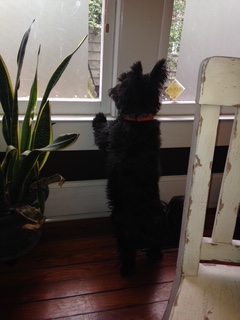
Image of Scottish Terrier standing on two legs looking out the window. Also pictures are potted plant and distressed dining chair.
Duncan standing on two legs looking out the window

I got Duncan for company and road trips, having been without a dog in the house for a few years. I had owned terriers before, but never a Scottish Terrier. While he was typical of the terrier breed, he was a Scottie, which gave him unique attributes, like not wanting his feet touched. He would yip and howl in holy terror at nail clipping time. He was a detached little fellow who did not need to be in my lap. In fact, I think he preferred to lie quietly at my feet. I discovered his staunch independence the day I brought him home. He was 10 weeks old, and I took him outside to the big front yard to start working on toilet training. I am used to puppies who want to be right with you–underfoot. Scottish Terriers have old people personalities even as puppies. I looked away from him for a minute to speak to a neighbor, and when I turned around, he was gone.

I looked all over for him–up and down the street, all sides of the house, under the porch, under the car. By this time my neighbor, who had returned to her porch, could see I was getting frantic. I yelled across our yards, “I just got him, and now he’s gone!” My neighbor had four kids, who all had friends, and who were all out in her driveway on bikes. She gave them marching orders: “Get on your bikes and look for the puppy.” And off they peddled, circling the block. It reminded me of communities coming together in movies, you know, like you don’t often see in real life. None of them had Duncan with them when they came back together.

Image of a senior aged Scottish Terrier
My old man

It was then the next-door neighbor on the other side yelled to me from his back porch. “I see something little and dark. Is that him?” To this day, I don’t know how he had seen Duncan. I trudged to the pine tree he was pointing at in the far back of my wooded, sloped lot. There, under the tree in a patch of knee-high weeds sat Duncan. He was calm and stoic looking, peering through the fence toward the woods like Ferdinand the Bull in the story. This was the first of his sojourns, each one scaring me worse than the ones before.

When he was a young dog, he could escape from the average fence by burrowing under it. Terriers–from the French word “terre,” which means earth–were bred to “go to ground.” His favorite escape was to the woods to sniff for critters. Once, he cornered an especially slow squirrel and did not know what to do with it; fortunately for everyone but the squirrel, it died sitting there before Duncan could acquire the taste for blood. Usually, he headed off in the same direction–toward the woods–and the same neighbor would report a sighting after Sarah and I had been driving around the neighborhood for half an hour.

Image of Scottish Terrier next to a laptop computer
Duncan at work

One Sunday we came home from church to discover that not only had one of the kids left the gate open, but I had rushed out of the house (typical Sunday) without remembering to bring Duncan inside from his morning potty. Animal control had left a yellow note on the front door telling us when and where to come to bail him out. The one crabby neighbor in the neighborhood had called them. She had been afraid of a Scottish Terrier who was sniffing the ground and heading away from her house. We rushed to the pound, where one of the volunteers brought him out, jauntily jogging and smiling as he met us. The volunteer was happy with him, but not with us. She frowned as she took the opportunity to chastise us and issue warnings about consequences if it happened again. It didn’t. After that escape, we reinforced the bottom of the chain link fence with chicken wire, which I’m sure did not increase our property value.

He lived longer than the typical 10-year lifespan of a Scottie. One day I suddenly realized he was approaching 13, and I knew then he was living on borrowed time. He was noticeably slowing down, asking to be pulled in the wagon as we explored local trails. I had never been able to train myself to be a good leash walker (note how I said train me, not him). Duncan tugged and ran ahead until he found the perfect patch of ground, where he would have sniffed every blade of grass if I had let him. I couldn’t take him on brisk walks with cardio benefits because he would take three steps, stop to sniff, repeat. Now that he was a senior, we went on short walks with fewer stops and tugs. He reverted to peeing in the house on corners of the furniture when he got up for his nightly midnight drink. We began to crate him at night.

In the spring of his thirteenth year, he started throwing up. He was still eating and drinking, behaviors that I knew usually slowed and stopped at the end of life. I did not think we were there yet. The vet gave us a prescription for pancreatitis and told us to bring him back in a couple of weeks if the vomiting continued. After a few days, it got better…until it started again. The first night he threw up in his crate, we held our breath hoping it was a fluke. The second night we planned to take him to the vet for a re-check on the pancreatitis. Our wonderful vet gave us the dreadful news. “The pancreatitis is fine,” he said. “It’s these lumps I’m worried about. Let’s get him a scan.” The results showed golf ball-sized tumors in his abdomen. That was the first time I cried at the vet’s office.

Image of Scottish Terrier sitting on window ledge looking outside at a tree and building
Duncan on guard

Being the thoughtful person that she is, and to bring me out of my sadness to focus on what was really important during all of this, Sarah began to plan Duncan’s “bucket list.” At first, I just went along. But then I started to understand; it was really our bucket list–mine and his, together. We loaded up the little red wagon we had bought to cart the old man around and went camping. It makes me happy to think of him sitting in the middle of the campsite in that little wagon. We hit the trails and took road trips. He got a pup cup from the local ice cream shop. The only item on the list we did not get to was taking a trip to Alabama so that my folks could see him again. My sweet mother proudly reminds me that it was she who house trained Duncan when he stayed with them for a couple of weeks. She misses him, too.

The end came soon after. In three weeks, his belly was hard and swollen, and he began panting through the night. He was dying. I held him in my arms as we went into the veterinary room, held him when the kind vet administered the first shot, the one that sent him into a deep, peaceful sleep. But I could not bear the final shot. When I broke down and collapsed in the chair, Sarah petted and soothed him for the last time. It is the hardest thing I have ever done, and it broke me. I am crying now as I remember, and it is only now, months after, that I can bear to write about it. I still cannot look at the rosewood box with his ashes; Sarah has put it away for now.

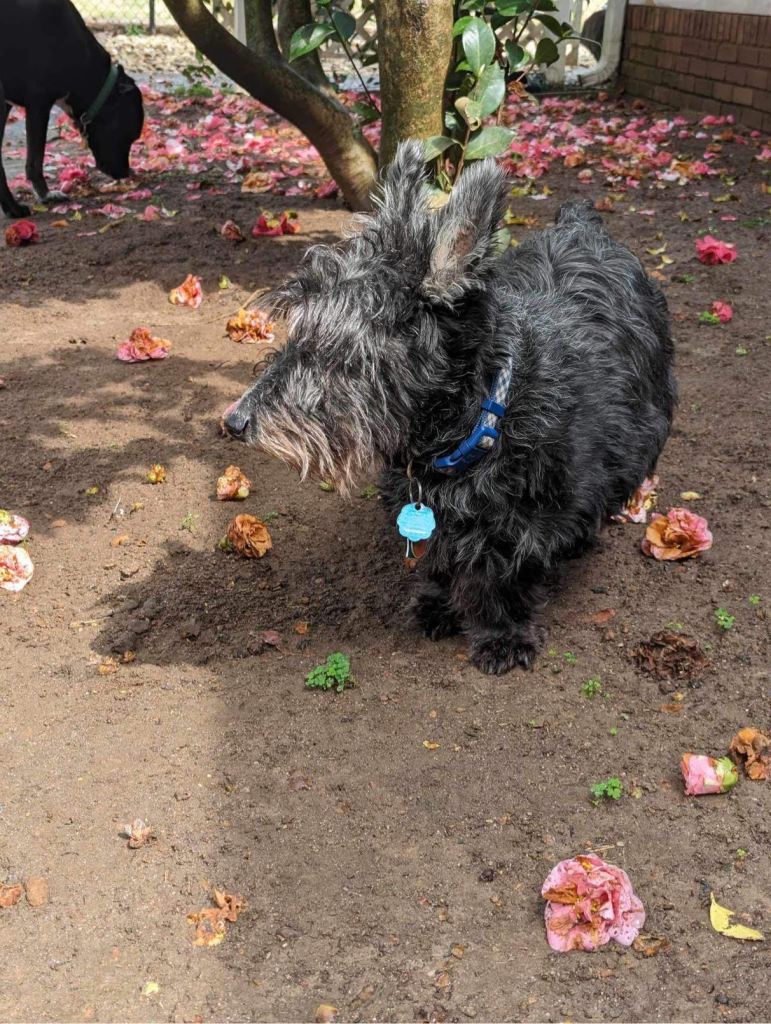
Image of Scottish Terrier under gardinia bush with gardinia flowers. Also pictured is a lab mix black dog.
Duncan under the gardinias

I don’t use the word “pet” when I can help it now. I don’t use the language of ownership anymore. I have done so here to reflect the lessons learned from my Duncan. He was my friend. A stalwart sentry, he was a proud dog who carried himself with dignity. Even during his last months, he never slouched or walked with his head down. Each step was deliberate and graceful, almost tiptoeing. He had the presence of a little gentleman. Duncan was lovingly stubborn until the end, tilting his head and gently pulling on his leash if he was not yet ready to continue our stroll. When he was groomed in that standard “show dog” cut, his brindle patterns were tiger-colored, swirling around on his back and neck like a chocolate and caramel brownie. He was magnificent.

Duncan has helped me navigate the passing of time, which is the gift from him I appreciate most. Life is short; if you want to see how short, reflect on the lifespan of a beloved furry companion. I grieved his death more deeply than I ever have before, with my immediate family still living. I am forced to prepare for inevitable loss of parents and the sad yearning of looking into the void where they once were. I picture Duncan looking at me and tilting his head, like when he was listening to me. “Yes, it’s indescribably hard,” he seems to think. “Just keep your nose down and keep tracking.” On days I work from home, I look at the sunbeams on the rug and think about how he used to sit and stare at the beams, expecting to catch one at any minute, his whole body alert and quivering, his tail wagging in anticipation. And after all, that’s life, isn’t it? Head down, keep tracking, and always look for that sunbeam you’re about to catch. Thank you, friend.

Image of Scottish Terrier named Duncan in a pond. His tongue is out as though he is smiling.
Duncan in a pond

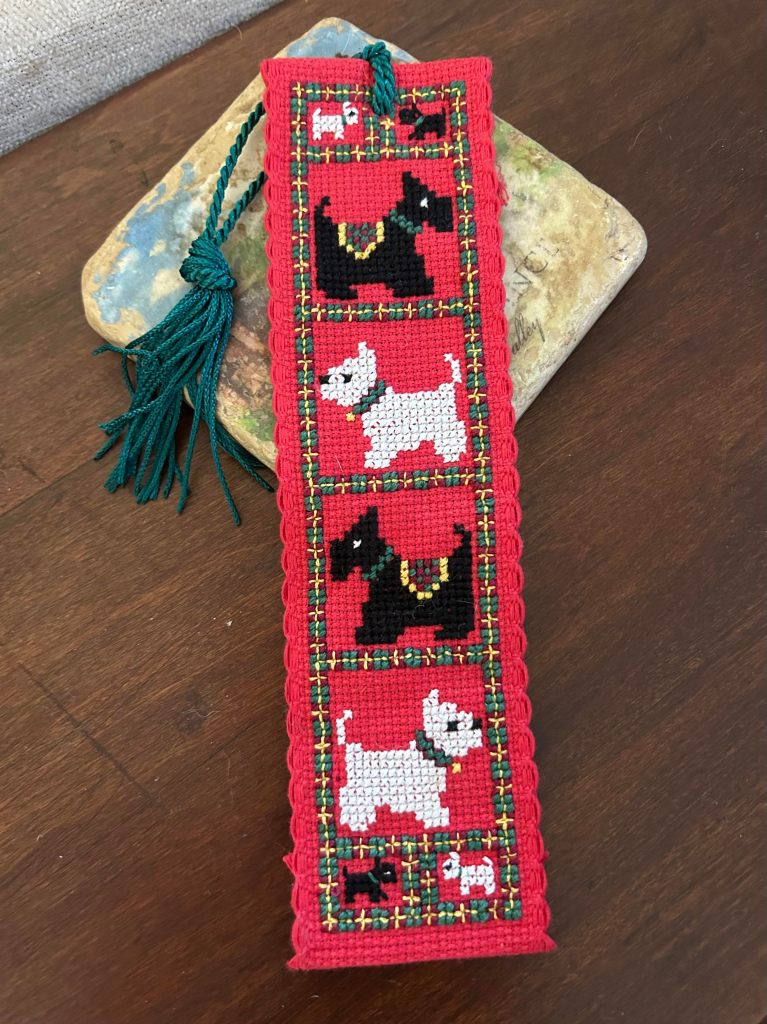
A final note, throughout the essay, I have referred to “we,” plural. In reality, Sarah provided Duncan’s end-of-life care and doctor visits. Reading this, she jokes about the so-called loyalty of Scotties, since when she entered my life, he adopted her as his person. He sat in her lap and asked for pets the day he met her–and continued to do so for the next 10 years. She reminds me that Duncan was in fact affectionate with her, if not so much with me. She was the only human whom he would allow to touch his feet. She made me the lovely Scottie bookmark in the picture, and I thank her for caring for us both.

Image of Scottish Terrier named Duncan reclining regally on a settee
Duncan looking regal and thoughtful
Image of Ugena Whitlock holding Scottish Terrier Duncan while on vacation.
Duncan and Me
Image of red bookmark with green tassle that shows two large Scottish Terriers, two large white Scottish Terriers, two small black Scottish Terriers, and two small white Scottish Terriers.
Beautiful intricate Scottish Terrier bookmark by Sarah

Starting Mounjaro after the Holidays

I have been waiting for a drug like Mounjaro for decades.

All my life I have struggled with my weight. I remember in elementary school they made us weigh at each report card time. In 3rd grade I broke 100 lbs. By my wedding at age 18, I weighed 170 lbs. And yes, the dress I had purchased a year earlier no longer fit. By my 40th birthday, I had reached what would be my highest weight ever: 253 lbs. It was at that point I was diagnosed with Polycystic Ovarian Syndrome (PCOS) and the accompanying Insulin Resistance (IR). Metformin helped me get down to where my body insists I should be: 200 lbs. For 20 years, my body and I have done a yo-yo dance. I have gotten as low as 168–for about 2 weeks and have weighed as much as 215, where I am today. Somewhere along the way, I began reading about weight loss pharma. I recall when they isolated the hormone that made you feel satiated. I recall the predictions that one day there would be a pill. I remember studies that connected Diabetes 2 and obesity. Oh, and I remember the first time my doctor noted “obese” on my chart and apologized for it.

Although D2 drugs that lead to weight loss like Ozempic and Wegovy have been around for awhile, it was not until the Mounjaro (tirzepatide) studies were announced with astonished and promising fanfare that I seriously began to hope. Was my 5 decade fantasy finally becoming a reality, like tvs in watches and time travel (I can hope, can’t I?)?

Mounjaro still has some setbacks: prohibitive cost, side effects, unproven record, threat of thyroid cancer, etc. But when I saw weight loss of up to 22.5% in study participants, I began to follow the research intently. It was approved by the FDA in May 2022 and showed up as an approved D2 drug in my insurance drug by Fall 2022. I decided to ask my doctor to prescribe it for me. I had my arguments laid out, see above with D2 threats sprinkled in. To my surprise, she had no qualms about trying me on it. My insurance company requires Prior Authorization, which I thought would take several days, but by that evening, tirzepatide showed up in my medications in MyChart. I was jaw droppingly amazed.

So here are some steps I have taken to begin my journey:

  1. I bought scales to start weighing myself daily again. For me, it has to be every day.
  2. I am committed to begin eating more healthily to start balancing out before I begin my Mounjaro, which will be when it gets in stock and after the holiday.
  3. I am making sure my doctor calls the insurance company for a Prior Approval. With PA, the cost is $25. Without, $1,000. It’s worth my time to get the dang thing approved.
  4. I took a “Day Zero” photo of myself. I have never done this, partly because I just never took the time to and partly because of really not wanting to see fat me documented in a photo. Mounjaro requires a re-wiring of the way you think, so I see this as a first step.

Day Zero Picture. Do you know how hard it is for me to post this picture? Even as I write, I can’t help staring at it. All I see are the fat parts. Well, it’s on.

To be honest, after reading blogs and sub-Reddit posts, I am a bit terrified of the side effects of Mounjaro. I won’t list them here, but the Reddit folks don’t hold back describing them. I can’t imagine working if I have some of them (I’m looking at you, Sulphur Burp). Still, I am willing to risk it. There are those who will judge and criticize me for not being happy and comfortable in my body, for wanting to put myself through a drug regimen to re-shape myself, for being driven by a smaller number and clothing size. Good for them. They obviously are not driven by the burning desire to shop for regular sized clothes at Talbots. I’m serious. When I go shopping there for my work clothes, I head straight to the back of the store for the plus sizes, which is about 1/4 of the store. The other 3/4 has a wide variety of cute, colorful, stylish clothes that go up to a size 16. I currently wear a size 16W, but those never come in candy apple red velveteen. So yes, what will get me through the nausea and other unnamed bodily functions are sexy pants and matching sweater.

I have included two helpful resources I found on Reddit. First is Best Food Choices for Ozempic, Wegovy & Mounjaro Weight Loss: Dr Lipman Endocrinologist

Here is Mounjaro/Ozempic/Wegovy/Trulicity Tips

*Take injection after a protein fortified meal

*Start fiber, magnesium powder or digestive enzymes listed below, at the start of the prescription so you don’t end up with severe constipation

*Take a multivitamin

*Eat protein every 3 hours (goal 80g – 100g a day) to maintain muscle mass during weight loss

*Drink 1-2 servings of sugar free electrolytes a day if eating low carb

*Drink 60+ oz of water daily

*Determine your daily caloric intake based on BMR & TEE determined by a dietitian/nutritionist. DO NOT go below 1000 calories – too few calories will stall your metabolism and the scale.

*Once you know daily caloric goal, track calories in an app like MyFitnessPal- https://www.healthline.com/nutrition/how-many-calories-per-day#calculator

Low Carb Protein Drink Suggestions 

READY TO DRINK

-Orgain – https://amzn.to/3PBUwdi

-Premier Protein – https://amzn.to/3BQbD5w

-Fairlife Core Power – https://amzn.to/3WwMcxw

-Fairlife – https://amzn.to/3HKKHry

POWDERED

-Clean Simple Eats – https://amzn.to/3hKTOxE

-Premier Protein – https://amzn.to/3HJ6Y9c

– Just Ingredients- https://justingredients.us

Nausea

– eat protein every 3 hours

– drink electrolytes – https://amzn.to/3FJv2pR

– Non Drowsy Dramamine – https://amzn.to/3PMeu5e

– Ginger Tablets – https://amzn.to/3YyegT8

– Isopropyl alcohol inhalation – https://www.ncbi.nlm.nih.gov/pmc/articles/PMC6189884/ 

– Zofran prescription – can create additional constipation

Constipation

– Fiber https://amzn.to/3VbCmAh

– Calm Magnesium Powder – https://amzn.to/3WurkHf

– Digestive Enzymes – https://amzn.to/3jfsBUv

– Miralax – https://amzn.to/3je8yWj

– laxatives, senna or Smooth Move tea are not suggested because they are absorb into the bloodstream and can be addictive

Burping

– Digestive enzymes before you eat  https://amzn.to/3WtY6Iz

– Gas X before you eat https://amzn.to/3Vjuahy

– Vitanica Digestion Tonic – https://amzn.to/3G2Lsek

Acid Reflux

Immediate Relief

* Apple Cider Vinegar 2 TBSP  in 8 oz of water

* Apple Cider Vinegar Supplement https://amzn.to/3v41rT6

* Tums https://amzn.to/3Yzyyvx

* Mylanta https://amzn.to/3G7CFrD

Long Term Relief (take daily) –

* Bromelain – https://amzn.to/3v3AFdq

* Digestive Enzymes – https://amzn.to/3WtY6Iz

Multivitamin

* Mary Ruth’s Liquid – https://amzn.to/3jgl6wu

* Passion 4 Life Liquid  https://amzn.to/3v3KIPN

* Vimerson Health https://amzn.to/3W9uYGY

* Ritual https://amzn.to/3BJm7TV

Loose Skin/Hair Loss 

* Vital Protein Collagen – https://amzn.to/3PGxTEz

* Physician’s Choice – https://amzn.to/3G4B0CV

* Sanar Naturals Collagen – https://amzn.to/3PUdk7T

* Dr Emil Hair, Skin & Nails – https://amzn.to/3BPaj2N

Long Term Results

The goal while losing weight is to learn how to make different choices and create new habits that will create sustainable, long term results that start with mindset work. Here are a few books on Audible that will help you assess your brain and your habits!

* Chasing Cupcakes – https://amzn.to/3WiaEDq

* Beck Diet Solution – https://amzn.to/3Wu04sr

* Beck Diet Solution Workbook https://amzn.to/3BN84Nl

* Never Binge Again – https://amzn.to/3BNA5UR

If you are looking for virtual doctors who are prescribing to compounding pharmacies, here are a few to research

* PUSH

* SEQUENCE

* JOINMOUCHI

Food choices:

https://www.richardlipmanmd.com/best-food-choices-for-ozempic-wegovy-mounjaro/?fbclid=IwAR3wEmM2HJ7W5nbZPQYhvkCmJumnvm8XcsdyJTG1kXIansUaTRi_kAALQok

Medical Advice Disclaimer

DISCLAIMER: THIS DOCUMENT DOES NOT PROVIDE MEDICAL ADVICE

The information, including but not limited to, text, graphics, images and other material contained on this document are for informational purposes only. No information on this document is intended to be a substitute for professional medical advice, diagnosis or treatment. Always seek the advice of your physician or other qualified healthcare provider with any questions you may have regarding a medical condition or treatment and before undertaking a new health care regimen, and never disregard professional medical advice or delay in seeking it because of something you have read on this document.

Go back

Your message has been sent

Warning

My Sugar Addiction, Day 1

I am gaining my weight back. Again. Like just about every person who has ever battled their weight, I have tried every diet plan imaginable. I’ve taken diet pills–over the counter and prescription–and for awhile I took Alli fat blocking pills, which was the grossest diet plan ever. Google that one. I’ve done Weight Watchers, now WW so you will feel like a winner, thank you, Oprah. It’s still Weight Watchers. I’ve exercised for a solid year; that, along with WW, which works if you work it, resulted in my losing the most weight I ever had in my adult life: 70 pounds. It felt so good! I got a complete new wardrobe and felt young again. I was so encouraged this time when I read that if I could keep it off for 3 years, I could keep it off for good. When it started creeping back after about year two–those crisp white shirts and modern-cut pants started feeling snug (a word of terror for fat people)–I looked that factoid up again. It had said five years, not three. I had weighted 168 for exactly 2 days, and as I creeped back up in the 170s, I told myself that my body wanted me to be in that range. Again, if you’ve ever been a weight warrior, you know the feeling in the pit of my stomach as I watched myself outgrow my clothes. Again.

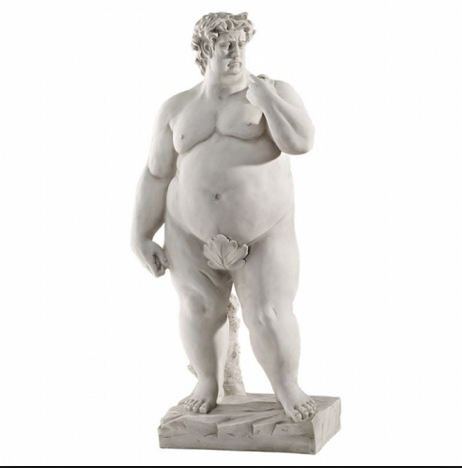
fat david

My size 10 Levis were the first item to go, then my pants for going out. I donated my cute pinstripe suit after church one Sunday when a guy jokingly–it’s always jokingly, you know, but there’s truth behind it and it hurts like a sucker punch–said “Hey girl, you trying to show off those biceps?” I looked down at curved stripes on too-tight sleeves. Last year, I bought size 16 Levis, telling myself I still had not reached my highest weight–253, so 16 was okay. I was still under 200 pounds. Then came another holiday season.

I don’t even bother making New Year’s resolutions any more. What is the point? It’s always the same: lose some weight. Weight warriors, familiar? Knowing most people gain a few pounds over the holidays, and also knowing I didn’t have any to gain, I was determined to practice portion control. I didn’t gain during the month-long eat fest, but I began to feel my body change beyond the feel of my clothes. I put out of my mind that the size 16 roomy L.L.Bean pants’ waistband was getting snug. (oh no!). I was out of breath in the shower. I developed a candida fungus under my belly fat. Yes, that is so far the most embarrassing thing that I’ve ever felt about my body. Fat can be fluffy if you tell yourself enough. But a seepy, smelly rash made me feel nothing but shame.

This weekend an interview with Molly Carmel popped up on my newsfeed, and led me to her new book, Breaking Up With Sugar: Divorce the Diets, Drop the Pounds, and Live Your Best Life. I had do decide whether to add another weight loss book to my Kindle. I have books on insulin resistance, carbs, and the keto diet, for example. I know the science, and I know the “secrets” of weight loss. If knowledge were enough, wouldn’t we all be thinner and healthy? That, precisely, is Carmel’s point. I ‘m going to call her Molly, since the tone of her book is friendly and encouraging. I’m reading Breaking Up now, and I’m glad I bought it.

sugardownload (1)

Here’s Molly’s About the Author on Amazon: Molly Carmel has made it her life’s mission to help people find a sustainable solution to the battle of obesity and related eating disorders. After battling her own eating disorder for over 20 years and finding no solution in available treatment, she created The Beacon, where she helps clients recover from similar addictions. Carmel received her Bachelor’s in Social Work from Cornell University and her Master’s from Columbia University’s School of Social Work. She has extensive training in Dialectical Behavioral Therapy, addiction, and nutrition.

The chapters support the breakup/divorce/find a healthy relationship theme of the book. I’m on Chapter 3, “The Truth About Your Sweetest Love,” where Molly gives a summary of how sugar is in reality “Suicide on the Installment Plan.” I wanted to include her list of sugar’s lethal capacity here: But Sugar also negatively affects every single part of your body. Some of these harmful effects are more well known than others. Eating sugar has been linked to: inflammation, migraine headaches, anxiety, brain fog, trouble sleeping, weakened eyesight, gum disease, heart disease, increased cholesterol, asthma, suppressed immunity, kidney damage, nonalcoholic fatty liver, overworked pancreas, arthritis, osteoporosis, metabolic syndrome, and leptin resistance. There’s even terrifying research showing that Sugar increases the risk of developing certain cancers. And of course, let us not forget Sugar’s piece de resistance, glucose intolerance and diabetis

And yet, knowing all of this and having encountered many of the effects on Molly’s list, I keep right on eating sugar and its evil twin flour anyway. I’m going to keep reading, but I’m open to the idea that I think and behave like an addict when it comes to sugar–and I suspect toward food in general. I looked ahead to see whether Molly had made me a shopping list and a suggested meal plan? She had? Ah ha, I thought, but are they easy or complicated? Maybe they were like keto, a list of foods and meals of stuff I really don’t like (how much butter can I eat?). Nah, Molly included good, whole foods. I felt healthier just reading the foods and plans, which are easy and sustainable. I went through her lists of proteins, fats, carbs and made a grocery list.

I’ve already started the self-doubt talk in my mind. I’ve done this before–so many times. What is different about this time? How long will I be able to eat this food, which I’ll get tired of, won’t I? It’ll take too long to lose this much weight, so what’s the point? But Friday is pizza night! You work so hard, don’t you deserve a reward?  Molly, though, has already thought of this–she describes how she herself heard those same voices. Of everything I’ve read so far, this passage has hit me most profoundly was about how rats respond to excessive Sugar–which Molly capitalizes to remind us that we really are in a relationship. After describing sugar DTs, she writes, What’s more, when the rats withdrawing from Sugar were placed in water, they were less likely to swim or climb out, and more likely to passively float. They had lost their will to survive. I’m going to keep reading, Chapter 4 is “Defining Your Relationship: How Bad Is It Really?” There’s even a quiz. I know already; it’s pretty bad. I have a food addiction. I’ll start from there.

cuterat


A Game of Thrones Travelogue: Or, Finding Community in a LaQuinta in Orlando, Florida

Like all GoT fans, Sarah and I had been awaiting Season 8 for two years. For the last month, we’ve been organizing our weeks around Sunday nights at 9:00. We’ve organized our Sundays around that one hour. This week, for the series finale, we had a minor change to our normal routine of gathering around our tv with tailgating snacks. We were in Orlando for a math conference. No problem~~we’d just watch it on HBO at the hotel. On Friday night, we discovered the LaQuinta provided complimentary Showtime. Not HBO. We had 48 hours.

Saturday was spent researching, me poolside and Sarah from a panel session. We called Buffalo Wild Wings, who was running commercials nationwide showing the Mother of Dragons. This probably meant they were going to have their monitors blaring with the final episode. Nope~~they didn’t have an HBO subscription. Could we live stream through our cable provider? Apparently not unless we were in proximity of our cable box. Did we know anybody who actually 1) lived in Orlando and 2) had HBO? Time was running out! Game of Thrones, GoT, LaQuinta, Orlando, Florida, Community, Entertainment

Thanks to Google, we discovered HBO Go and made plans to stream on our laptop that evening. Since Sarah’s high school friend–an engineer–was hanging out with us, we’d watch in the lobby. It was the best we could do. We started set up early, an hour ahead of time. Putting our heads together to make the most of our viewing environment, we got up our courage to ask the receptionist if she might dim lights and lower the volume of the lobby monitor blasting out Men In Black, which she was clearly watching from the desk. I was elected to ask.

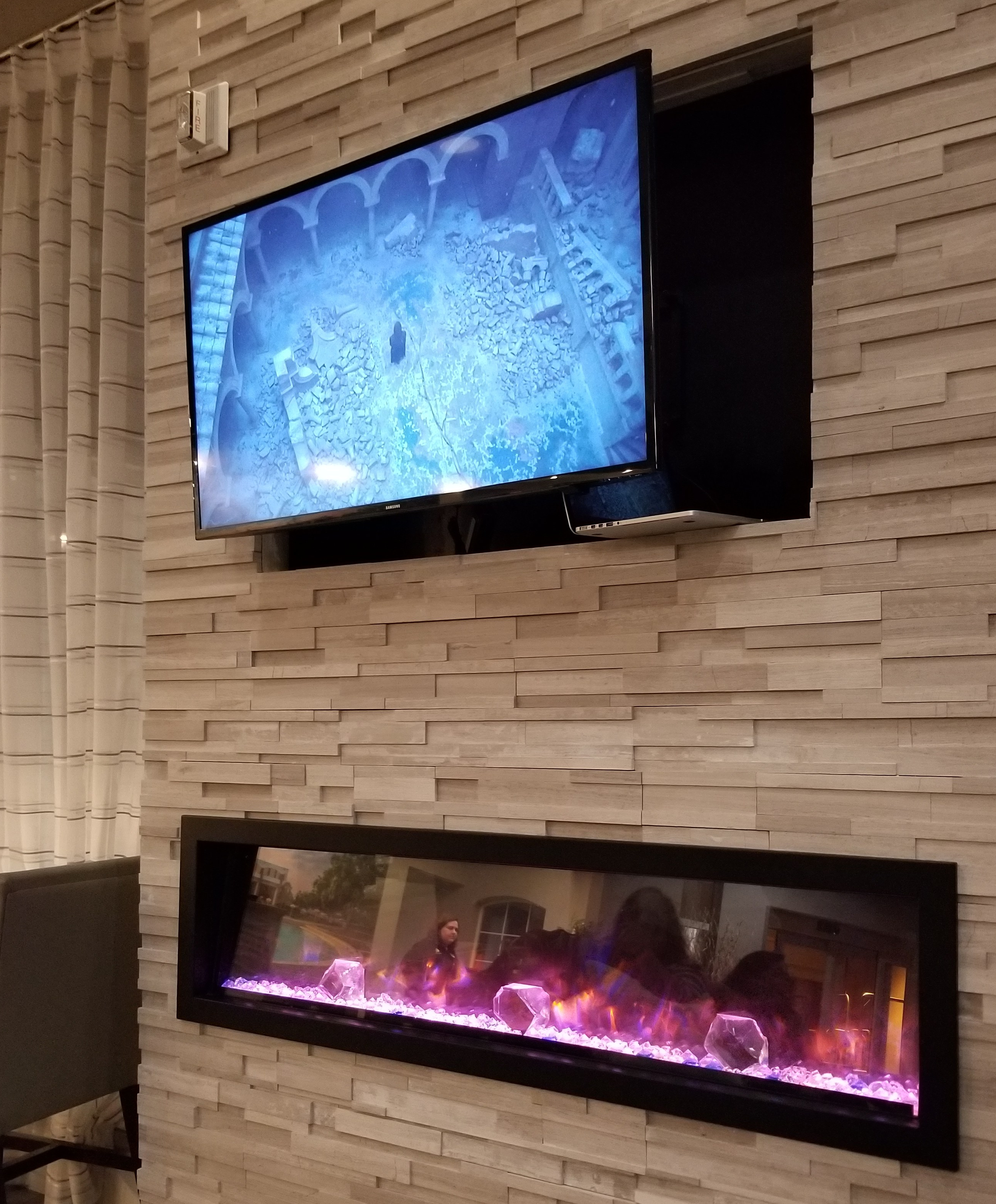
“Lights? No problem!” replied desk clerk Julie to my first request. “I’ll dim what I can.” “Would you like to hook up the computer to our HDMI cable so you can watch it on the big tv?” A viewing event was going to happen after all! We grabbed the engineer and it was ON! Lights dimmed and the three of us planted ourselves on the comfortable LaQuinta lobby furniture just as the announcer began, Previously, on Game of Thrones. 

Then a woman walked by and saw Lord Tyrion walking through the ruins of King’s Landing, above. “Oh my God, it’s ON!” We invited her to join us. She ran down the hall and returned with a hotel pillow. “Hi, I’m Sandy,” she said, not waiting for returned introductions as she snuggled in. Sarah texted her math pal Laurie, also at the LaQuinta, to join us; she appeared, giddy with excitement. The family checking in turned and looked at us and the tv. Their teenage daughter drifted over as her mom said, “Yeah, you can just stay right here and watch.” The teenager took a seat at a table behind us, on the margin. “Come on, join us~~it’s ok!” She took a seat on the couch. Sarah made a mad dash to the room to grab our road trip snacks–grapes, Triscuits, Babybel cheese.

We were, for that hour, persons of a common union, communing around an entertainment event. Sentimental sap that I am, I looked at us, and it felt good, comfortable. We didn’t talk~~except when Sarah’s friend enthusiastically punctuated each scene with a question. Is Lady Brienne pregnant?? Is Jon going to kill her?? I heard there’s a poison chalice!! There’s one in every community, and we love them anyway. Sandy’s phone buzzed non-stop, except when it was ringing. She eventually tucked it under the pillow. And, keep in mind we were in a hotel lobby; I’m heartened to know the Orlando LaQuinta is doing such good business from 9:00-10:00pm on a Sunday night. There was a steady stream of check-ins.

As the last scene faded and the credits started to roll, Julie turned the lights back up. As if on cue, our little viewing community began to stir, turning away from the big screen, where we had–finally–found out who would rule the 7 Kingdoms (sort of, fans will know what I mean) and watched Arya head west of Westeros. The most some of us could utter was, wow. Although some elaborated with expressions of disbelief–or validated predictions, whichever.

Our little band milled around, gathered up our belongings, and began to drift off. “A selfie~~we need a selfie!” Sarah insisted. “Gather around, everybody.” I looked at the teenager, “What’s your name?” “Chelsea,” she grinned. Game of Thrones, GoT, LaQuinta, Orlando, Florida, Community, Television

Communities are like families: they come in different shapes and sizes. Sometimes we don’t get to choose its members. They give us a sense of belonging, if only for an hour in a hotel lobby. They can be chosen, but sometimes they form spontaneously. Sometimes they are temporary, like this one, never to be exactly replicated again. Thinking about it now, my heart is warmed, and its strings are tugged. I hope it happens again and again, random people who share a few moments. I think world peace and reconciliation could happen that way, friendly gatherings. Maybe not over tv; maybe over food or sports. Is that naive? Yes, of course. But there is something child-like in naivety–an openness to wonder and whimsey, to connecting. As a concluding thought, I was going to do as I usually do and end with a well-placed quote from Game of Thrones, but upon checking, I couldn’t find one that captured the spirit of anything other than violent-war-and-slaughter or mockery. So I settled on one of hopefulness and determination and purity of heart and, well, of openness–not unlike the promise of community. Hold the door!

A Parenting Psalm: Wisdom Prayer for My Children

I remember as a young girl my Daddy pointing out the difference between knowledge and wisdom. Wisdom comes with age, he said. Well, he finished, it ought to. It occurs to me—I am trying not to worry about it, really—that because of life’s circumstances, there are many “words of wisdom” I have not taught my children and may not ever have the opportunity to tell them. Help me, oh God, put some of them down here.

Be happy with how you look—love your body; it contains your beautiful spirit. Your body will change as you get older; help it along with kindness. You don’t ever have to think of unpleasant or embarrassing moments from your past; banish them as soon as they enter your mind if they bring you pain. Try to forgive your parents; they are deeply flawed. Know that you are loved, and it’s ok to feel the love from generations before you. Fill your life with non-human animals; you already know they love you unconditionally. You can feel it. Carry yourself with pride without being prideful; it just means admire yourself with humility. If you have children, teach them the Bible stories and make them learn some verses; if you have forgotten, learn them again. Don’t be afraid of the dark; don’t be afraid to fly; don’t be afraid to travel. Stay away from negative people; trust your instincts if you have doubts about someone’s integrity.

Never settle when it comes to a partner; never be with someone who is settling for you. Go outside. Go see some old ruins. Go to New York City and Washington D.C. and New Orleans. Go to the Pacific Ocean. Go stand in an old cathedral and an old country church in the woods. Remember to look up at stars. Find a job you like and stick with it. Save enough money, but don’t worry about not having a lot of it. Don’t accumulate a lot of things; curb your desire for things. Let yourself be enthusiastic. Let yourself be awed. Remember that children are raised to grow and go—whether it is you or your children. Read. Pray for guidance when making decisions: let your litmus test be, Will I regret more if I do it or don’t do it? Sing. Learn to do something fun that you are proud of. Eat dessert now and then. Keep a journal. Know that when most people say “happy” they mean “instantly gratified.” Those aren’t the same: be happy. Be kind. Let yourself be a nerd when it comes to learning. Never stop learning. Have integrity. Look at some art, and learn something about it. Take care of earth however you can; we’re using it up and won’t get another. Help people. Take help from people when you need it. Learn poetry. Believe in God so that you can know that God is with you and has been there through all of it.

This is my prayer, God, for my children. Amen.

IMG00071

Louisiana Black Church Fires: A Psalm of Community Lament

Holy God, we must speak the names. St. Mary Baptist. Greater Union Baptist. Mount Pleasant Baptist. Louisiana smolders. In the names and the smoke our sin is manifest. We do not speak of their pain because the pain is their own—it belongs to their hearts. We do not get to cry those tears. Theirs is not our story to tell. Our story is a 21-year-old in an orange jump suit staring back at the camera. “His dad has been a sheriff for a number of years, he’s a good fellow,” said a state congressman. “My understanding is the son has had a troubled past.” Yes. Sons of the South have troubled pasts. “Not guilty,” he pleads. It is we who need to plea, yet ours can be no other than guilty. In 1963, two other sets of eyes looked back at the camera, in Birmingham; our pasts are troubled. “I tremble for my country,” Jefferson said, “when I reflect that God is just; that his justice cannot sleep forever.” Louisiana burns, God, and we tremble in our transgression. Do you yet sleep?

Church Ruins

God, we trust you~~that we are not condemned to forever suffer the consequences of our sin by perpetuating evil. At the hearing, the 21-year-old arsonist’s father, the deputy, left the courtroom in tears. What did he cry for? His “good boy”? A lost youth? A youth lost? His boy took pictures of himself. Pouring gasoline. With a blazing building. Among the ruins. He claimed this.

God of justice, God of righteousness, we trust you and we offer you all praise~~but we do not know exactly what to ask you. Has nothing been asked before? Have we not prayed for forgiveness? Have we not prayed for good relations? Have we not prayed white prayers that our white children would not detect our locked-away resentment of freedom ringing? Correct us. Guide our hearts to pray those prayers. Awaken your justice, God, and direct us toward reconciliation and love—discernible in the photographed eyes looking back at us. Amen.

Church Ruins 2

The Choice to Live Passionately

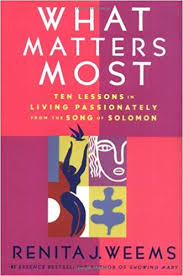
My Spiritual Formation this week is from What Matters Most: Ten Lessons in Living Passionately from the Song of Solomon by Renita Weems. She takes takes the “ten lessons” from the Shulammite woman’s fearless living and loving in the Song. Interestingly, I’ve heard the Song of Solomon called “The Porn Book of the Bible,” which reinforces masculine patriarchal dominance of Scripture. Weems allows the Shulammite woman to claim her identity through characteristics of liberation. Three quotations from this week’s reading on Choice stood out to me. Here they are with my reflections:
The Shulammite risked ridicule, criticism, challenge, failure, and embarrassment for the possibility of living a bigger life than the one society assigned to her as a woman (Kindle, p. 80).

Societal rules are powerful, so powerful that we internalize them and regulate ourselves. Growing up, I wanted to be a CIA agent or a lawyer. It was inconceivable to me, my parents, my friends—everyone who knew me—that I would not go to college on a scholarship straight out of high school. But gender role norms are deeply embedded in how we think and act and move about in the world. By my junior year I was “engaged,” in a relationship just like the other girls. I was married at age 18 and had a baby when I was 19. I look at those numbers and shudder—so young! I gave up my own bigger life.

Being passionate means living your life fearlessly. What if I make a mistake? What if something goes horribly wrong? What if I lose more than I gain? What if I make a fool of myself? (p. 83).

Before age 35, I had never lived outside of Alabama. That year, I got divorced, came out to myself, got a job at the Louisiana Department of Education, enrolled in a doctoral program at LSU, and moved to Louisiana. After escaping with my identity—which I had fought for 16 years to hold onto—I did not once ask myself these questions. Like the Shulammite, I was living fearlessly. However, and this is important, my communing with God was a one-way conversation. Although God was ever-present with me, I continued to press through under the delusion that I was accomplishing these things by myself. I give thanks now in retrospect.

But what if the path you’re about to take leads you off the beaten path and falls outside the norm of what others deem acceptable? (p. 87).

On the day I moved to Louisiana, my mother was seeing me off. It was a poignant moment. Two women whose love for one another most often went unspoken, said goodbye. “Mother,” I said, “I’m sorry. It’s hard. I just…” trailing off, not knowing how to speak the things that were in my heart about my life, about her, about all the years I felt I had lost. She thought for a minute, trying hard to blink back tears so that I would not see them—something I learned years later she had often done. “You go ahead. I know you need to. We always knew you’d leave one day.” The beaten path, my parents knew, was not for me, no matter how hard they had tried—through church, modeling, instructing, shaping—to guide me along it. That day, when the strongest women I have ever known blinked back tears and let me leave, was the day I began to live without a net, yes, but in vivid color.

What Matters Most: Ten Lessons in Living Passionately from the Song of Solomon


(An) Embodied Prayer

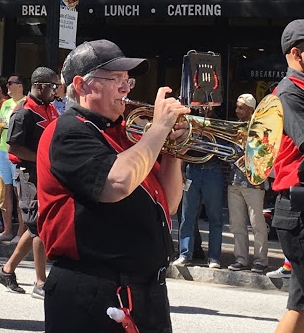
Marching with the AFB
Even though this is one of the happiest moments of my life, I never published this photo because of how I looked. Doing so now is an act of love, kindness, and prayer.

Two words concerning prayer life resonate with me this week: intention and attention. I sometimes fret about my prayer life, especially when I hear my fellow seminarians openly talking about theirs; I even have a professor outside of this class who returns our attention to prayer life. This week’s reading reminds us that naming our longing to be always in relationship with diving (intention) and by paying attention to where we see God in our daily life (attention) remind us of divine presence and grace.

Reflecting this week, I sought connections between my praying self and embodied self. I realized that an important connection is the esteem in which I hold my spiritual and physical being–or the regrettable lack thereof. So I would like now to discuss body issues and return to embodied praying.

I came across two pictures of myself a few months ago. The first was of myself on my wedding day, taken by my new husband. It was a snapshot, and I was looking at him over my shoulder. My first thought was how young and beautiful I was–and at the time I did not realize it. I was never not weight conscious. Realizing the many gaps of pertinent information here, I will say that my husband, who struggled with his sexuality throughout our marriage, had no words to express his inner turmoil; however, he did have words to turn his issues around toward me. One example: I never fixed a plate of food for myself in sixteen years that he did not look at and comment about my weight. As you can imagine, this affected me deeply. I have apologized to the girl in the first photo.

The second photo is of me at about age 37. I am bloated and look unhealthy. No longer married, working on my doctorate, in a new relationship, starting a great adventure in a new state–my body tells a deeper tale. It is one of insecurity, uncertainty, and a different kind of unhappiness. More gaps, I know, but I was struck by this picture in which I looked like a completely different person, one who was dancing–and apparently eating–as fast as she could. I apologized to the beautiful woman in that picture, too.

Reaching middle age–I am 55–has forced me to communicate with my body. I am aware of new aches and pains; it takes me a few seconds of walking before the muscles catch up (I call it having a “hitch in my getalong'”); and I am having to become acquainted with the grayed and wrinkling woman in the mirror. Thing is, I know this body has fewer days left than it has experienced, and that’s ok. When I do see that lady in the mirror, I assure her that she is beautiful and that I appreciate her–that face, that body. I promise her to live in such a way that I will mindfully value her now, in this moment, so that I never look back with regret at failing to do so.

This is what praying with my body feels like–gratefulness to God for my body as a presence in God’s divine creation–no fear of scales or mirrors or photos. Just thankfulness for this familiar likeness.

Coda: I read somewhere that 65% of women report that they have cancelled a doctor appointment because they do not want to step on the scale at check in. I myself have done this. Yes, read that again because it is in fact incredulous. Last week I had my check up. In I walked with the nurse who held my chart and directed me to the scale. “We have to do this,” she said, “but don’t worry, it’ll be over in a minute.” I boldly stepped up on the scale, keeping my shoes and jacket on this time. “It’s ok,” I replied, “I’m good.”

Thoughts on Prayer Following the Christchurch Massacre

As I write this, another heinous mass shooting has taken place by white supremacists, this time in New Zealand. Almost 50 of our Muslim neighbors were murdered and 20 seriously injured, killed while they were praying. This attack is on my mind and heart as I contemplate this week’s Core Forum on prayer. As one public figure tweeted this morning, “Whether it is antisemitism in Pittsburgh, racism in Charlottesville, or the xenophobia and Islamophobia to day, violent hate is on the march at home and abroad….Silence is complicity.” I include this because the connection is made to multiple groups that are targeted for no other reason than hatred of any particular difference. The city where this atrocity occurred is called, ironically or not, Christchurch.

I have a chaplet that has inspired my prayer this week. If any of you are like I was and do not know what a chaplet is, it is a kind of small rosary–a prayer object–that usually has a saint medallion/object attached to the beads. Mine has two medallions. The first is St. Francis, whose prayer I have always loved, and the other, newer one is Julian of Norwich, whose mystical experiences inspire me. Julian’s words also comfort me like a gentle voice and touch soothes a child: All shall be well, and all shall be well, and all manner of thing shall be well. I also made this quote my phone wallpaper–a postmodern engagement with the 15th century mystic. Still, when I see the words, I pray them. I’m thinking Fundamentalist Evangelicals do not a rule pray chaplets or contemplate icons in our prayer life. That’s unfortunate because for me it has deepened my prayers. Henri Nouwen says, “Icons…lead us into the inner room of prayer and bring us close to the heart of God” (p. 61). Whether icons are kinesthetic like mine, or natural, they open us to the Mystery of God’s presence.

The politician’s quote, above, suggests to us that the end to hatred and violence–peace–comes at a great price: our psychological, emotional, and embodied engagement. I am reminded that when the messages of MLK, JFK, and RFK turned from civil rights to peace, their lives were extinguished. The work of peace is a work of justice, and justice is the nature of God. Thoughts and prayers are not acts of peace in the world; prayer is that place of mystery where we might know that all will be well. Prayer is the interior castle (Teresa of Avila) where we are lost with and strengthened by our Beloved. Prayer is not what we do for the oppressed; prayer is what we do for ourselves so that we can have the strength to do the hard work of justice. God waits for us.

Coda: When John Lennon’s “Imagine” was released in 1971, it scared people–Christians who feared the new peaceful, global social order it suggested. In an interview with Playboy magazine, Lennon said that Dick Gregory had given Ono and him a Christian prayer book, which inspired the concept behind “Imagine.” A prayer book. He said,

The concept of positive prayer … If you can imagine a world at peace, with no denominations of religion – not without religion but without this my God-is-bigger-than-your-God thing – then it can be true … the World Church called me once and asked, “Can we use the lyrics to ‘Imagine’ and just change it to ‘Imagine one religion’?” That showed [me] they didn’t understand it at all. It would defeat the whole purpose of the song, the whole idea. (Wikipedia).

They were right to be scared, for it calls for an end of systems of domination, by definition the domain of the dominant culture. I wonder if we are any more willing to pray it today.

Imagine (a Prayer)

The lyrics are below.

Imagine there’s no heaven
It’s easy if you try
No hell below us
Above us only sky
Imagine all the people
Living for today (ah ah ah)
Imagine there’s no countries
It isn’t hard to do
Nothing to kill or die for
And no religion, too
Imagine all the people
Living life in peace
You may say that I’m a dreamer
But I’m not the only one
I hope someday you’ll join us
And the world will be as one
Imagine no possessions
I wonder if you can
No need for greed or hunger
A brotherhood of man
Imagine all the people
Sharing all the world
You may say that I’m a dreamer
But I’m not the only one
I hope someday you’ll join us
And the world will live as one