
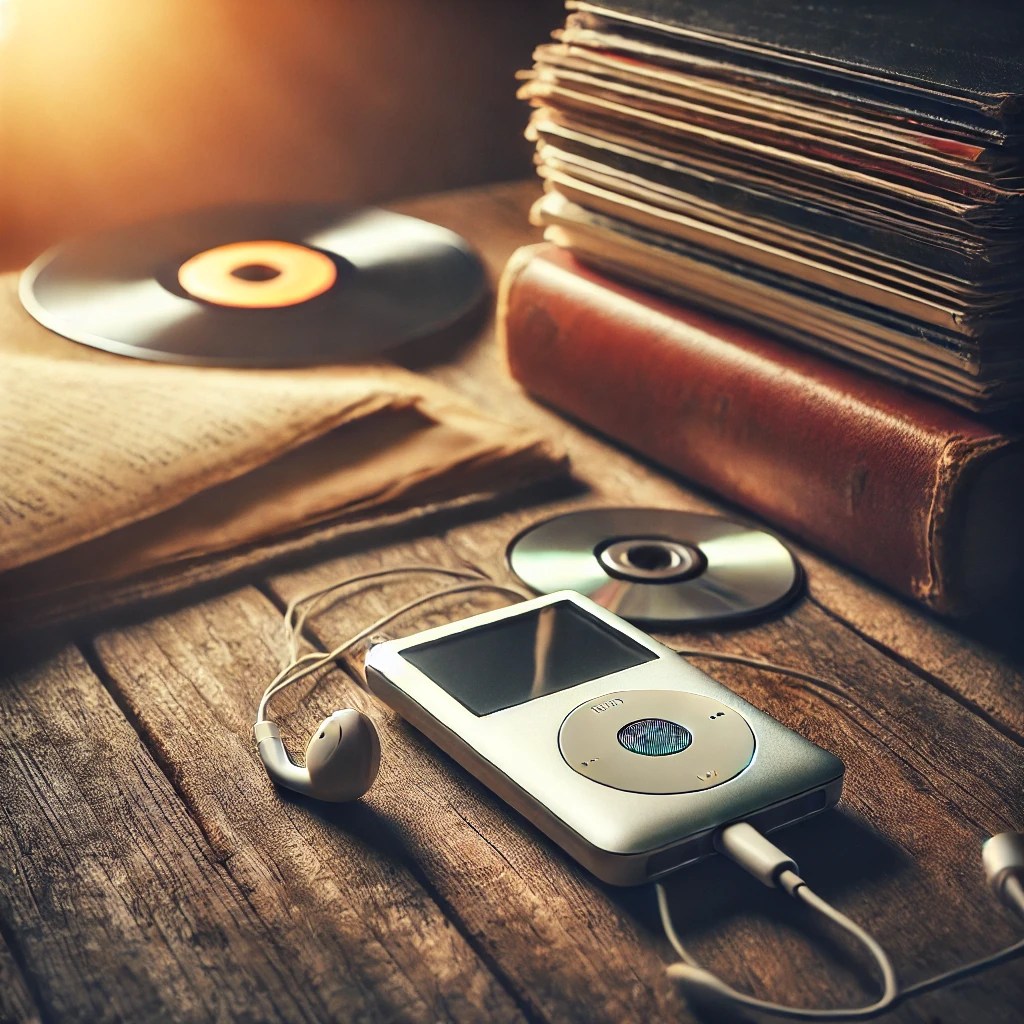
I Found My iPod: Rediscovering Happiness Through Music, Part 1
Last year, I completed an End of Life (Death) Doula program with INELDA, the International End of Life Doula Association. The experience itself deserves its own post, but one lesson from the program keeps coming back to me: the role of music in creating peace during life’s final moments.

As the person in our care begins their end-of-life journey, we were advised not to play their favorite songs as background music. At first, this advice seemed strange to me. After all, wouldn’t a familiar melody bring comfort? It sure does for me! But then it was explained: favorite songs are deeply personal and emotionally charged. They can evoke strong memories, longings, or attachments that might not be conducive to a peaceful transition. Instead, we were taught to choose ambient tones or tranquil soundscapes to foster an atmosphere of calm and rest.
Not being a doula or having experienced end-of-life caregiving firsthand, this suggestion went against my intuition. The more I thought about it, though, the more sense it made. If it were me, I could imagine holding off my own passing just to hear my favorite song finish! The idea stayed with me: music is powerful, not just for its personal connections but for its ability to transcend memory and emotion, helping us navigate transitions when we need it most.
This thought was still on my mind when I stumbled across something I hadn’t seen in years—my old iPod.
From Records to iPods: A Musical Journey
As a Generation Jones Boomer, I’ve collected music in just about every format imaginable. I started with records and CDs, eventually amassing hundreds of them. Many of my favorite records were handed down from my parents when they got rid of their stereo. I didn’t have a record player either by then, but I kept the albums for the memories. Over time, I replaced many of those records with CDs, though I had to replace some of those twice after accidentally leaving my CD holder in a car I sold.
Then came the 2000s and the rise of digital music. When Apple introduced the iPod in 2001, I thought it was the pinnacle of technological advancement. I was as excited about it then as I am about AI now–granted for different reasons. I finally got one in 2005, and that summer, I spent two weeks downloading every CD I owned onto it. I painstakingly created playlists for every mood and occasion, collecting songs I thought I’d never hear again.
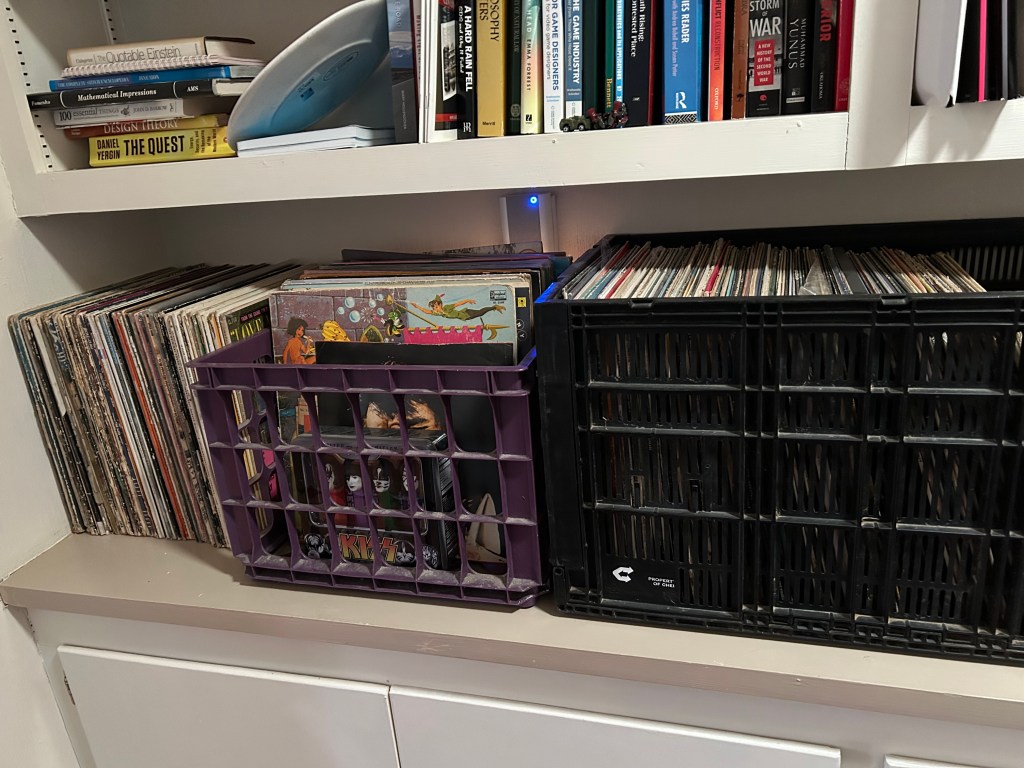
By 2012, I had curated over 3,000 songs. I refused to sync my iPod with updated iTunes software because it wouldn’t preserve my playlists exactly as I had arranged them. They were perfect, and I wasn’t about to mess with perfection.
But as MP3s, smartphones, and streaming services like Spotify and SiriusXM gained popularity, iPods started to feel outdated. I used mine occasionally for chores around the house, but even that became less frequent. By 2022, Apple officially discontinued the iPod, and mine had long since stopped holding a charge. Eventually, it wouldn’t turn on at all. But I couldn’t bring myself to discard it permanently—it still held my songs.
Rediscovering My iPod
Last week, while searching for batteries in a drawer, I came across my old iPod again. Out of habit, I plugged it in, hoping for the best. The Apple logo flickered to life for a moment, and then… nothing. “Ugena,” Sarah said, “we live two minutes from a computer repair shop. Take it over there and see if they can fix it.”
The tech guy at the shop popped the back plate off, took one look, and said, “It’s your battery. See how it’s puffed up like a pillow? It should be flat. That’s an easy fix.” I was overjoyed.
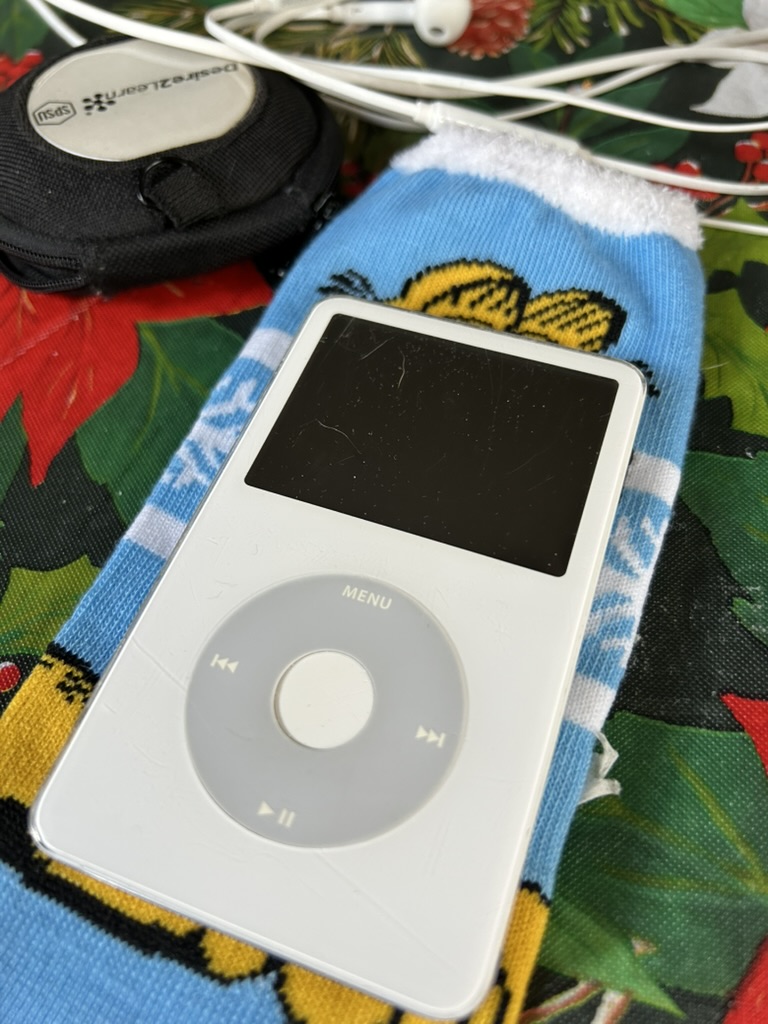
When I picked it up a week later, I could hardly contain my excitement. After nearly a decade, I saw my playlists on the screen again. I navigated the wheel (nothing like the sound of those clicks as it turns!) to find the perfect song for the moment, and when “Love Grows (Where My Rosemary Goes)” by Edison Lighthouse began to play, I felt an overwhelming sense of contentment. I was home.
More Than Memories
For me, music isn’t just about nostalgia. While certain songs remind me of people or moments—like Elvis always bringing my mom to mind—it’s the music itself that moves me. The key changes, the minor chords, the walls of sound (a la Phil Spector) all stir something in me that feels bigger than words.
And yet, sometimes it is the words. A perfectly turned phrase can be so compelling, so beautifully crafted, that it draws me in completely. It stirs a visceral reaction, and I can’t help but sing along. And yes I do grab a hairbrush for a makeshift microphone. At that moment, the three of us–mind, body, and spirit–are in sync with the melody and words. During my free concerts, whether in the shower, the car, or empty house, my old romantic self rises to the surface, caught up in the sheer power of the lyrics.
This emotional connection reminds me of Howard Gardner’s theory of Multiple Intelligences from his 1983 book Frames of Mind. One of these intelligences, musical intelligence, refers to the ability to recognize, create, and emotionally connect with music. Though the theory is considered pseudoscience by some, it resonates with me. It helps me explain feelings that go far beyond simply liking music. What I feel is deeper, more profound—something that connects to the core of who I am.
Rediscovering my iPod wasn’t just about finding old favorites. It was about reconnecting with a part of myself—a good and strong piece of myself that, during my distractions with job advancement and the trappings of success, had been suppressed. During those times, I was lost, adrift, unaware of how much I had let go of what truly anchored me. But when the music is back in my life, it’s as if I’ve found my way home—a reminder of who I am and what brings me joy. In the words of the old song, “Was blind, but now I see.”
The last 5 random songs played on my iPod while I’m writing this:
- Bad Romance, Lady Gaga
- My Heart Skips a Beat, Buck Owens
- Silver Wings, Merle Haggard
- On the Street Where You Live, Bill Shirley dubbed for My Fair Lady
- Livin’ in the Sunlight, Lovin’ in the Moonlight, Tiny Tim (from Spongebob Movie)https://youtu.be/hERIZmJpwTI?si=JSKnB7XR5_rwbiHq









 This is a place for peaceful contemplation inspired by story.
What is spiritual mindfulness? For me, it is remembering to feed my spirit. This blog is a spiritual practice~~storying the soul, if you will.
Most sites I find on either one of these topics focuses on meditative and wellness practices. Maybe that’s what you are expecting here. I hope you’ll be pleasantly surprised as instead you find a narrative approach to exploring spirituality, mindful of the everyday. That’s what I do–I write. For almost two decades I dedicated my time and energies (a lot of mental energy, i.e. worry) to academic writing. Here’s how I did it: I would write my narrative essays about place, religion, gender, sexuality, white privilege, etc., and then cite the requisite sources (that’s the academic part). But a funny thing kept happening. People would approach me after a panel presentation and say, “You know, you really ought to write a book with just your stories.” Which is exactly what I wanted to be doing. The problem is, I am an academic; thus, the academic writing.
This is a period of discernment and transformation in my life. Of course, that’s part of what you’ll find here too. I started to seminary and had to make some life choices. One was to step back from academic writing and do the kind of writing I really do enjoy–and that’s what you are reading now. I invite you to come along on my journey as I nourish my own spirit through story telling, being mindful of every, every minute, as Emily in Our Town would say. It is my hope that my stories offer you nourishment of some kind too.
The writing here comes from observations that dawn on me as I go about living life with as much intentionality as I can muster. That’s the mindfulness part. What makes it spiritual? Well, that’s the part of me where the words come from—the part that hopes to connect us to, as Paul Tillich would put it, the ground of our being. One.
This is a place for peaceful contemplation inspired by story.
What is spiritual mindfulness? For me, it is remembering to feed my spirit. This blog is a spiritual practice~~storying the soul, if you will.
Most sites I find on either one of these topics focuses on meditative and wellness practices. Maybe that’s what you are expecting here. I hope you’ll be pleasantly surprised as instead you find a narrative approach to exploring spirituality, mindful of the everyday. That’s what I do–I write. For almost two decades I dedicated my time and energies (a lot of mental energy, i.e. worry) to academic writing. Here’s how I did it: I would write my narrative essays about place, religion, gender, sexuality, white privilege, etc., and then cite the requisite sources (that’s the academic part). But a funny thing kept happening. People would approach me after a panel presentation and say, “You know, you really ought to write a book with just your stories.” Which is exactly what I wanted to be doing. The problem is, I am an academic; thus, the academic writing.
This is a period of discernment and transformation in my life. Of course, that’s part of what you’ll find here too. I started to seminary and had to make some life choices. One was to step back from academic writing and do the kind of writing I really do enjoy–and that’s what you are reading now. I invite you to come along on my journey as I nourish my own spirit through story telling, being mindful of every, every minute, as Emily in Our Town would say. It is my hope that my stories offer you nourishment of some kind too.
The writing here comes from observations that dawn on me as I go about living life with as much intentionality as I can muster. That’s the mindfulness part. What makes it spiritual? Well, that’s the part of me where the words come from—the part that hopes to connect us to, as Paul Tillich would put it, the ground of our being. One.







 The Front Porch Professor