(An) Embodied Prayer

Marching with the AFB
Even though this is one of the happiest moments of my life, I never published this photo because of how I looked. Doing so now is an act of love, kindness, and prayer.

Two words concerning prayer life resonate with me this week: intention and attention. I sometimes fret about my prayer life, especially when I hear my fellow seminarians openly talking about theirs; I even have a professor outside of this class who returns our attention to prayer life. This week’s reading reminds us that naming our longing to be always in relationship with diving (intention) and by paying attention to where we see God in our daily life (attention) remind us of divine presence and grace.

Reflecting this week, I sought connections between my praying self and embodied self. I realized that an important connection is the esteem in which I hold my spiritual and physical being–or the regrettable lack thereof. So I would like now to discuss body issues and return to embodied praying.

I came across two pictures of myself a few months ago. The first was of myself on my wedding day, taken by my new husband. It was a snapshot, and I was looking at him over my shoulder. My first thought was how young and beautiful I was–and at the time I did not realize it. I was never not weight conscious. Realizing the many gaps of pertinent information here, I will say that my husband, who struggled with his sexuality throughout our marriage, had no words to express his inner turmoil; however, he did have words to turn his issues around toward me. One example: I never fixed a plate of food for myself in sixteen years that he did not look at and comment about my weight. As you can imagine, this affected me deeply. I have apologized to the girl in the first photo.

The second photo is of me at about age 37. I am bloated and look unhealthy. No longer married, working on my doctorate, in a new relationship, starting a great adventure in a new state–my body tells a deeper tale. It is one of insecurity, uncertainty, and a different kind of unhappiness. More gaps, I know, but I was struck by this picture in which I looked like a completely different person, one who was dancing–and apparently eating–as fast as she could. I apologized to the beautiful woman in that picture, too.

Reaching middle age–I am 55–has forced me to communicate with my body. I am aware of new aches and pains; it takes me a few seconds of walking before the muscles catch up (I call it having a “hitch in my getalong'”); and I am having to become acquainted with the grayed and wrinkling woman in the mirror. Thing is, I know this body has fewer days left than it has experienced, and that’s ok. When I do see that lady in the mirror, I assure her that she is beautiful and that I appreciate her–that face, that body. I promise her to live in such a way that I will mindfully value her now, in this moment, so that I never look back with regret at failing to do so.

This is what praying with my body feels like–gratefulness to God for my body as a presence in God’s divine creation–no fear of scales or mirrors or photos. Just thankfulness for this familiar likeness.

Coda: I read somewhere that 65% of women report that they have cancelled a doctor appointment because they do not want to step on the scale at check in. I myself have done this. Yes, read that again because it is in fact incredulous. Last week I had my check up. In I walked with the nurse who held my chart and directed me to the scale. “We have to do this,” she said, “but don’t worry, it’ll be over in a minute.” I boldly stepped up on the scale, keeping my shoes and jacket on this time. “It’s ok,” I replied, “I’m good.”

Transgender Day of Remembrance (TDOR)

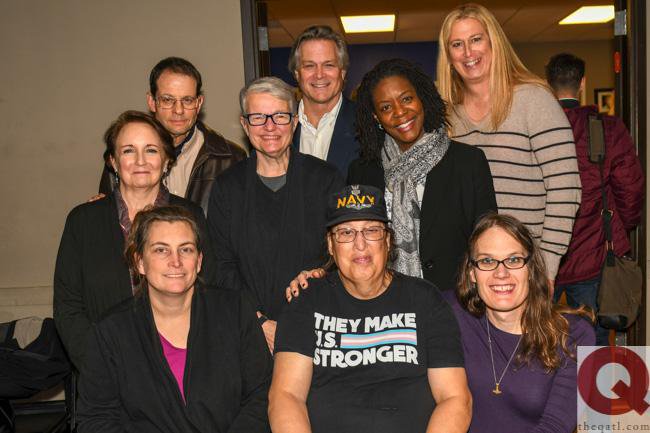
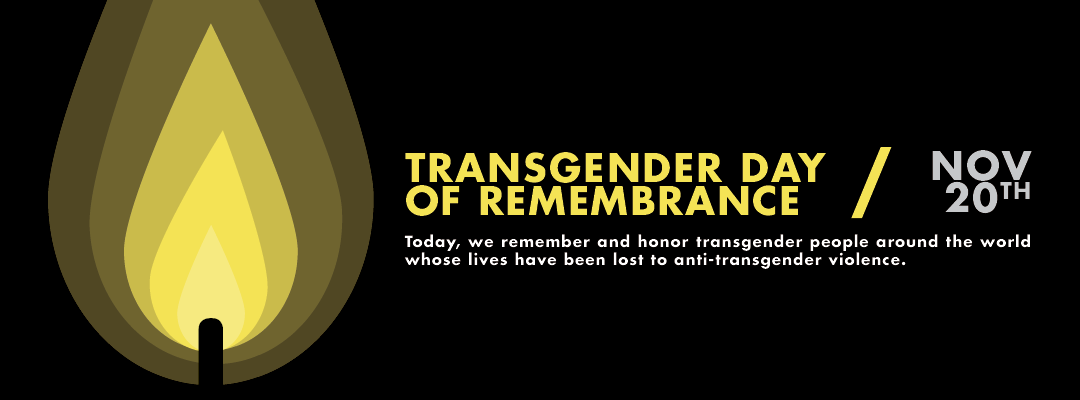
This week a group of us from Pilgrimage United Church of Christ (PUCC) went to the 20th Transgender Day of Remembrance ceremony in Atlanta. Transgender Day of Remembrance (TDOR) is an observance every year on November 20 that honors the memory of those whose lives were lost in acts of anti-transgender violence. We went to pay respect and to support two of our members, Monica and Darlene. Darlene organized the ceremony and is a strong presence in Atlanta’s transgender community. Her wife Monica is a Navy Vet who served on a submarine. Monica is extremely proud to be a veteran. She wore her USN cap when she was recognized at Atlanta Braves games–and when she was an Atlanta Pride Parade Grand Marshall this year. Monica designed the Transgender flag, below. The original is in the Smithsonian in D.C.

Transgender Flag
Transgender Flag, Designed by Monica Helms, USN, Ret.

The first thing you should know is trans people are murdered, and when they are, they are victims of trans-related hate crimes.

These are persons who often leave homes so that they can live their true identities, their true selves, often at great cost to themselves. And when they die, as I learned at the Atlanta observance, that identity is stripped away from them. How? Families, obituaries, police reports, newspapers refer to them by their “dead names,” their name before transition. What difference does that make? Well, after having fought so hard for true self, dead naming erases that self in a final, crushing blow. Still not clear? Ok, when cis-people (those of us whose gender identity matches the one we were assigned at birth–e.g., I am a woman, who was assigned female at birth) drop dead in a parking lot, our drivers license matches our reality–both our name and our gender would be the same. The paper reports that “Ugena, female, 55, Marietta” was found, etc., etc. If I have been living my true self as Eugene for the last decade or so, guess what? The paper would probably still report Ugena’s death. My funeral service–if my family were not too ashamed to have one–would be a farewell to Ugena. Would anyone remember Eugene? Would anyone notice or mourn me? That is what TDOR is for–to remember and remind us why it is important to remember.

The Transgender Day of Remembrance seeks to highlight the losses we face due to anti-transgender bigotry and violence. I am no stranger to the need to fight for our rights, and the right to simply exist is first and foremost. With so many seeking to erase transgender people — sometimes in the most brutal ways possible — it is vitally important that those we lose are remembered, and that we continue to fight for justice.”
– Transgender Day of Remembrance founder Gwendolyn Ann Smith

The TDOR service is, as are most funerals really, for the living. For members of the transgender community, it provides critical space for both joy and lament, laughter and tears–that for all the struggle and turmoil and oppression, they live. Not just live, but prevail. As an outsider–an ally but still an outsider–I observed these persons comfort and lift one another up. Those of us there as friends, family, and allies needed to see the strength and vibrance of a community that asks only a life of liberty, justice, and dignity. We needed to laugh and break bread together–which we did Atlanta style with Fox Brothers Barbecue. When you think about it, there are a few times in life that an opportunity for justice, hospitality, and compassion–an “integrity moment”–taps you on the shoulder. This is one of them.

Every Transgender Day of Remembrance observance concludes with a Reading of Names to honor each victim (that’s the word used at the GLAAD TDOR link). This was done, followed by a tolling of the bell, for each of the twenty-five U.S. dead and for the unnamed trans people who died violently while incarcerated. Here are their names, and if you scroll to the end of this post, there is a screenshot of the TDOR program with their photos.

  • Brooklyn BreYanna Stevenson
  • Rhiannon Layendecker
  • Christa Leigh Steel-Knudslien
  • Viccky Gutierrez
  • Celine Walker
  • Tonya Harvey
  • Zakaria Fry
  • Phylicia Mitchell
  • Amia Tyrae Berryman
  • Sasha Wall
  • Carla Patricia Flores-Pavon
  • Nicole Hall
  • Nino Fortson
  • Gigi Pierce
  • Antash’a English
  • Diamond Stephens
  • Keisha Wells
  • Cathalina Christina James
  • Sasha Garden
  • Vontashia Bell
  • Dejanay Stanton
  • Shantee Tucker
  • Londonn Moore
  • Nikki Enriquez
  • Ciara Minaj Carter Frazier
  • Those Unnamed

Another of the photos below shows the number of deaths by state. Georgia has one: Nino Fortson was killed in Atlanta on May 13. Here is a description of Nino from the HRC web site:

Fortson, 36, also went by names Nino Starr and Nino Blahnik, and was a gender-expansive individual…An active participant in Atlanta’s ballroom scene, Fortson was a member of the House of Blahnik, a national organization serving LGBTQ performers of color. Fortson was known for walking in the “Butch Realness” category.

A “gender expansive individual”–I wonder why it is that more of us don’t understand this as a gift, or a superpower? The last photo shows the number of known violent deaths of transgender persons, worldwide. There are 309. The U.S. ranks third. I would really like to live in a world where we don’t need to have another TDOR, but sadly, we seem to be moving in the other direction. Step back and think about why there is such a violent need to legislate gender. I can’t think of a reason. Yet, see articles like this one and look up #WontBeErased:

Trump’s Anti Transgender Push: 6 Things to Know

I’m finding whenever it gets really discouraging to contemplate how humanity treats one another, it is helpful to turn to Mister Rogers and Dr. Seuss. Ever since Tuesday evening, I’ve been thinking of an elephant named Horton, who heard a small noise.

“Mr. Mayor! Mr. Mayor!” Horton called. “Mr. Mayor! You’ve got to prove now that you really are there! So call a big meeting. Get everyone out. Make every Who holler! Make every Who shout! Make every Who scream! If you don’t, every Who is going to end up in a beezle-nut stew!”

And, down on the dust speck, the scared little mayor quickly called a big meeting in Who-ville Town Square. And his people cried loudly. They cried out in fear:

“We are here! We are here! We are here! We are here!”

“Because a person’s a person, no matter how small.” We will remember.

Here is the feature article in Project Q:

LGBTQ Atlanta honors victims of anti-trans violence at annual vigil

dsc_5014__large6477986554222300399.jpg
Members of Pilgrimage United Church of Christ attend Atlanta’s Transgender Day of Remembrance observance at the Philip Rush Center, November 20, 2018 (Photo by Russ Youngblood)