Formed by Certainty, Learning to Wait: An Advent I Didn’t Grow Up With

The Church Without a Christmas Tree

I grew up in the Church of Christ, a tradition shaped as much by its doctrine as by its careful adherence to what we understood as the inspired Word of Truth—New Testament scripture. Christmas—Christ Mass, after all—carried with it echoes of liturgy, ritual, and ecclesial authority that did more than make us uneasy; they were not supported by scripture. It felt too “Catholic.” Nativity scenes, Christmas trees in the sanctuary, pageants, and concerts all felt suspect, as if they edged too close to something we had worked hard to distinguish ourselves from.

Our doctrine emphasized Jesus’s death, resurrection, and promised second coming—the salvation story in its fullest and, to us, most biblically faithful form. That was where the weight belonged. Christmas, when it appeared at all in worship service, seemed secondary. There might be a sermon in December, but it was usually framed as a reminder not to let sentiment distract us from the real celebration: the cross, the empty tomb, and the anticipation of Christ’s return.

Beginning sometime in the 1980s, our monthly church fellowship included a “greedy Santa” party in the fellowship hall—an accommodation that felt almost humorous in its contradiction. At home, though, the birth of Christ was acknowledged and celebrated in quieter, more personal ways. Christmas existed, but it lived more in our houses than in our sanctuaries.

Wonder, Anyway

Even so, Christmas always carried a sense of wonder.

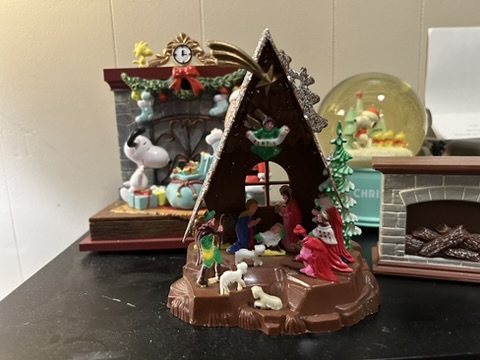
In my family, it was joyful and wonder-full. We celebrated the birth of Christ. We sang the songs, set out nativity scenes, and watched cartoons that made room for the baby Jesus alongside Rudolph and Frosty. I developed a passion for Little Debbie Christmas Tree Cakes that continues to this day. But Christmas was never treated as a central moment of worship. It was present and honored, but it did not occupy the same place in our worship as the cross and the resurrection.

Instead, Christmas lived easily among us. It shared space with Santa Claus and stockings, with family meals and laughter, with the ordinary magic of being together. Faith was there, woven into the fabric of the season rather than standing apart from it or asking to be the center of attention.

We sang Away in a Manger and Have Yourself a Merry Little Christmas with equal sincerity.
Some of my strongest Christmas memories are of going to town with my mother—just the two of us—walking down Main Street in Russellville, Alabama. We stopped at Elmore’s and White’s, always went to the bank, and did a bit of Christmas shopping. We also made our rounds to TG&Y and Bargain Town U.S.A. Going to town with Mother is one of the memories that has never faded. She loves Christmas. I suspect that is where I get it.
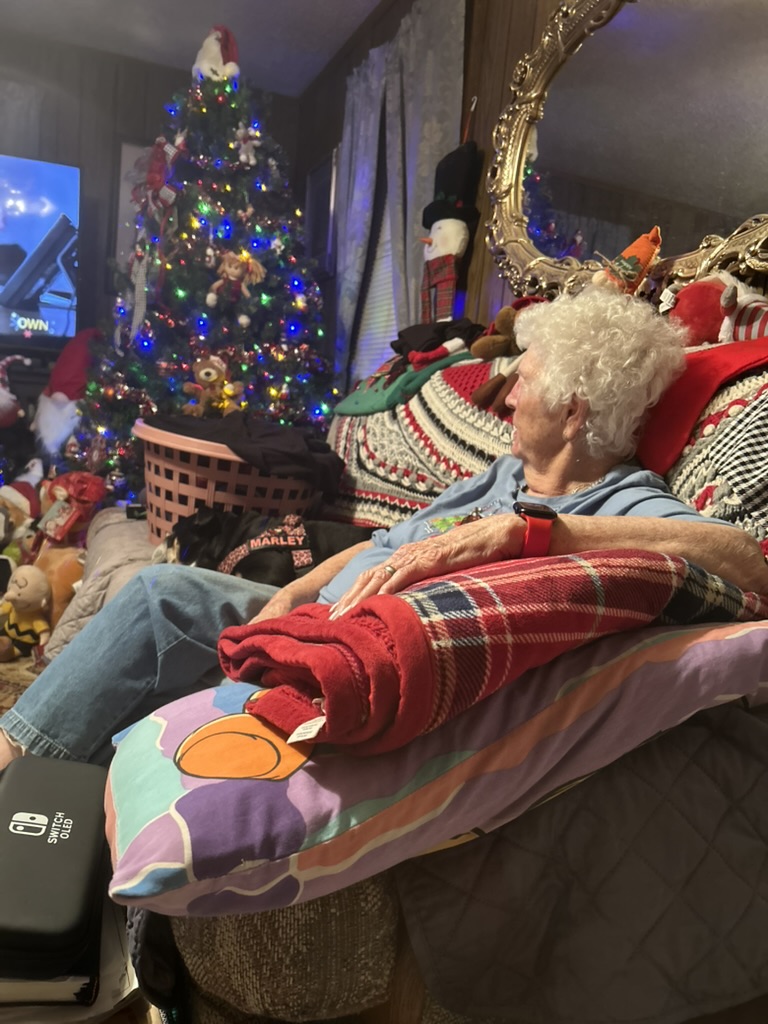
Perhaps the magic was not Christmas itself, but Mother making it all come together. Daddy—God bless him—was assembling bicycles late into the night, helping Santa Claus eat the cookies and drink the milk when no one was awake, and getting up early to turn on the heater before us kids stirred.
So Christmas has always carried for me the emotions and images of Advent: love, peace, and joy. Yet as I’ve grown older—and as I’ve celebrated Advent more intentionally in churches I joined later—I’ve come to realize something important was missing from my early experience, at least as I have come to understand it now.

Hope.

That missing note, I’ve learned, is at the very heart of Advent: not the anticipation of Christ’s return, but the radical, trembling hope of waiting for Him to come the first time.

Before I go any further, I want to be careful about how this contrast is read. I don’t mean to disparage the Church of Christ or its seriousness about salvation and the life to come. The emphasis on the afterlife was never meant to diminish this one; it was meant to anchor it. There is something steady, even bracing, about a faith formed around the cross and the resurrection, around the somber knowledge of what comes on Friday during Holy Week and the refusal to look away. That certainty shapes the tone. It is sober, resolved, and grounded in knowing how the story ends.

Advent, I am learning, asks for something different. It invites a looking forward that is almost visceral, a waiting marked by anticipation rather than knowledge. During Advent, we do not yet know what is coming, even though we think we do. Christmas and Easter are both joyous occasions, yes, but they are not the same kind of joy. Easter joy comes after suffering we already understand. Advent joy comes before anything has happened at all. It is hope without proof, expectation without resolution.

Perhaps that is why Advent feels so unfamiliar to me. I was formed in a tradition that lingered near the end of the story. Advent asks me to return to the beginning, to wait not with certainty, but with hope.

That difference between certainty and waiting is something I didn’t fully understand until I found myself, almost by accident, living Advent rather than merely knowing about it.

Learning Advent by Living It

Just recently, we joined a church that could not be more different from the one I grew up in.

Trinity United Methodist Church sits at the end of our driveway—practically in our neighborhood—and has been there for over a hundred years. We watched carefully last year as the United Methodist Church faced its painful and very public division. We waited to see whether Trinity would stay or go. They stayed. So we went.

Well—I went first.

Returning to church was part of my larger journey back to music. I wanted to sing again. I wanted a choir. So I showed up, and they welcomed me. Then Sarah came. I can say, without exaggeration, that I have never felt so genuinely welcomed in any congregation.

Of course, in a liturgical church, if you arrive in the fall, you don’t ease into Christmas—you begin preparing for Advent.

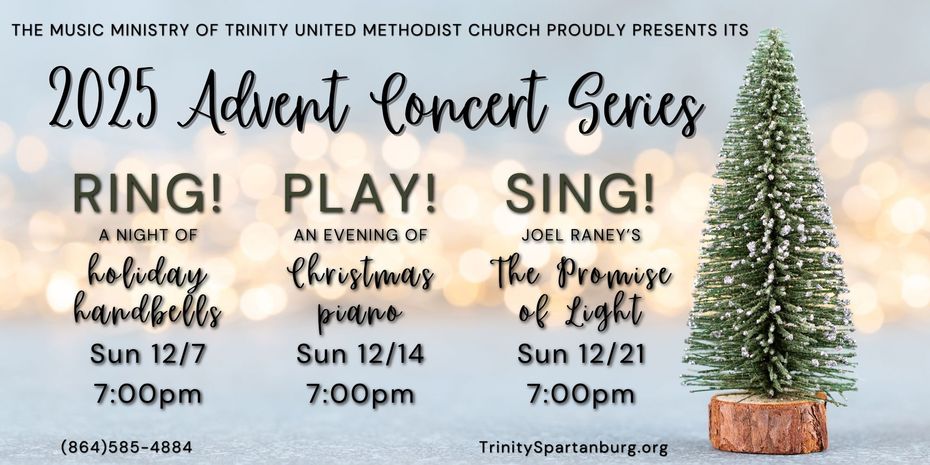
Trinity has all of it: the church calendar, the seasons, the art, the rhythm of the year itself. And it has a gifted music director, Ben Chumley. Music is not ornamental there; it is formative. Part of Trinity’s long tradition includes a concert series—bell ringers, piano recitals—and on the Sunday before Christmas, a full choir cantata, offered as a concert for the community.

I had never sung in an hour-long Christmas cantata before. It is exhausting—poignant and fulfilling, but exhausting.

At the same time, the sermon series centered on the coming of the Christ Child, and Sunday school was immersed in a deep study of Advent, framed by John Wesley’s theology. I knew what Advent was, of course, at least in name. I associated it with calendars and chocolate, with Advent functioning more as a reference point for Christmas than as a practice, something observed from the outside rather than lived. What I had not understood was Advent as a way of inhabiting time itself, a season that asks something of you slowly, deliberately, and in community.

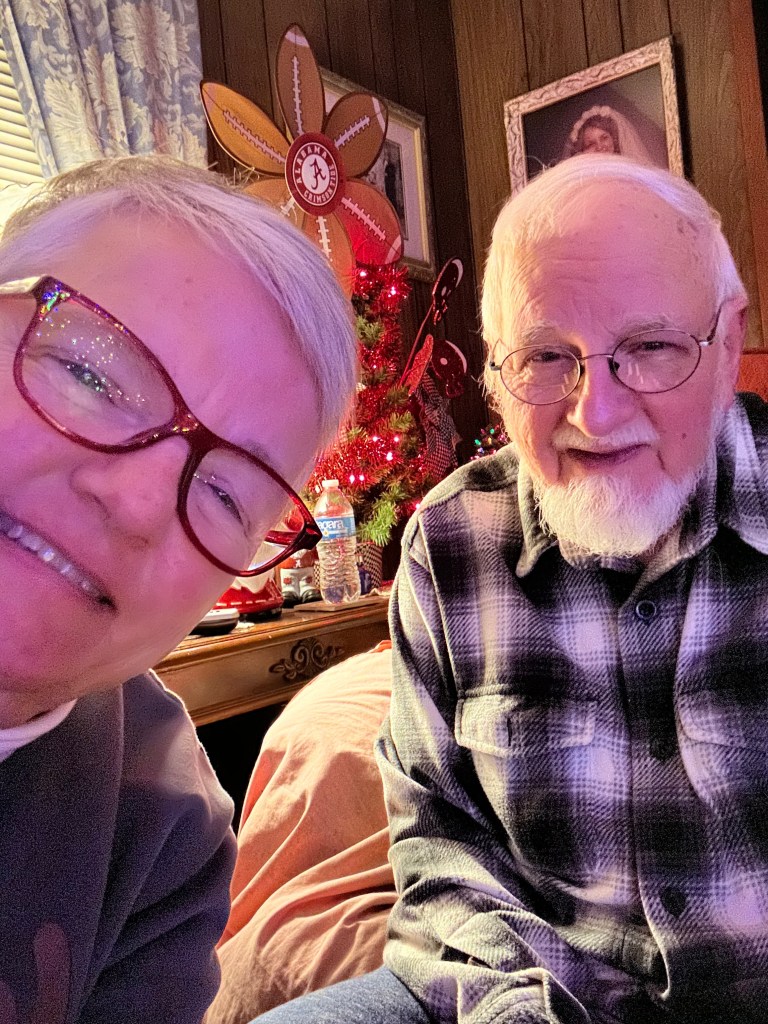
Then one Sunday after service, Ben approached us and said, “I’m planning the lighting of the Advent candles this year, and I want to represent all kinds of families. I wondered if you and Sarah would like to light the first candle.”

So there we were—new members, still learning our way around the sanctuary—and suddenly we were the first family of Advent.

Our candle was peace.

You had better believe Trinity has a children’s Christmas pageant. There were painted backdrops of Bethlehem, shepherds with headgear slightly askew, stars projected onto the ceiling. Children of all ages belted out The First Noel at the top of their lungs. Candles glowed in the windows. The chancel was full.
From the choir loft, I expected—modern church attendance being what it is—that maybe two-thirds of the usual congregation would show up.

Instead, the church was full. This wasn’t novelty. This was a neighborhood showing up for something it clearly understood as theirs.

What struck me most, though, was how hope was being practiced, not merely preached. Alongside the music and liturgy, the church’s auditorium filled with donations for local children—gifts, necessities, abundance. Hope, in this space, was not about someday escaping the world. It was about showing up for it.

That was new for me.

Hope, in my religious formation, was almost always about heaven—and, implicitly, about avoiding hell. I didn’t have language yet for hope as active, communal, and embodied. Wesleyan theology was quietly teaching me something different: hope as something you do.

I should add that this wasn’t ignorance on my part. I had studied the church calendar before and even took a full course on it in seminary at McAfee. Sarah, who grew up in England, seems to have absorbed it almost by osmosis sometime in childhood. But knowing about liturgy and living inside it are not the same thing. What was happening at Trinity was not instruction; it was formation.

I haven’t left fundamentalism. I don’t think that’s possible, any more than it could ever leave me. It formed me. What I am learning now is not replacement, but expansion. This way of waiting, this attention to beginnings rather than endings, is becoming part of my formation too.

On the night of our final choir rehearsal before the cantata, I walked home through the neighborhood in silence. The street was lit only by Christmas lights and the moon, their glow softened by fog hanging in the air. We don’t get much snow here, but the light did the same work. Everything was hushed. All was calm. All was quiet.

I felt joy. Not only for the coming of the Christ Child, but for the possibility that the world could feel like this more often. That peace might be practiced, not just promised. And that, somehow, I could be part of it.


The Promise of Forgiveness & Reconciliation, part 3

I call this last post The Promise Forgiveness & Reconciliation because I want to end on a hopeful note.

The Mystery of Forgiveness & Reconciliation, part 1

The Limits of Forgiveness & Reconciliation, part 2

I believe it is justifiably hopeful given the theory, theology, and practical parts of the topics. If I were going to teach a Sunday School class, or even present a lesson in a college education class, I would begin by scouring literature and web sites. I would, in the style of Worthington and Lederach, turn to case studies and current events. Much like these blog posts, the organization of a brief curriculum would be somewhat as follows:

  1. Introduction, Definition of Terms, Participant Questions
  2. Deeper Understandings: Contexts, Benefits, Limits
  3. The Scope of Forgiving and Reconciling: Interpersonal, Local, Global
  4. Putting It All Together, Where Do We Go From Here, Revisit Initial Questions

Peace Dove 1

I have included below Revisiting the 10 Practices of Just Peacemaking Theory by David P. Gushee (2019) from EthicsDaily.com. Developed by the late ethicist Glen Stassen. Although the practices reference peacemaking (which I use interchangeably with reconciliation, knowing there are differences) at the global setting, I believe they can be modified to allow us to act upon them locally.

  1. Support nonviolent direct action.
    Nonviolent direct action occurs when citizens confront injustice through peaceful public protests and other resistance strategies, including boycotts and strategic noncooperation. Practiced effectively by Mohandas Gandhi and Martin Luther King Jr.
  2. Take independent initiatives to reduce threat. 
  3. Use cooperative conflict resolution. These skills train adversaries to see each other as human beings with dignity and legitimate needs rather than as sub-humans whose every negotiating demand is illegitimate just because of how evil they are.
  4. Acknowledge responsibility for conflict and injustice; seek repentance and forgiveness.
  5. Promote democracy, human rights and religious liberty.
  6. Foster just and sustainable economic development. Hungry people easily become desperate and violent, and, when they rebel, their need is at least temporarily exacerbated.
  7. Work with emerging cooperative forces in the international system.It stands to reason that the more nations are involved in these webs of interaction, the less likely they are to make war.
  8. Strengthen the United Nations and international organizations.
  9. Reduce offensive weapons and weapons trade.
  10. Encourage grassroots peacemaking groups and voluntary associations. Everybody needs somebody looking over their shoulders to keep them in check. See the full article here

Peace, justice, dignity, equity, voice, and the resolution of conflict are the basis of reconciliation. What about forgiveness? Psychology Today states, “Forgiveness is the release of resentment or anger.” It does not mean reconciliation–no person or entity has to return to a harmful relationship. “Forgiveness is vitally important for the mental health of those who have been victimized. It propels people forward rather than keeping them emotionally engaged in an injustice or trauma.” It has physical, emotional, and psychological benefits, and has been shown to “elevate mood, enhance optimism, and guard against anger, stress, anxiety, and depression.” Forgiveness and Reconciliation are like a suit: you can wear the jacket and pants separately, but they also go together. Maintaining the distinction acknowledges the offended party (I am avoiding the word victim here). If this complicated process is worked prayerfully and diligently, there are situations where both are possible outcomes. Link to Psychology Today: Forgiveness

peace dove 2

The following is the beginnings of a collection of resources that I will add to over time.

  1. Duke Divinity School: Center for Reconciliation Resources https://divinity.duke.edu/initiatives/cfr/resources
  2. Peace Center for Forgiveness & Reconciliation http://www.choosetoforgive.org/
  3. The Forgiveness Project https://www.theforgivenessproject.com/
  4. Racial Equity Resource Guide http://www.racialequityresourceguide.org/organizations/organizations/sectionFilter/Racial%20Healing
  5. Racial Equity Institute https://www.racialequityinstitute.com/partner-organizations
  6. Reconciliation Ministry (Disciples of Christ) https://reconciliationministry.org/
  7. Conciliation Resources http://www.c-r.org/
  8. Truth and Reconciliation, Commission of Canada http://www.trc.ca/resources.html
  9. Community Tool Box https://ctb.ku.edu/en/table-of-contents/spirituality-and-community-building/forgiveness-and-reconciliation/main
  10. Center for Justice & Reconciliation http://restorativejustice.org/#sthash.i2cZEw7o.dpb
  11. Lederach, J.P. (2014) Reconcile: Conflict Transformation for Ordinary Christians. Virginia: Herald Press.
  12. Jones, G. (1995). Embodying Forgiveness: A Theological Analysis. Grand Rapids: Eerdmans.
  13. Worthington, E.L. (2001). Forgiving and Reconciling: Bridges to Wholeness and Hope. Illinois: InterVarsity Press.
  14. Walker-Barnes, C. (2019). I Bring the Voices of My People: A Womanist Vision for Racial Reconciliation. Grand Rapids: Eerdmans.


asymmetrical-ethics

The Limits of Forgiveness & Reconciliation, part 2

I have heard horror stories of people in abusive relationships who have sought spiritual advise from their church leaders, only to be told that they should forgive their partners–forgive the verbal, psychological, physical abuse and/or infidelity, for example. They are told to forgive as God forgives (remember the theological model I mentioned in my last post?) The Mystery of Forgiveness & Reconciliation, part 1   People who have escaped relationships of abuse are even sometimes counseled to reconcile. Many years ago, I was divorced, and for years I had recurring nightmares that I was being forced to reconcile with my husband.

Forgiving and reconciling have limits that are dependent upon circumstances and injustice. I learned from my own experience that I forgive so that I can move forward, but nobody–not in dreams or consciousness–can make me reconcile.

Every kind of relationship includes relations of power, privilege, and politics–and these must be acknowledged. In The Politics of Apology and Forgiveness,  Joretta Marshall identifies five connections between power and forgiveness that I think are important. 1. The misuse of power invites power into a relationship. 2. The person who has the power to cause harm does not have equal power to require forgiveness—only to apologize and ask for forgiveness. 3. The giving or receiving of forgiveness, like an apology, cannot be coerced. 4. There is a dance between power and vulnerability in the forgiveness process. 5. Forgiveness emerges through the shifting of power in relationship. Forgiveness has its own subversive power in its potential for transformation.

In The Limits of Forgiveness, Norlock and Rumsey unpack the costs and limits of forgiveness, which are to be found in situations where “radical evil” exists. They argue that social and political recognition, including punishment of offenders and provisions for the economic and physical safety of victims, are requisite conditions” (p. 119). The authors demand that we critically analyze what we ask of those we expect to forgive offenders. What is that about? Forgiveness is fraught with complexity, and the existence of radical evil does not allow us the luxury of taking the process for granted.

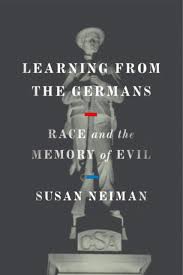
I also discovered the book, Learning from the Germans: Race and the Memory of Evil, by Susan Neiman. This text, which is the kind of reading I do for fun (me = nerd), examines the intentional efforts at “working through the past” by the German people—individually and collectively—in the wake of the Nazi Reich. She argues that the United States—White Southerners, in particular—can learn and take cues from the Germans, although the evil of slavery and Jim Crow is a different kind of evil than Nazism. She explicitly states that this is not a suggestion of comparative suffering or oppression, but one of comparative reconciliation. Thomas Jefferson, the embodiment of questions Americans must ask of ourselves, said, “I tremble for my country when I reflect that God is just and that his mercy cannot last forever.” When I think about forgiveness and reconciliation, radical evil and sin, power and privilege—and how these fit in the Kingdom of God, I tremble too. Germans book

So whether we are talking about relationships at the personal or global level–or anything in between–power relations are maintained and reproduced that are paramount to the nature of the relationship. They also affect the approach, expectations, and limitations in the process of forgiveness and reconciliation. Social categories such as race, ethnicity, class, gender, sexuality, religion, ability, and cultural background also have great bearing on the process, particularly since these categories are socially constructed, fluid, and flexible.


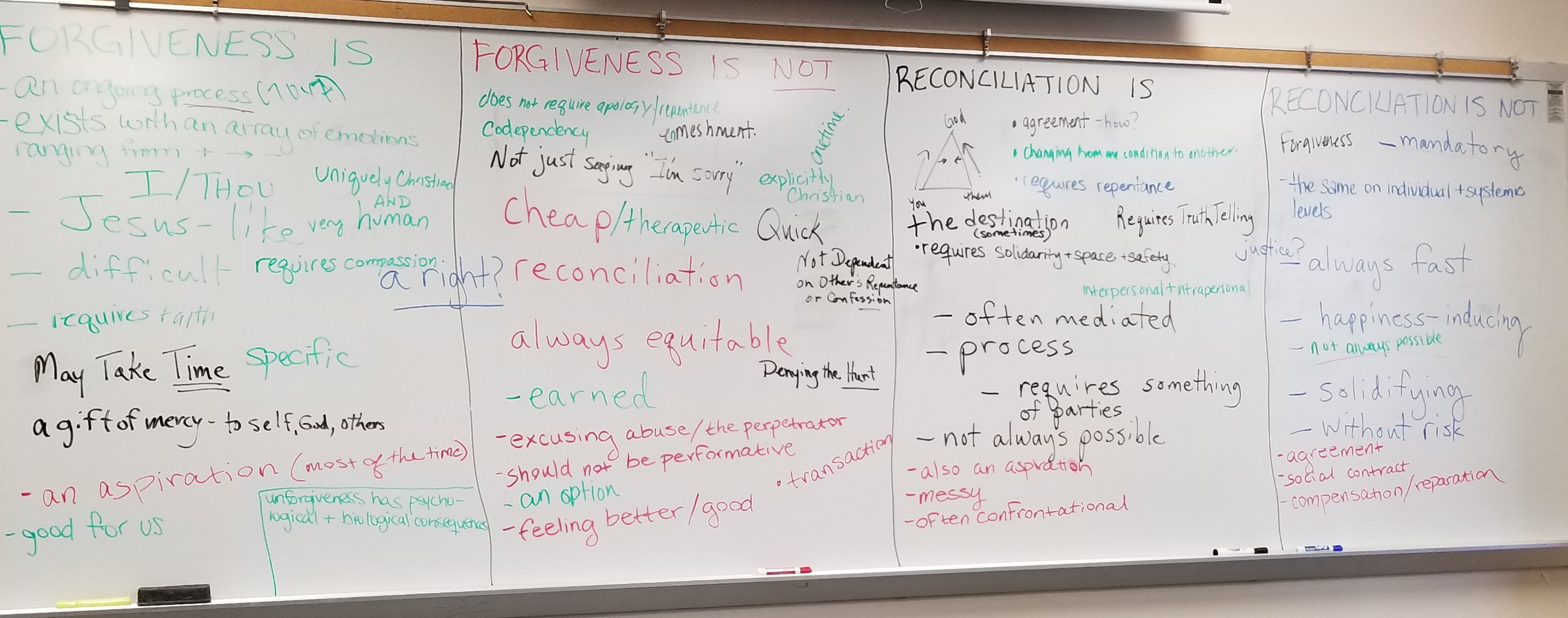
On our last day together, our F&R class organized our thinking around F&R on the board (see below). These are our findings:

Forgiveness is…

  • an ongoing process, as illustrated by Jesus’s metaphor of 70 X 7
  • an array of both positive and negative emotions
  • effective in an “I/Thou” relationship, such as that believers have with God
  • Jesus like
  • difficult and takes time
  • requires faith
  • a gift of mercy–to self, God, others
  • an aspiration (most of the time)
  • good for us
  • Note: “unforgiveness” has psychological and biological consequences

Forgiveness is not

  • the same as reconciliation
  • requiring of an apology or repentance
  • enmeshment or codependency
  • cheap or therapeutic
  • just saying “I’m sorry”
  • explicitly Christian
  • always equitable
  • a denial of hurt
  • earned
  • excusing abuse or the perpetrator
  • performative
  • an option
  • transactional
  • a feel good fix

Equity

Reconciliation is…

  • contextual
  • requiring of repentance
  • requiring of truth telling
  • requiring of solidarity, space, and safety
  • interpersonal and intrapersonal
  • often mediated by a third party
  • a process that requires something of the parties
  • an aspirational
  • messy
  • often confrontational
  • dependent upon justice
  • not always possible

Reconciliation is not

  • the same as forgiveness
  • mandatory
  • the same on individual and systemic levels
  • always fast
  • happiness-inducing
  • solidifying
  • without risk
  • agreement
  • a social contract
  • accompanied by compensation or reparation
  • always possible

I will add that reconciliation is part of the peacemaking process. In my next post, I will share 10 Practices of Just Peacemaking Theory from EthicsDaily.com.

Blackboard Outline Forgiveness & Reconcilliation

My White Privilege: An Unexpected But Unsurprising Glimpse

privilege, white privilege, race, racism

This week I had to check my whiteness two times, first at the ONA Coalition National Gathering and then at the UCC General Synod. The lesson was reinforced for me that, even though I have more than one historically marginalized marker with which I identify (gender and sexuality), that does not mean I am enlightened or evolved in relation to other marginalized populations. It is no fun having to face this in real world situations, but it’s crucial to remember. It also teaches me that in discerning for the ministry, I have a lot to learn. It is God saying, “You’re not there yet.”

The first was during a talk given by a candidate on the slate for a UCC national office. Right after the UMC vote, I had been a little indignant about African delegates being the conservative votes that put the resolution against LGBTQ ordination over the top. Reverend Karen Georgia Thompson pointed out that the African delegates had been heavily lobbied and probably manipulated by conservative (probably Southern) delegates. Of course they had; it created the narrative that benefitted U.S. delegates while reinforcing the stereotype that Black bodies and Black churches were by nature “essentially” conservative. 

The second instance was personal. I had a roommate for Synod, a gifted African American chaplain I’ll call Susan. One night, we went to a late evening reception for Members in Discernment for ordination. It was late, so there weren’t many people in the large Hilton hotel suite. In the corner, engaged in conversation with a conference delegate, sat Reverend Traci Blackmon, a rock star minister, prophet, activist in the UCC. She came on the national scene in helping people from Ferguson, Missouri, respond to the Michael Brown murder in 2014. Naturally, we were both star struck. While helping ourselves to the snacks and wine, Rev. Blackmon walked over and began heating up her leftovers from Maggiano’s. The three of us struck up a conversation about a contentious topic in the last session. She was very gracious and seemed to me to be in the mood to talk. It seemed like she needed to unwind before calling the very long day a night. So the three of us sat down in the living room area of the spacious suite while she ate. Even though it was late, I was energized. Like those cop shows where they have to keep the caller on the line so they can trace the call,  I just wanted her to keep talking. She is a public theological intellectual, and like bell hooks, a treasure.

UCC, United Church of Christ, microaggression, white privilege, general synod, member in discernment

When we got back our room, I was revved up from the experience. “Traci Blackmon had a conversation with us,” I said. “Well,” said Susan, “she had a conversation with you. I think I may have made one statement.” Screeching halt. She was right. I, in my white academic privilege, had manipulated the conversation so that I could “own” an engagement with this person I admired. I knew how to guide conversation, to interview a subject, and that’s what I had done. My new friend was gracious, and to her great credit, she didn’t excuse or deny it to make me feel better. The irony is that throughout the conversation with Rev. Blackmon I kept telling myself that I was humbled to be in her presence. No I wasn’t; I was proud. Humility is what Susan exhibited, yet I was so blinded by my privilege I did not see it.

I am not suggesting Susan did not have voice–she did, and she could have called me out severely as we debriefed. What I realized was that in this space where justice and covenant were sacred ideals to be put into practice by all Christians, I had performed a microaggression from a place of privilege, so I am glad the space is also one of grace and mercy. Although, like the tools of privilege in my invisible backpack, I do not deserve them.

Was St. Thomas Aquinas in My Head? A Very Fitting Study Prayer to Mary

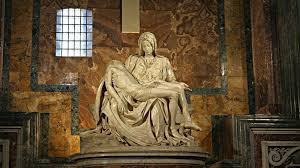
Here is a prayer by St. Thomas Aquinas, addressed to Mary, whom he called on for inspiration and strength in school. Thank you to my McAfee Classmate Benjamin Smith for sharing it:pieta

O Mary, Seat of Wisdom,
so many persons of common intellect
have made through your intercession
admirable progress in their studies.

I hereby choose You as
guardian and patron of my studies.
I humbly ask You to obtain for me
the grace of the Holy Spirit,
so that from now on I could
– understand more quickly,
– retain more readily, and
– express myself more fluently.

May the example of my life serve
to honor You and your Son, Jesus.
Amen.

Other prayers: A Parenting Psalm: Wisdom Prayer for My Children (Un)Holy Saturday: A Community Lament Psalm Louisiana Black Church Fires: A Psalm of Community Lament

← Back

Thank you for your response. ✨

(Un)Holy Saturday: A Community Lament Psalm

dark cross

It is Holy Saturday, God, the day good Christians celebrate Jesus’s body lying in the tomb while his soul descended into hell, the Harrowing of Hell, they call it. Holy Saturday is coming home from a funeral. Everybody is exhausted, and the loss is starting to get real. You have to eat~~people have brought food~~but you are not hungry, might never be hungry again. After Big Mama’s funeral, I sat at the familiar kitchen table with her old friends, who told stories. Those of us at the table laughed until we cried, but the sisters—my mother and Lois and Mary and Judy and Barbara—were in the dark bedroom where their mother had taken her last breath; they did not laugh. They could hardly hold themselves up, so they held each other. It was raw and ugly, and if any of them had dared, they might have cursed you, God. They were groaning in their utter desolation. Holy Saturday started like that, with women holding vigil in their sorrow.

There is another word I first (and pretty much only) heard in the Bible: iniquity. Iniquity is to wickedness what groaning is to grieving. You are good, God, and trust in your goodness outweighs my worry; but my fundamentalist conscience tells me our United States will give an accounting for our iniquity. We sin together, all of us: we are inhospitable to neighbors at our borders, we march in hatred to maintain an apartheid state, and we lay offerings at the feed of corporate gods. We do not merely turn our heads as our poor fight to live—and often lose the fight—but we defiantly jut out our chins at them because they got what they had coming. It helps that they are different colors than we are. We incarcerate young men of color to prove our point. We busy ourselves with what goes on in one room of the house—the bedroom—with little concern with what goes on in the rest of your world. Longsuffering God, batter our hearts, as the poet cried (John Donne). Lay us bare again so that in our nakedness the only place our eyes can turn is to you. On this Holy Saturday, harrow our souls toward reconciliation with you as we keep vigil for the terrifying Resurrection we (don’t) know is coming. Amen.

Louisiana Black Church Fires: A Psalm of Community Lament

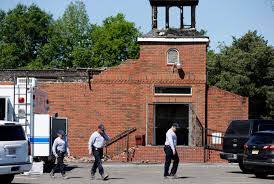
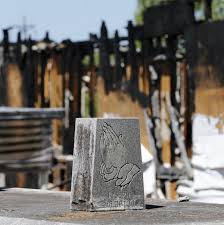
Holy God, we must speak the names. St. Mary Baptist. Greater Union Baptist. Mount Pleasant Baptist. Louisiana smolders. In the names and the smoke our sin is manifest. We do not speak of their pain because the pain is their own—it belongs to their hearts. We do not get to cry those tears. Theirs is not our story to tell. Our story is a 21-year-old in an orange jump suit staring back at the camera. “His dad has been a sheriff for a number of years, he’s a good fellow,” said a state congressman. “My understanding is the son has had a troubled past.” Yes. Sons of the South have troubled pasts. “Not guilty,” he pleads. It is we who need to plea, yet ours can be no other than guilty. In 1963, two other sets of eyes looked back at the camera, in Birmingham; our pasts are troubled. “I tremble for my country,” Jefferson said, “when I reflect that God is just; that his justice cannot sleep forever.” Louisiana burns, God, and we tremble in our transgression. Do you yet sleep?

Church Ruins

God, we trust you~~that we are not condemned to forever suffer the consequences of our sin by perpetuating evil. At the hearing, the 21-year-old arsonist’s father, the deputy, left the courtroom in tears. What did he cry for? His “good boy”? A lost youth? A youth lost? His boy took pictures of himself. Pouring gasoline. With a blazing building. Among the ruins. He claimed this.

God of justice, God of righteousness, we trust you and we offer you all praise~~but we do not know exactly what to ask you. Has nothing been asked before? Have we not prayed for forgiveness? Have we not prayed for good relations? Have we not prayed white prayers that our white children would not detect our locked-away resentment of freedom ringing? Correct us. Guide our hearts to pray those prayers. Awaken your justice, God, and direct us toward reconciliation and love—discernible in the photographed eyes looking back at us. Amen.

Church Ruins 2

Missionary Position: The UMC, Sexuality, and the Global Church

First, I need to acknowledge my white privilege and citizenship in a colonizer nation. Additionally, I am a U.S. Christian in a missionary culture, which has contributed to colonization. That said, I am also a gay female Christian from a rural Fundamentalist denomination, so I also can speak from intersecting places of marginalization.

In late February, the United Methodist Church voted to maintain its traditional stance against same-sex marriage and non-celibate gay clergy. This could very well be the issue that splits the UMC; in fact, the fissures started as soon as the vote was counted. The “Traditional Plan” passed with 438 votes in favor and 384 against, 53% to 47%. Yet in 2014, a PEW Research Study reported that 60% of U.S. UMC members believed that same-sex marriage should be accepted. On the eve of the 2018 General Conference, informal guestimates predicted that 66% of U.S. delegates would vote for the One Church Plan, which would allow individual churches and regional conferences to decide whether to ordain and marry LGBTQ members (https://mainstreamumc.com/blog/groups-are-misusing-survey-results/ and https://religionnews.com/2019/02/25/united-methodist-committee-rejects-one-church-plan-which-would-allow-lgbt-clergy/). So what happened?

il_794xN.1845053811_ovr9

The UMC has around 12 million members globally, about half its members. Methodists from outside the U.S. are generally more conservative and favor traditional positions on sexuality, reports Christianity Today. At the General Conference, 41% of the 864 delegates were non-U.S, 30% of those from Africa. I don’t even have to break out my calculator to know that without global delegates in the mix, the Traditional Plan would almost certainly have been defeated. (Take a look at the UMC World Map here: https://www.christianitytoday.com/news/2019/february/united-methodists-lgbt-vote-umc-general-conference-denomina.html).

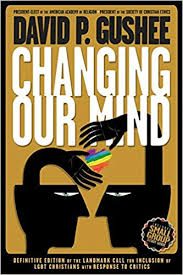
There are several issues to eventually unpack, such as how to reconcile the U.S. UMC and whether or not it will lovingly include its LGBT members and clergy within its community. Very briefly, though, I want to consider another ethical dilemma the UMC faces: how to be Christ’s universal church when the majority of half its members oppose changes taking place in U.S. culture. “In this case,” says Mercer University ethicist David Gushee, “culture looks more like the gospel than churches do” (Changing Our Minds, https://www.youtube.com/watch?v=7oO81hxbmGM). One delegate from Mozambique said the Traditional Plan “is what God Wants in the church in this world” (https://www.christianitytoday.com/news/2019/february/united-methodist-lgbt-vote-conference-plan.html). Is it? More important here, is it what U.S. Methodists believe?

Gushee, whose book Changing Our Minds gives his account of changing his mind about the inclusion of LGBT persons in the church, notes that he is, “convinced this is not a sexual ethics issue, but it’s about human dignity” (YouTube). He goes on to pose three questions for which I propose the UMC hold itself—locally and globally—accountable. Who counts as equal? Who counts as having dignity? And at a level fundamental to the gospel—Who counts as included within the reach of the good news that God loves human beings in Jesus Christ? After all, he reminds us, sexuality is but a “tertiary concern” compared to issues of the sacredness of life and human dignity.

After nearly 250 years, the Methodist Church has accomplished one of the greatest missionary feats in history—preaching Jesus the Christ throughout the world and adding over 6 million souls to its count. Problem is, in many of these areas, it is not even safe to be “out” as a LGBT Christian. And, the UMC usually holds a mainline, moderate stance on most issues in U.S. culture. In February, the conservative global element nudged the church in a direction against itself. At least I hope that is the case—for herein lies its denominational ethical dilemma. What is the Methodist Church today?

I’ll turn once more to Gushee, who argues if we aren’t in solidarity, we’re part of the oppression. He notes profoundly, “this solidarity will be costly” (YouTube). It will indeed. If the UMC—as a microcosm of the greater church—does not actively seek to recover the broader narratives laid out by Gushee—the Kingdom of God, justice, the example of Jesus, love of neighbor, the Golden Rule, and compassion for those who suffer—then it admits its own ugly complicity in rejecting human dignity. It will have nearly literally have gained the whole world but forfeited its soul (Mk. 8:36). Now is its chance to do both.

Gushee

Changing Our Minds by David Gushee

Till Death?: The Curiously Ethical Question of Intentional Monogamy

This week’s post is an updating of a one that began as a paper I presented at the 2017 South Eastern Women’s Studies (SEWSA) Conference called Intentional Monogamy: Not Your Grandma’s Sexual Ethics. I’m thinking about monogamy as an act of queer intentionality.

Even before I started my MDiv at Mercer, I had been playing with God-talk (theology) in my curriculum theory writing. For example, I believe that Dietrich Bonhoeffer’s notion of ethics and existentialist theologian Paul Tillich’s conceptualization of God and Christ are not just relevant to our world today, they are essential. Three semesters in to seminary, I’m just learning what I do not know about Christian Ethics, so I will start small, with the most common state of being in a relationship in Western practice—monogamy—I’m thinking about it in the context of the current issue of same-sex marriage. We have constructed a God to suit our dominant White Western culture, just as we have constructed normal, normative sexual ethics. The god we crafted has a preference, which we codified into morality, for matrimony. Marriage is one man, one woman, monogamous. You know the Wedding Vow: “I, ___, take thee, ___, to be my wedded husband/wife, to have and to hold, from this day forward, for better, for worse, for richer, for poorer, in sickness and in health, to love and to cherish, till death do us part, according to God’s holy ordinance; and thereto I pledge thee my faith [or] pledge myself to you” (https://www.theknot.com/content/traditional-wedding-vows-from-various-religions).

In Mimi Schippers Beyond Monogamy: Polyamory and the Future of Poly Queer Sexualities (2016), she extends Adrienne Rich’s idea of compulsory heterosexuality to include compulsory monogamy as a “regime of sexual normalcy” (Kindle loc 183) and offers a critique of mononormativity. She points out, There have been very few theoretical interrogations of how monogamy is implicated in and productive of gender, race, and sexual hierarchies or the role of monogamy as an organizing rationale for regimes of normalcy and social structures of inequality (loc 254). Schipper didn’t leave much space for conceptualizing a postmodern, queer monogamy. Intentional monogamy is queer monogamy–even if the participants are heterosexual, cis-gender participants. It holds similar queer possibilities for disruption. How? Because of its intentional nature. Hence, intentionality is transgressive.

Intentional monogamy confronts monogamy by default, which renders monogamy invisible, unconsidered. Also by default is the assumed and legitimized feature of monogamous couples to reproduce the heterosexual, heteronormative family. There is a whole other discussion here—for another time—on how the re-production of “the family” also reproduces the hierarchies and inequities—personal, political, institutionalized, time-honored. There is a lot hinging on monogamy.

So, in this space, I want to look finally at the intentional part of Intentional Monogamy. For this, I need a story. In Beyond Monogamy, Schippers makes a very interesting point that I will admit I had not thought about, but of course should have: that cheating narratives are important to maintaining mononormativity and leaving monogamy invisible as the hegemonic norm (loc 742). Cheating is the threat that keeps couples within monogamous bounds. Cheating holds monogamy together. It is to relationships what sin is to Christianity. Like sin, cheating is a transgression of the vow to be in right relation. But again, what if we flip this thought so that intentionality is the transgressive turn?

About a year and a half into our relationship, Sarah and I began discussing the terms for our future together. Knowing Sarah, this in fact is romantic. One evening she entered the room, stopped in the middle of it, and said, “I’m monogamous.” I half-looked up from emails or the tv, or whatever I was doing and said, “Yeah, so am I.” And that, as they say, is when it started getting real. She got my complete attention by telling me that to her, I wasn’t at a place to make that assertion. It’s true: I had been living under a few assumptions, stretching all the way back to adolescence and dating. Yet I thought our own commitment had been understood when we had made a commitment. Exclusivity, to me, had implied monogamy, and that was her point. Implied monogamy was not sufficient grounds for a long term relationship. I argued, cajoled, reasoned—used all my skills to persuade her—and myself—that I was a confirmed monogamist. And then she said something so shocking and profound that I knew it to be true: You say you are monogamous when what you really want is someone who won’t cheat on you. 

Sarah’s declaration of monogamy, her intentionality, was a disruption of heteronormative compulsory institutional default relationship form. For me, it troubled the cheating narrative, which played right into reinforcing hetero- and mononormativity. From Beyond MonogamyMonogamy needs cheating in a fundamental way. In addition to serving as the demonized opposite of monogamy, the mark of the cheater is used to push individuals to conform to monogamous behavior and monogamous appearances (loc 748). Wow. You have to confront your monogamous privilege just like you do your white privilege. You have to know that there are other ways of being in relationships–ways that involve more than two partners, she said, and then you can come back to monogamy. Of course, my first question for her was, “Good lord, do I have to try them?” “Not necessarily”, she said,” just as long as you know enough to make an informed decision.”

My students often ask whether anyone can be queer; that is, can you be a straight cis-person and be queer. Sometimes I give them a simple answer. Queer has a political requirement to it; it is purposefully disruptive of normative structures (yes, that’s part of my simple answer to them). It is intentional. So, I tell them, to be queer, you have to believe yourself to be. And that is part of how monogamy can be a queer act—in its intentionality. Monogamy is not a condition to be bound to, a “till death” sentence of imbalanced power. It is a state of free, into which we might freely enter. After about a month of my coming to learn that, Sarah was satisfied. We married on the day the US Supreme Court ruled on Obergefell, June 26, 2015.

Untheorized, monogamy brings its heteronormative baggage into sexual ethics, thereby invalidating its very underpinnings. There’s a famous line from Our Town:  People are meant to go through life two by two. ‘Taint natural to be lonesome. Along my journey toward monogamy, I have learned that ‘taint necessarily natural to go two by two, but if we want to, it’s queerer than we might think.

Schippers, M. (2016). Beyond Monogamy: Polyamory and the Future of Polyqueer Sexualities. New York: NYU Press.

I Heart Blogging, or, Thank You Dorothy Allison

Here’s what you’ll see on my About page now.

When Sam Phillips’ secretary at Sun Records, Marion Keisker, asked Elvis who he sounded like, he replied, “I don’t sound like nobody, ma’am.” Writing can be such an isolating activity, that I’m sure I’m not alone in feeling like I don’t write like anybody else does. I sure don’t feel like my writing is a neat fit in most other places. Blog writing feels right. First, it isn’t traditional academic writing like I’m required to do as a professor. I cheat at that usually–it’s such a formulaic, forced disciplinary exercise. When I do it, I write my narrative first and then sprinkle in the theory. Don’t laugh~~it earned me a Ph.D. and tenure. Thing is, the narrative is all I ever want to write.

For the purpose of categorizing it, I’m going to call it personal essay and memoir writing. It’s personal, and it’s narrative.

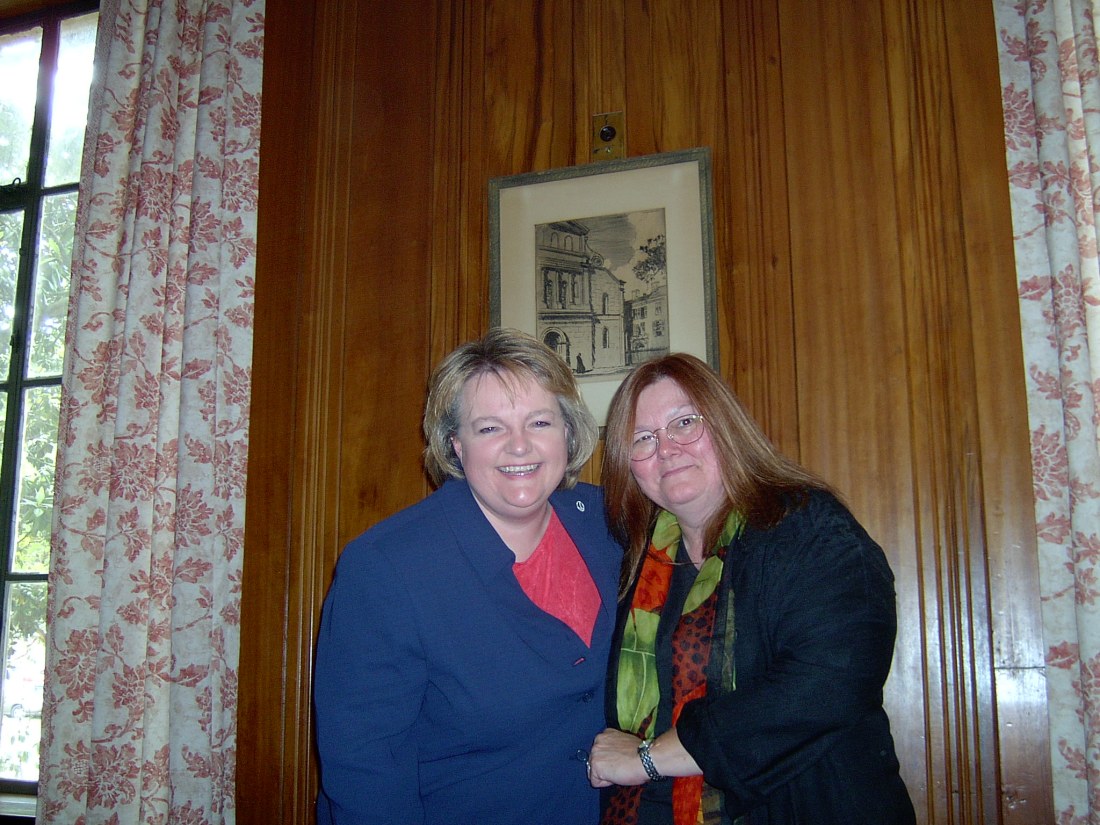
It’s not exactly essay, if by essay we prescribe more gatekeeping formulas. Same with memoir. It’s not storytelling exactly either, not like fiction. It is storying, though.  For example, here’s a true one. Back in around 2003, Miss Dorothy Allison came to LSU while I was working on a doctorate in education. I just love Dorothy Allison, especially her Skin: Talking About Sex, Class and Literature. I was lucky enough to participate in a writing workshop one evening, lucky because most of the spots were taken by English majors.

One of the exercises was to free write for a few minutes. She asked for volunteers to share, and I, having a huge student crush, shot my hand up. I truly think my writing is not half bad, and have been told as much. So I shared. Did I mention that almost every other participant was an English major? English majors take their critiques of writing very seriously. The most scathing was from a very serious woman who accused me of attempting to replicate Miss Allison’s style, which honest to God, had never crossed my mind. You know how crushing it is to the soul when someone looks at you–and you recognize the look as one of pity? Miss Dorothy Allison looked at me like that.

Still, it’s–this–is the kind of writing I want to do. The kind that, try as I might, is what comes out. I still don’t think it’s half bad. That’s why I’m putting it out here. If not another soul reads it–or if English majors do and snicker like the Prufrockian Eternal Footman–I like seeing it here.

hp photosmart 720
Me and Miss Dorothy Allison, 2003. Before the English majors got a hold of me….