God Laughs, or Fun with Bell’s Palsy

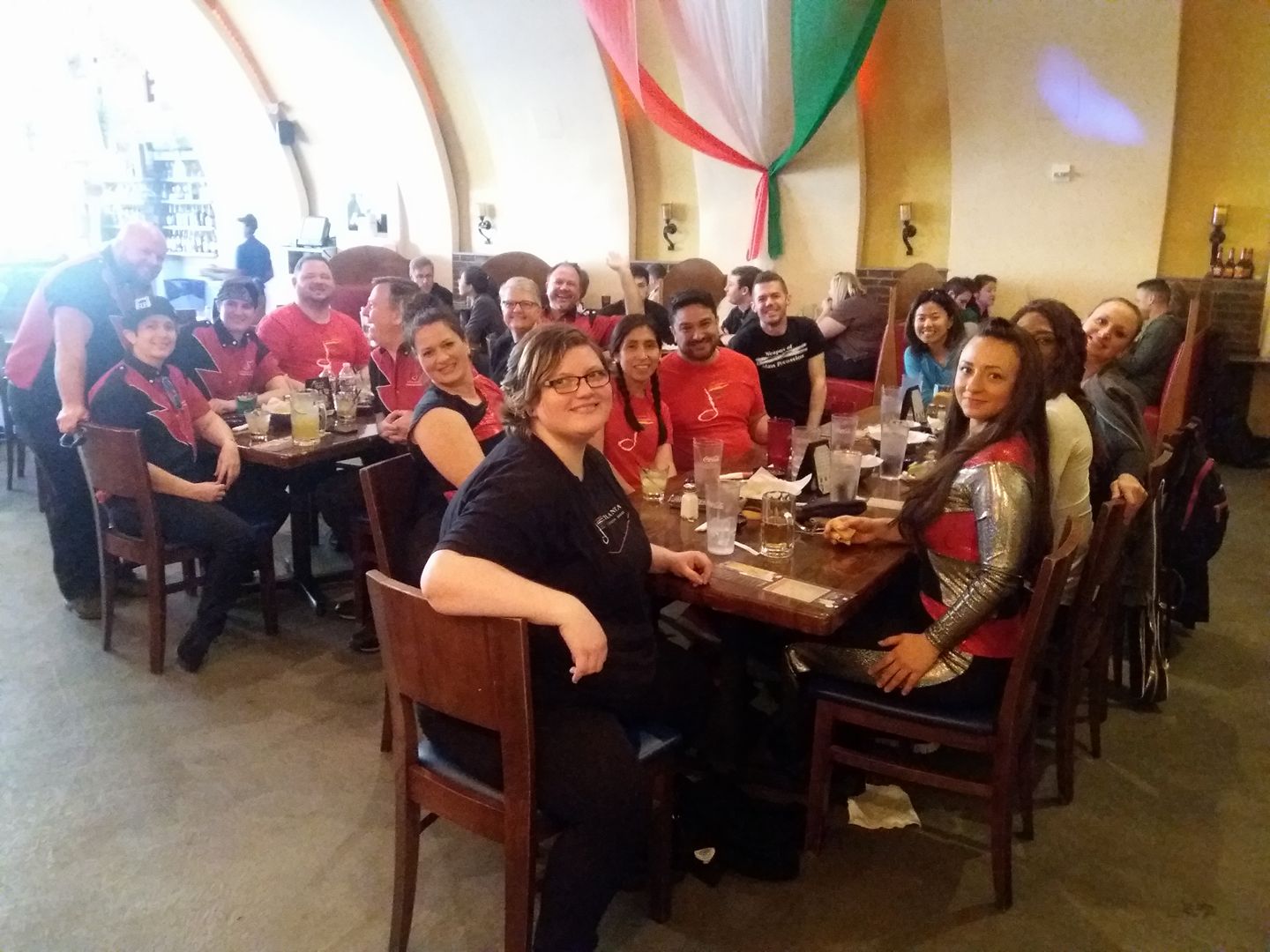
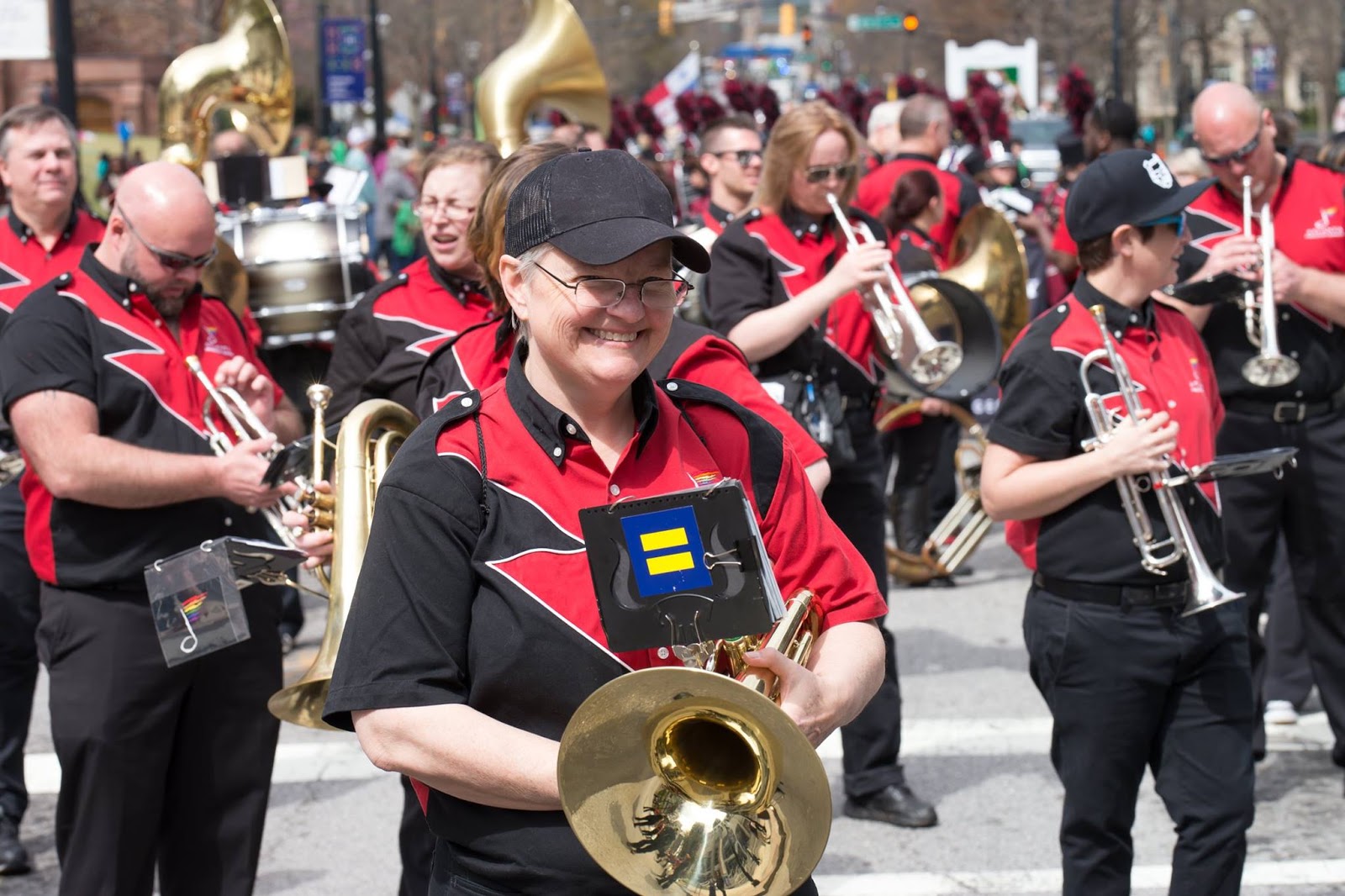
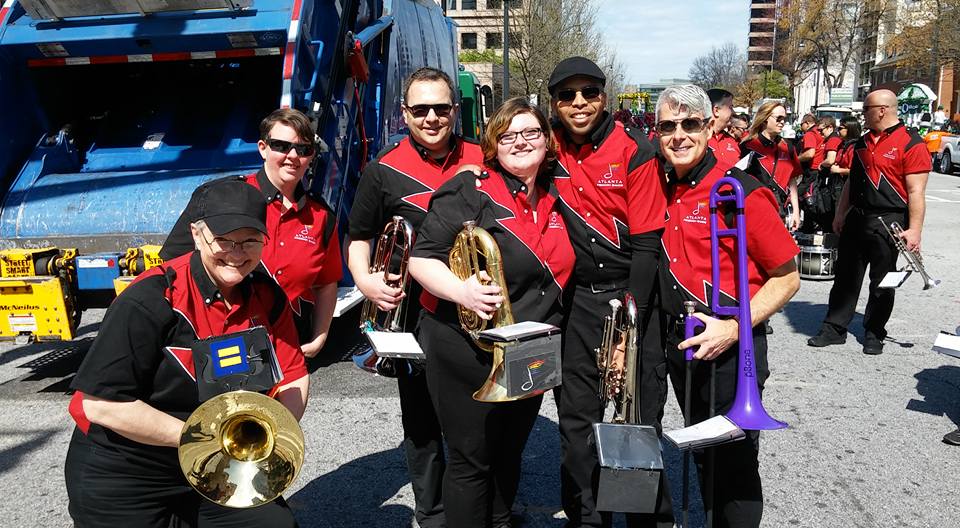
You make your plans, and God laughs. That’s what happened to me over the weekend. Let me go back, though, and start with discovering the Atlanta Freedom Bands, which I wrote about here in November 2014. I recollected how finding the band made me realize how much I had missed making music, marching in parades, performing in concerts. How after more than 30 years, finding the AFB was like discovering a new, yet long lost treasure. Last year, I marched my first season of parades in various Atlanta community festivals. It was wondrous. And at Christmas, I performed in my first concert playing French Horn in 35 years. Last Saturday morning, I marched mellophone with the AFB in the Atlanta St. Patrick’s Day parade. Afterwards, members of the band had lunch and drinks and fellowship at a local restaurant, which is the custom with this group.

Saturday night, kept waking up with what felt like a neck cramp. When I woke up early Sunday my speech was slurred, which I chalk up to needing a little more sleep, so I went back to bed. When I woke up again, I couldn’t blink my left eye. I ended up Sunday at the emergency room in Marietta. After they have ruled out a stroke, which was probably the best news I have ever received in my life, they told me I had a textbook case of Bell’s palsy. After a lot of googling I found out that it’s caused by virus, kind of like shingles. Likely because I had the flu, and that virus was in my system, it ended up attacking my facial nerve, causing it to be droopy and paralyzed. Like shingles, it was likely triggered by stress. In addition to facial paralysis–a word, like biopsy, fills me with terror–I have heightened ear sensitivity in my left ear, so loud noises, including my own sneezing, amplify like I’m standing in front of a Bose speaker. By all accounts, I will (should?) regain use of my facial muscles. Most well-wishers report success stories. It is totally unrelated to a stroke, and contracting it one time does not mean I will get it again. Those are the things I know. The worst part is that I can’t blink, so my eye gets dry and irritated. And that can lead to all kinds of trouble. I have to keep eye drops in it and wear a patch. Having only one eye affects depth perception and means I can’t drive. I can’t whistle or smile or buzz my lips. And buzzing one’s lips is essential to playing a horn.

Even though I realize I am very blessed in that this could’ve been so much worse, I’m still having to learn to deal with it. There are lots of adjustments I’m having to make pretty quickly. I’m learning how to have meals with straws and napkins. I’m learning how to turn my head in order to see better with an eyepatch. I’m learning to enunciate words using one side of my mouth. I’m learning how to encounter other people whose first response is to look away from me. I tried to go to the office yesterday, and by the end of the day I was exhausted from having to compensate physically in order to get from point A to point B, or participate in meetings. Talking and looking took a lot of energy that I had taken for granted. Part of the dealing with is going through my own stages of grief: denial, anger, bargaining, depression, and acceptance.

Sunday and Monday I was in denial. I jokingly made a list with Sarah of one eyed characters for costume parties. We go back and forth with one-eyed jokes. In case you didn’t know, there are many one-eyed one liners. Believing the doctors that taking the meds would speed up recovery by months, I thought, Well if I can’t play horn, I’ll just break out the old flute and play that! I tried for half an hour to form the embrasure to blow air across the mouthpiece.  I waited to blink at any minute. I planned to go to choir. Tuesday night begin my descent into anger. I kept a dinner engagement with some visitors to campus, old friends from my curriculum world. When I entered the restaurant, Marlows Tavern, which I had been to so many times over the past few years, the hostess looked at me and then looked away. Same thing happened when the waitress came to take my drink order. I realize now that I do the same thing automatically–probably most of us do.  The next day, I mentioned choir to Sarah, who slowly turned and looked at me and said, Honey, you’re not going to choir. When I looked back at her in one-eyed disbelief, she started singing a little bit of the Hallelujah Chorus, which we’ve been working on for a month. I thought my left ear would blow out. No, I wasn’t going to choir. When she dropped me at the office,  just walking from one building to the next took all my energy to keep my eye covered so it would not dry out. I had two meetings where it was very important that I be able to speak, and that was extra energy. My colleagues, wonderful people, tried very hard to look at me in a normal way–and for that I will forever be appreciative. Nevertheless, I feel different, I talk different, I look different. And that was psychological and emotional energy spent that I wasn’t used to spending.

I’ll let you know when I’ve moved from anger to bargaining. Till then, in order to work through some of that anger, in order that something generative and therapeutic might come from it, I decided to pick up the blog again. It’s always been my favorite, preferred mode of writing. Academic work is important, but it isn’t accessible, and it limits my flow of thinking since I have to measure my tone and phrasing as well as the thoughts themselves. Here, I can have a conversation, if only with myself. Plus, Sarah approves of it since it will help keep me out of trouble–like trying to do home-improvement projects with one eye that doesn’t need to get dust in it. Most important, this is all helping me put my life in perspective and put the parts of my life in priority. It isn’t an overnight revelation, but I realize that stress is counterproductive and can be harmful. I reaffirm that life is always already about the people in it. That being present and being mindful is living. I am intentionally choosing hope and happiness. Hope and happiness are not default properties, and being intentional about them makes a difference. As I think about it, coming to this place is a kind of bargaining. I will trade impatience for writing, frustration for processing, sight for insight.

Band friends at Sr. Patron’s
Mellophone


A mello-photo bomb

Finding Free: The Atlanta Freedom Bands and Coming Full Circle

When I was in fifth grade at Littleville Elementary School, something magical happened. One day, our teacher announced that the band teacher from the nearby high school would be coming to Littleville to talk to kids and their parents about joining the band. It was 1973, and resources for extra-curricular activities–heck, resources for curricular activities–were limited. I remember in previous years, our musical exposure at school had been the on the rare occasions when our teachers had brought out a box with mostly percussion instruments and let us play with them, mostly trying to keep time while a record was playing. This was different. This was band. I could hardly wait for the meeting. When the evening came, the band director, Mr. Wright, brought a variety of instruments so that we could try them out and, with his advise make our selection. I realize looking back that, of course, he wanted a well rounded group of instruments, which is probably why I became a flute player. From that point on, I was in love.

I went to high school in a football town, and a football town doesn’t scrimp on its band. When two new, shiny mellophones arrived at the bandroom, I volunteered to learn to play, and I loved the big, smooth sound of a horn–I was a woodwind no more! We were the Marching 100. I remember the day I was issued my uniform. I remember band camp and big, chartered band buses, chocolate sales and Homecoming parades. I can still remember how to play The Horse–if you have ever marched, you know The Horse. I remember our signature parade song–a marching mix of China Grove and Smoke on the Water. I still remember–and feel–lining up on the sideline for the halftime show, and I can feel again what it felt like then standing on the field, horn up, knees slightly bent, leaning back to hold the last note until the crowd stood and cheered. And they did. Every time.

I quit the band just before my senior year for a very, very bad reason. It’s a story for another time, because this one is about joy. But I must say–for the rest of it to make sense–that over the next thirty years I had recurring dreams about being back. Sometimes, they would let me join them again for just one performance. Sometimes, in my dream, it was entirely acceptable for an alum to join up years later. Whatever the scenario, I slept happy. Then woke. It was not unlike dreaming of someone who has passed then waking to sadness when you realize it was only a dream.

So  when I say how happy I am to find the Atlanta Freedom Bands and to sign up to march with them, you get some idea of how much it means to me. I’ll write more about it later no doubt, but this post was prompted by a conversation I had with my new band friend Mitchell. He  mentioned that during the recruitment drive at Pride this year, one new member was telling him that finding the AFB was like coming home again–a feeling not unlike ones I have been having. I bet I’m not the only one, either, or that new fellow. I bet a lot of band members feel like this is both a musical and community home. I bet a lot of us thought we might not ever have that kind of home again. Of course it’s also a helluva fun group that throws a mean party. Robert Frost wrote, “Home is the place that when you have to go there, they have to take you in.” I know the “Freedom” in Atlanta Freedom Bands has rich, multiple meanings, but certainly for me–and I bet for others–it is a home place that sets me free. I am awfully glad they have taken me in.

Hissing Ball of Fury: Losing Diana

The cat hated everybody. Everybody, that is, except me. And Sarah, of course–but she had owned Sarah for seventeen years, so that was to be expected. I only knew her for five months, and I didn’t really expect her to warm up to me. More than that, I never expected to warm up to her. So when we helped her to her final sleep on Monday, the last thing I expected was to feel what I felt and react how I did. 

First of all, I am not a cat person. I had a cat once, and I despised it. Yes, my cat-loving friends will be shocked at that. Kitty was part Siamese and was mean. Worse than that, she caused me to lose sleep every night. If she was outside, she wanted in; if she was inside, she wanted out. Day in and day out. Why didn’t I just leave her in or out, you might ask? Well, I believe if you ask that, YOU are not a cat person. She would come to my bedside and claw at the blinds until I was awake. If I shooed her away, she’d wait till I lay back down and begin again. When she was outside, she would come to my bedroom window and claw on the screen, which is not a sound conducive to sleeping, especially as I lay there envisioning a trip to Home Depot to replace yet another screen. When I moved from Louisiana to Georgia, I gave the neighbors a bag of cat food and $20 to take care of the cat. I drove the U-Haul truck away as fast as I could so that Kitty couldn’t somehow attach herself and hang on for the cross-country trek. I was free of cats. Until Diana. 

Sarah called her Hissing Ball of Fury because that’s what she turned into whenever anybody tried to touch her. Over the months, as I met Sarah’s friends, they all asked, “And how are you getting on with the Little Cat?” Only they don’t say “Cat.” They had learned the hard way. “Oh, she’ll like ME,” they had said, one by one. “I’m good with animals,” they had said, one by one. And one by one, they had approached Diana talking softly and reaching to pet her, only to have her turn into Miss Fury. Diana had been banned from veterinary practices in two states because she bit. I witnessed this myself when we took her to the vet three months ago. Two young techs had assured us, “Oh, she’ll be fine with us,” only to bolt from the room to fetch the doctor to do this first-year vet school procedure himself. “Diana bites” was written in bold red letters across the top of her chart. And so she did. 

So what was my secret? I think it was that I let Diana be Diana. I let her come to me. When she sat with her back to us, which was her usual position until she got ready to be petted, I let her be. I only spoke to her when she looked at me, and never reached out to touch her. Then one day when she came to Sarah for her evening head-butts (Diana was a head-butter), she walked right into my hand. Then one morning I awoke with a cat sleeping on my head. On my head. She only hissed at me once. I had reached down to pet her as I walked by the couch where she was lying, foolishly thinking that we had bonded over the head-sleeping. “Don’t get to comfortable with me, old gal,” she seemed to imply in that hiss. “I come to YOU.” I only picked her up once. It was the day before she died. That is how I knew it was over. 

The vet must have felt the same way when he picked her up on Monday morning and said, “This is the first time I’ve really gotten to examine her completely.” He gently felt her frail body and asked Sarah if she was sure of her decision. She was. We had set up what Sarah called “Kitty Hospice” at the bungalow over the weekend, administering IV fluids and concocting what looked like an awful mess but was evidently a cat delicacy Sarah called “duck soup.” Diana would take a little, then lie on a pile of Sarah’s clothes and her old teddy bear, Ted, until we took her outside to lie in the grass warmed by the sun. The fluids never pepped her up as Sarah had expected; she was that far gone. So we fed her duck soup and let her be outside as much as she wanted. She even hissed at a stray cat once. We had one brief second of hope, then watched as she turned away all but a bite of food. I am glad we had that weekend. As we watched Diana, I watched Sarah say goodbye to her friend of seventeen years. 

I think things happen for a reason. Like finding an abandoned kitten two weeks ago–one that has pretty much taken over our lives by blessedly taking up our attention during the last week. I’ve heard the old saying that we don’t find pets–rather, pets find us. This one was put in our way at precisely the appropriate place and time. Just like Pastor Kim’s prayer in church on Sunday. As I sat there in the choir loft during the service, the words startled me out actually praying, hoping that it might in some way bring Diana’s human some comfort. Give us the courage and grace to live through the dying season, was the prayer. The grace to understand death, as well as life, even though the dying–the perpetual winter–dims a light in our souls.

As we sat outside with Diana Saturday, Sarah told me that she had chosen her name from Edith Hamilton’s famous book Mythology. It is appropriate–and somewhat ironic now–that her name had come from that book. In it, Hamilton quotes from Aeschylus’s Agamemnon
Drop, drop—in our sleep, upon the heart
sorrow falls, memory’s pain,
and to us, though against our very will,
even in our own despite,
comes wisdom

by the awful grace of God.
Aeschylus describes the process by which we come to the understanding for which the pastor prayed. Drop by drop upon the heart by the awful grace of God. How profoundly simple that it might come from the great blessing of being owned by a pet. But, if you are a cat person–like I am now–that is no surprise. 

Getting Happy

Somebody I used to know once told me she thought happiness was overrated. I’ve thought about that statement for going on a dozen years now, and I think she was wrong. Well, I think she was talking about pleasure, about following one’s desire, about gratification–and all of these are different from happiness. Not only is happiness not overrated, I don’t believe it is rated nearly highly enough on our collective list of priorities.

I was recently on a long, 9-hour drive from Atlanta to South Florida when I began running through my usual thoughts: money, work, goals, writing, weight. I was even running scripts through my mind of events that I envisioned happening so that I would have a ready response. For example, I pictured a scenario in which my boss asks me to assume additional duties at work. I was amazing myself at my sardonic, pointed remarks to her. Then I thought to myself, “I have a 9-hour drive and I am going to sit here and make myself miserable the whole time? This is my vacation, what if I only thought happy thoughts the whole drive, heck, the whole trip?” So I practiced. I made myself happy, or so I thought at the time. Looking back, I think it’s more accurate to say, I rejected negative thoughts for positive ones. Happiness, a deceptively simple notion, is more complicated than it seems.

I’m reading a book by Barbara Ehrenreich called Bright-sided: How positive thinking is undermining America. Ehrenreich has nothing against positive thinking per se, but she argues it has become a tool to lull Americans into compliance with a neo-liberal, consumerist culture. It is, according to her, in the best interest of institutions to keep the population thinking positively because it deflects attention off inequities of capitalist society by focusing on ourselves. Be positive, work harder, pick yourself up, you can do it (!), you deserve it, and my own personal favorite, “everything is going to be just fine/work out….” Ehrenreich goes on to present some amazing survey results: even though we Americans have embraced the power of positive thinking, we don’t report that we are very happy. There are plenty of other, frankly, negative countries whose people are happier than we are. Being happy is not the same as thinking positively. Positive thinking is something you can choose to do; and while I’ve heard it suggested that we “choose happiness,” I think it is more of a state of being. I”m sure the two are connected somehow, and maybe I’ll think about that later.

I can be negative. I am often cynical and suspicious (of politics and banks, for example). I get the blues and feel lonesome. I come from a long line of worriers–it would have been a piece of cake to have found something to worry about the whole drive down to Florida. But, I am a happy person. I am not jolly, and I don’t feel euphoric all that often. So am I sure about this happiness thing? Yeah, I’m sure. I haven’t figured out yet whether happiness is situational, contextual, or even genetically influenced. In fact, I have just begun to think about it at all–apart from that comment about it being overrated all those years ago. Lots of thing “make me happy”: music, Taco Bell, marathons on TNT, watching the ocean, people in my life. But really, I think these things bring me some joy; they bring me feelings of happiness. Happiness, it seems to me, is what you are left with if feelings were stripped away. I think it would and should be articulated differently by different people. For me, it is serenity of the soul. But that’s just a way of saying it. Can one “get happy”? What is happiness? How does happiness fit in with the violence all around us? That is, can our own happiness intersect with that of others? What does that look like? What good does being happy do us? That’s a lot of questions for something so taken for granted.
More on this later.

Save the Worms

Coastal areas with their sea turtle preserves have nothing on red clay states like Georgia and Alabama.

Yesterday morning I was walking Duncan. The sky was just a little lighter than the gray of the asphalt paving of my apartment complex. It was warm for a January morning, and the rain had just stopped. As we made our way around the buildings, one sniff at a time, I began to notice earthworms. I will always notice a worm. I invariably think back to when I was a kid we would go digging for worms to take fishing. Back then, I almost never found any, so whenever I see them now, I notice.

These were perfect conditions for them to come out of their dirt to…well, to do whatever it is that earthworms do. Except, I think ideally, they would come out of their dirt to explore more dirt–not pavement. I noted to Duncan, who was mostly ambivalent, that there sure were a lot of worms out. We turned a corner and sidestepped a large puddle under a cypress tree, when I looked out into the street between the buildings. There, spaced out across the deep gray like long flesh-colored surfaced submarines, were about a hundred worms. Sadly, some of them had been flattened by early morning drivers.

It was one of those sights I will stop to see. I took hope for a minute when it looked like more of them were nearing the curb, approaching safety. But taking a deeper look, it was clear they were not coming but going–further out in harms way. I hoped again for the best, since it was still early and the college kids had not awakened and headed to Starbucks in their cars. They would most likely not notice the wriggling armada.

Two hours later Duncan and I made our second round of the day. When we got to that same spot, I saw not a single worm, dead or alive. Maybe they were washed away; maybe they made it. I do not know.

Some people take time to smell the flowers or  see the beauty in a sunset. I’ll do those things too, but I’ve learned there is something majestic in the resolve of hundreds of earthworms that know when it is time to emerge.
More on this later.