Title: Sojourners Together: Supporting Students Through the Struggle
In my last post, I shared how online teaching has rekindled my passion for the classroom. I’m enjoying the challenge of engaging students in new ways, and I’ve found it fulfilling to build connections through messages, stories, and shared experiences. But as much as I’m finding this fresh approach to teaching rewarding, I’m also deeply aware that many of my students are struggling.
A Boat Adrift
Recently, I sent out a weekly check-in message—something simple, just to touch base. While many students voiced their overall enjoyment of the class, several also let me know they’re having a hard time. These aren’t typical undergraduate students juggling part-time jobs and coursework. These are working professionals, members of a cohort in our Master’s in Applied Learning and Instruction program. They teach in local partner school districts. They’re educators, spouses, parents, coaches, community members. They’re churchgoers, pet owners, and caregivers. And yet, despite all these roles, they’ve committed to taking two graduate classes each semester for two years.
They do this not just for a much-needed pay raise, but for their professional growth—to become better teachers for their students. Our children. And that humbles me. It’s not easy.
These students took a heavy blow during COVID-19. They were asked to be miracle workers, juggling the impossible demands of remote learning while supporting students, families, and their communities. If there was one silver lining to the pandemic, it’s that thousands of parents who had their children learning from home gained a newfound appreciation for teachers. They saw firsthand just how challenging this work is.
And yet, despite all of this, my students show up. They’re willing to do the hard work every day. But I know—and they know—that time is scarce. They probably don’t have six extra hours a week to devote to their studies, yet that’s the general guideline for graduate coursework. They’re balancing it all, and their struggle deepens my sense of responsibility as their instructor.
If I expect them to make time for this class, I have to make it worth their while. I owe them my best. If I want them to give of themselves, I need to give of myself.
Is the reading dry this week? Then I’ll record a discussion to bring it to life. Is the assignment complicated? I’ll walk them through it, step by step. Are assignments feeling routine and uninspired? I’ll revise them to appeal to different learning styles and spark engagement. Do they need more time to complete an assignment? I’ll do my best to accommodate that. Are they feeling overwhelmed? Then I’ll be present—showing up in the class, personalizing my feedback, and ensuring they don’t feel adrift in the online world.
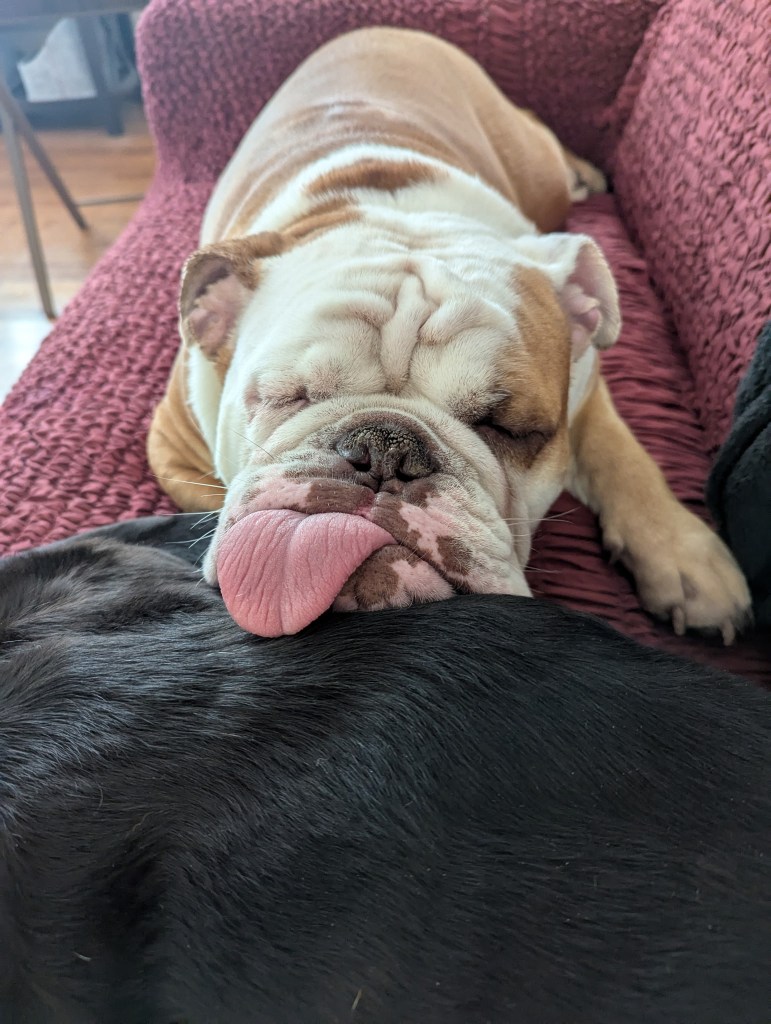
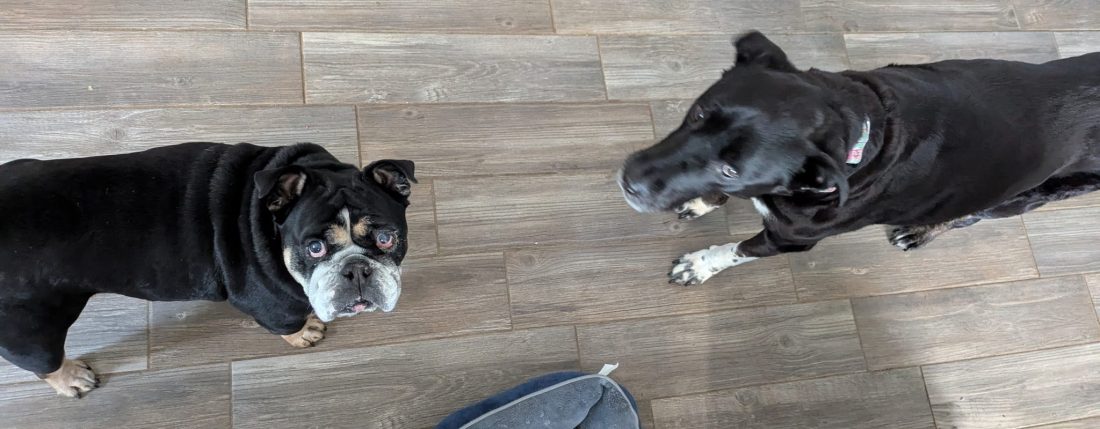
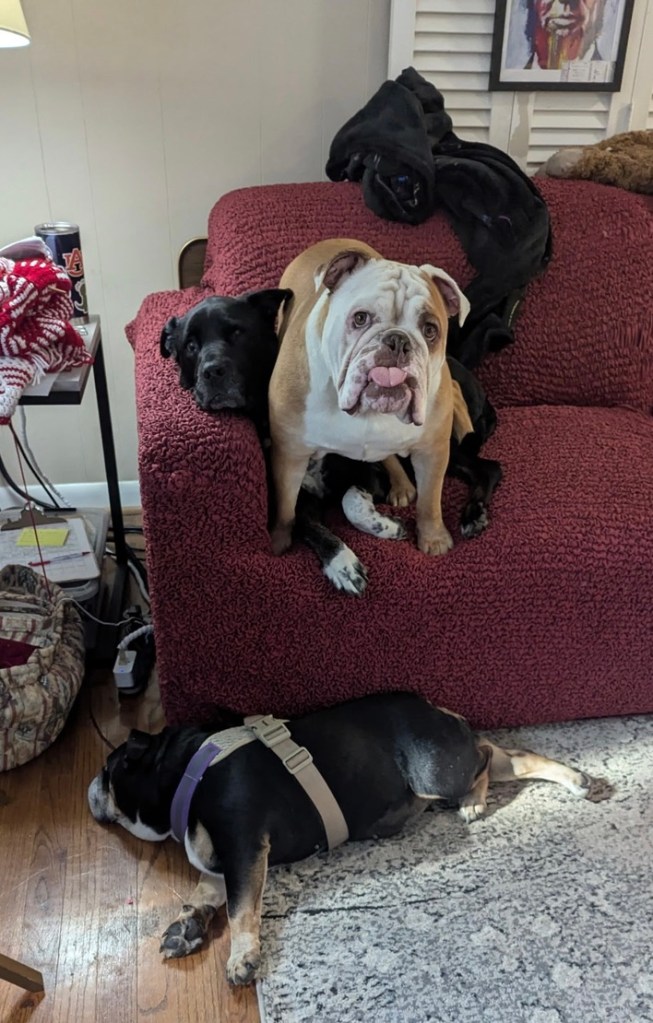
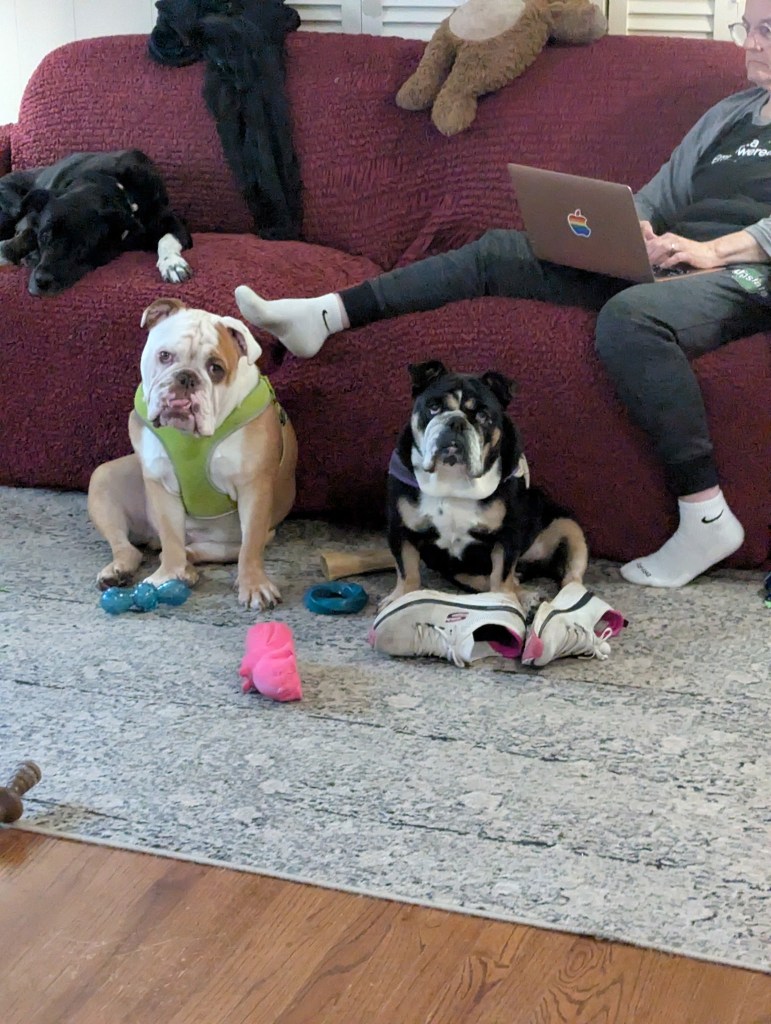
I’ve practiced social-emotional learning long before it had a name. I know the value of a supportive learning environment, and yes, sometimes that means sharing pictures of our five pets to give them a chuckle. It’s about reminding them that I’m here, on the other side of the screen, rooting for them.
Boats, together
As hokey as it might sound, caring is part of the classroom culture I want to cultivate—a culture of care and connection. Teaching can be a lonely profession. Being a professor can be just as isolating. But this online space offers a chance to bridge that gap, to connect people who might otherwise feel alone in their struggles.
It is important that I keep asking them to check in—asking how they’re doing, beyond just the coursework. These check-ins aren’t just about staying informed; they’re about fostering trust and reminding them they’re not alone in this. We are sojourners together this semester. Yes, they will struggle. That’s part of the journey. But the most important assurance I can give them is that I am here. And sometimes, that’s enough to make all the difference.
Old Dog, New Tricks: How Online Teaching Rekindled My Passion for Teaching
When I decided to step back into online teaching after nearly a decade, I thought the biggest draw would be the freedom to work from anywhere—maybe even while spending time with family in Alabama. The idea of crafting lessons with location flexibility sounded like the kind of balance I needed in this season of my life. But as it turns out, the freedom to work from anywhere is just the icing on the cake. What I didn’t expect was how much I’d reconnect with the heart of teaching itself.
It turns out, all of my classes are online this semester. My institution uses Blackboard Ultra—a platform that’s more advanced than the clunky tools I remember from my last online teaching experience. Back then, fostering real connection in an asynchronous class felt nearly impossible. I remember the difficulty setting up video calls and lectures, for example. This time around, though, something clicked. I’m not just uploading assignments and grading papers. I’m building relationships, one announcement, one message, one shared story at a time.
Finding Connection in an Self-Paced World
Online classes can roll along on autopilot if you let them. I could easily pop in, grade assignments, and call it a day. But that’s not how I’m wired. I need to feel connected—to know there are real people on the other side of the screen. I’m also a texter—I have been since the advent of smartphones. Messaging appeals to my introverted nature, the one that has an aversion to phone calls. This same preference drives how I approach my students. So, I make it a point to check in regularly with my students. I send out announcements throughout the week, not just about deadlines and assignments, but to share something about myself and encourage them to do the same—something that reminds us we’re people, that we’re travelers together, not just consumers of virtual learning, detached and mechanical.
One week, I sent out a simple message: “Time to check in. How’s the course going? How are you doing?” I wasn’t sure what to expect, but the responses both caught me off guard and moved me. Students didn’t just give me feedback on the course—they shared snippets of their lives, their challenges, their small victories. A few thanked me for asking about their well-being, calling it “refreshing” to have that kind of interaction in an online class. That’s when it hit me: this wasn’t just about teaching content. It was about building community. (They also mentioned how they struggled with balancing all of their responsibilities with their coursework. That’s coming up in my next post.)
Bruno, Bulldogs, and Building Community
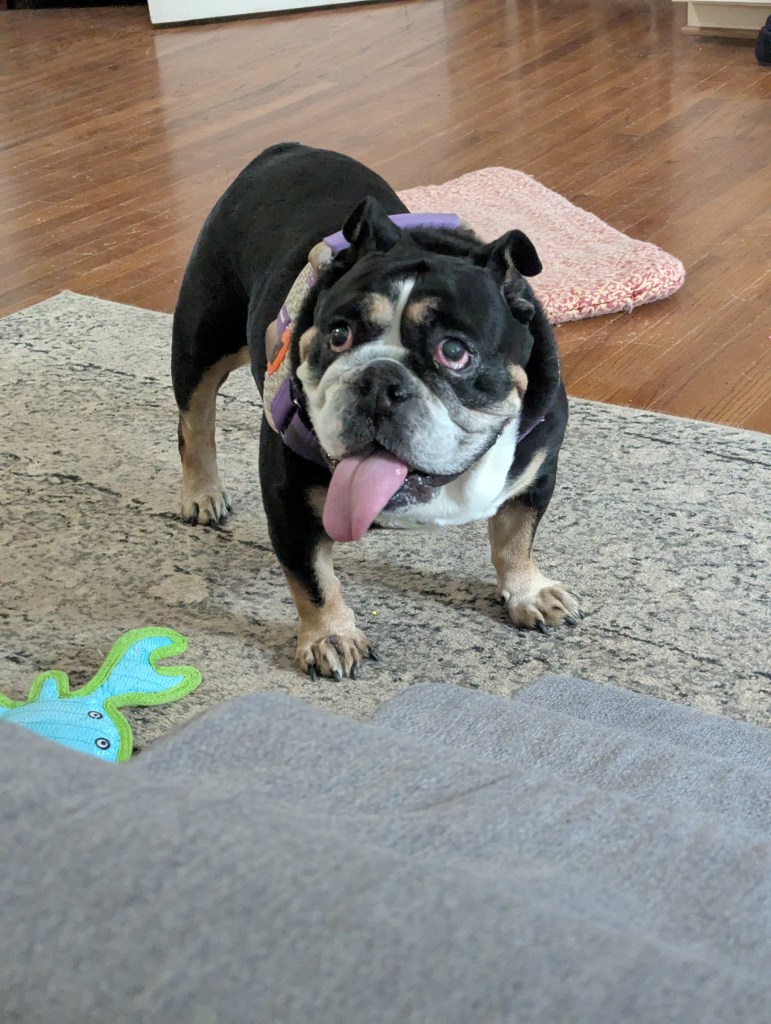
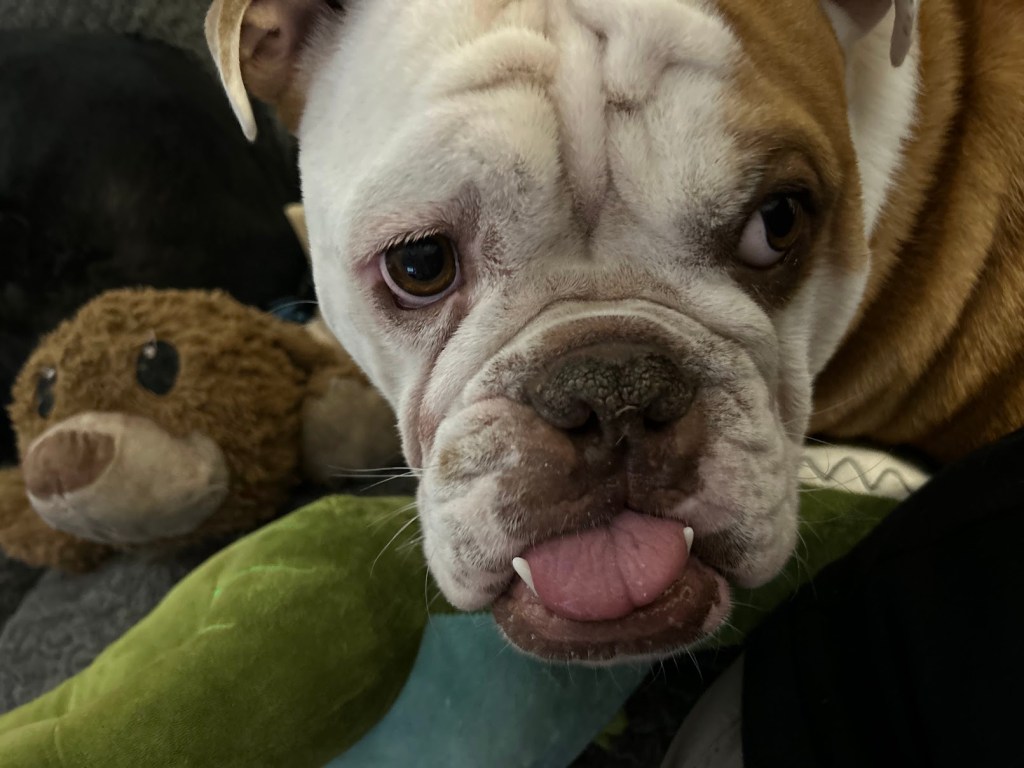
Stories have always been the glue that holds people together. I started sharing little anecdotes about my life—like tales of my dog, Bruno, and our recent adventure adopting an older bulldog, a lady named Marley. I didn’t think much of it at first, but the response was immediate and heartfelt. Students shared stories about their own pets, adding humor and warmth to our digital space. Today, I even shared a picture of “the pack,” and the flood of responses made me realize that even in a virtual space, we could connect as people.
Our Pack: Bruno, Caroline, and “new” Old Dog, Marley
Adapting While in Progress: Revising the Syllabus Mid-Course
Not everything has been smooth sailing. One of my classes didn’t feel as rigorous as it should’ve been. The material wasn’t pushing students to engage deeply, and I could tell it wasn’t encouraging them to read as much as they needed to. So, two weeks into the course, I did something I’ve never done before: I updated the syllabus mid-stream, knowing it could disrupt the flow of the class.
I rebalanced the points on existing assignments and added lightweight quizzes as reading guides. It took me about three days to get everything in order, and then I let the students know what I’d done and, more importantly, why I’d done it. Transparency matters. For a while, no one complained, and I breathed a sigh of relief, thinking the transition had been smooth. But today, I received my first piece of critical feedback.
One student reached out, expressing how overwhelmed he felt juggling work and two classes. Most of my master’s students work in local districts, and I could sense the stress in his message. I assured him that the quizzes were designed as reading guides—more of a nudge than a test—and if he read the chapters, he should be able to complete them as he went along. To ease the pressure, I removed the time limit on the quizzes. It may not have solved all his concerns, but it was important to me that he knew I was attentive to his feedback.
Why insist on these low-stakes checks of reading? Because they signal that the reading matters—not just to pass the class but to engage with the material meaningfully. It’s a gentle reminder that what’s in those chapters is essential, and I want them to take it seriously.
Grading as a Conversation, Not a Chore
I’ll be honest here. I say “reconnect,” but what I really mean is connect for the first time. I went into the teaching profession in 1985 because it was convenient. I had a challenging marriage, a young daughter, and was homesick and lonely. I just didn’t have the time to do the homework to pursue a career in law or chemistry—which I discovered I really liked in college. I went into the field whose subjects of English and history were easiest for me: education. It has sometimes felt as though I have been in a profession not of my freewill choosing for almost 40 years. This made me hold a resentment toward it. I resisted and rebelled against national standards, for example, through curriculum theory writing, taking a cue from other scholars in the field. I had missed—because it never appealed to me in the first place—the only valid reason to become a teacher: students.
Me, working on my online classes with the Pack in place
As I think about it, I love nothing more than being a student, and I have felt respect and fondness for teachers who truly cared about me. Yet I was not this kind of teacher to my students. This is not to say that I mistreated them—quite the contrary. I was the fun teacher for most of my career—the easy grader and the one who drew a little outside of the box. When I arrived at my current institution, a recurring theme that people actually spoke out loud was putting students first. I envied this and knew that I seemed a few steps removed from students. Now, as a non-administrative faculty member, I have a unique opportunity for a second chance—not to reconnect with a passion, but to form one. I find great hope in this—not just for second chances to find something I feel something for, but for redemption itself. This online platform of words—and blessed words are my seeds of connection—allow me to connect to my students and develop a relationship with them and teaching that, for me, is new.
Embracing AI and Lifelong Learning
Another unexpected twist in this journey has been my dive into AI. I’m realistic about it. I use AI tools, and I know my students will too—as will their own students one day. Instead of policing its use, I’m teaching them how to use AI as a tool, not a crutch. It’s part of preparing them for the future, and honestly, it’s been fascinating to explore.
AI As Learning Tool
I’ve been attending workshops, like the one put on by USC Upstate’s CAIFS last week, and I’m signing up for mini-courses through ACUE. There’s something deeply satisfying about being an “old dog” excited to learn new tricks. It’s reminded me that teaching isn’t just about imparting knowledge—it’s about staying curious, staying engaged, and always being willing to grow.
The Puzzle of Online Teaching: Finding My Niche
Part of what’s made this experience so fulfilling is how it taps into different parts of who I am. I’m an introverted Virgo and a bit of a gadget enthusiast. Online teaching feels like solving a puzzle, finding new ways to innovate, communicate, and engage. I don’t often get so absorbed in something that I lose track of time and forget to eat, but when I’m working on my classes, that’s exactly what happens. It’s a sign that I’m not just doing this because I have to—I’m doing it because I really, really enjoy it.
I’m drawing from my background in curriculum design and integrating best practices for online learning. One of the challenges I’ve set for myself is to create personalized video lectures for all my classes. Right now, I’m using pre-loaded videos from previous iterations of the courses, but I’m excited to make them my own—to bring more of my voice and personality into the mix.
Conclusion: More Than I Expected
When I first agreed to teach online again, I thought it would be a practical move—a way to work from anywhere and stay connected to my family in Alabama. But it’s become so much more than that. It’s sparked a passion for teaching, blending the challenge of engaging pedagogy with the joy of connecting with students. Serendipitously, it has opened up new avenues for growth and exploration.
Online teaching isn’t just a job for me now. It’s a space where I’m learning, innovating, and building community in ways I never expected. And as it turns out, this “old dog” has plenty of new tricks left to learn—and plenty of stories left to share from the front porch, whether real or virtual.
I began my career in higher education later in life. It was my second career after 14 years teaching in secondary schools. Transitioning from being a mid-career teacher to starting over as a university professor was both exciting and daunting. This kind of shift isn’t unusual, but for me, one important factor stood out: I entered it older. I became a brand-new assistant professor at age 40. Young by some measures, sure, but it meant that becoming established and reaching mid-career milestones happened in my 40s and 50s—not my 20s and 30s when ambition and energy seem limitless.
Career Stages and Life Stages
Sites like Indeed often categorize career stages neatly, like in the graphic below. Up until recently, I considered myself mid-career. But my academic career has never aligned well with life stages. This September, I’ll turn 62—an age when I can start drawing Social Security (though I’m not planning to just yet). The reality of this milestone makes it clear: I’m approaching retirement.
This period is commonly called the “Decline Stage” (a less-than-uplifting name, to say the least), which typically spans ages 55–65. By contrast, the “Late Career Stage” is defined as ages 45–55. For convenience, I’ve included descriptions of these stages from a cited resource below. Their cheery tone—especially the idea that late-career professionals don’t need to learn new things—makes me suspect the author might still be in the “Exploration Stage.”
When it fully sank in that:
I’m in my 60s, and I’m officially in late career, …my emotions ranged from shock to disbelief to sadness to resignation. I cycled through the stages of grief daily for awhile, but I usually landed at acceptance. When it comes to my career, though, I’ve found something better than acceptance. Let me explain.
A Shift in Perspective
Becoming an academic is thrilling, but being a good one takes work. Since entering the profession in 2005, I’ve poured myself into getting established: publishing, building networks, traveling to conferences, reviewing conference proposals, writing a book, editing another, editing a section in an academic journal, coordinating programs, organizing events, and even hosting visiting scholars. My mid-career years were spent in administration, serving as a department chair and, most recently, as a college dean.
Bruno contemplates a change of perspective
Looking back, I realize my career trajectory and life stage were out of sync. I was a late-stage-aged professional in a mid-stage career role, and it took stepping away from administration to fully understand that. While this epiphany is deeply personal, perhaps others in similar positions can relate.
For the first time in decades, I don’t have a clear next rung on the career ladder. I don’t have a career path.
How odd this feels. And yet…
Kevin McAllister Energy
Remember in Home Alone when Kevin realizes he “made his family disappear”? That’s how I feel about transitioning from a career ladder to what I call “career presence.” I don’t have a career path, and surprisingly, I don’t mind.
Now, don’t misunderstand me: I’m not suggesting I can coast until retirement. That’s not what I’m feeling at all, and I would not want to coast if I could. What I feel is empowerment, self-determination, and—dare I say it—freedom. For the first time, I’m genuinely content with my job. I want to realize the gratifying–and hard–work that comes with being a professor, and I have no doubt this is within my grasp. This must be how people who are passionate about their work feel: happy, hopeful, mindful, and present.
Charting a New Path
Instead of focusing on what’s next on the ladder, I’m charting a meaningful professional presence. It feels a bit like starting over, like I did when I became an assistant professor 20 years ago. Only this time, I’m not climbing—I’m walking.
I originally planned to end this post with “Five Goals for My Late-Career Path,” but I realized they all boil down to one: Be fully present—with students, colleagues, family, friends, neighbors, pets, hobbies, prayer, study, or entertainment–with myself. Shouldn’t this be the goal at every stage of life and career? Probably. But for me, this epiphany comes with the clarity of late-stage-ness.
The truth is, I’m running out of stages. I want to revel in my work, to wake up before the alarm, excited about the day ahead. My new trajectory is joy, and I am in the exact stage I’m supposed to be. That feels mighty good.
Excerpt from From Exploration to Retirement: 5 Stages of Your Career Journey:
Late-career-Typical age range: 45-55 years old
After reaching the middle of your career, the late-career phase offers a chance for a less stressful job setting. In this stage, people can teach, guide others, and find and train someone to take their place. They no longer need to learn new things.
Older employees can find fulfillment in mentoring younger colleagues, even if there are fewer opportunities for career advancement. Job changes are less likely during this stage, with one’s reputation and standing serving as security for their position.
Retirement is a time to think about life and have more free time for fun activities instead of work.This is what contentment feels like. This is what people feel who are passionate about their work.
Decline-Typical age range: 55-65 years old
Upon completing a fulfilling career and dedicating several decades to the workforce, many individuals reach the point of retirement.
Hello, friends! I’m thrilled to share that my blog is getting a fresh start under a new name: “The Front Porch Professor.” This new space will continue to feature the reflections, stories, and observations you’ve enjoyed, with a renewed focus on life, learning, and the journey ahead—all with a touch of Southern charm.
I’m currently working on exporting all my posts from Just Keep Swimming to the new blog, so nothing will be lost. If you’ve been following here, I hope you’ll join me on this new adventure! With any luck, your subscription will carry over seamlessly, but if not, I’ll share the link to the new blog soon so you can continue following along.
Thank you for your support and encouragement—stay tuned for updates and more from “The Front Porch Professor.”
Last weekend, I attended the National Gathering of the Southeast Conference of the United Church of Christ, a denomination with a history of social justice advocacy that dates back to colonial New England. The UCC has always, to my knowledge, ordained women ministers, and it is a space where I feel welcome to offer and develop my gifts of leadership. One evening at dinner, I gravitated to a woman dining alone and asked if I could join her. I didn’t join her because she was alone; I joined her because I had been in a previous session with her and heard some of her story. I remember she had said: I was in Alabama during the Civil Rights years, and the League of Women Voters kept me sane. I wanted to hear more.
Her name is Jenny Nixon, and she is a resident of the Uplands Retirement Community in Pleasant Hill, Tennessee, which, if you ask me, is one of the best kept secrets in retirement living. Jenny was hard to miss all weekend because of her booming voice, head of solid gray hair, piercing blue eyes, and the shape her body has decided to take as she got older, which required her to use a walker. Yes, I’d appreciate your company, she told me. I eat more slowly than most people these days. I fetched us a couple of pieces of strawberry short cake for us and sat down.
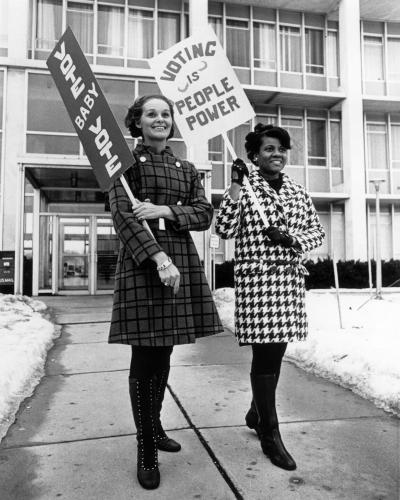
League of Women Voters, 1970’s
Jenny was born in Oregon in 1933 but had gone to college in California and lived for some time in Washington State. I’m a Westerner, she told me with a glint in her eye. What attracted me to her was that she had been a women’s rights activist in the 1960s and 1970s. It isn’t too often that I get to meet a feminist–a real feminist–from the “women’s lib” era. But that wasn’t the only reason I wanted to hear more of her story; our stories, as it turns out, had something in common: Alabama. Will you tell me more about your time in Alabama? I asked her. I think it’s important, and I know it’s interesting! That’s all it took. I will recreate her narrative here with only minimal interruptions of my interjections and comments.
My first husband was an aerospace engineer, and “Mr. Boeing” sent him to Huntsville, Alabama, where he worked on the rocket that sent us to the moon. It was 1964. Kennedy had been assassinated, but worked progressed on the space program. We lived in South Huntsville. Our kids eventually went to Chaffee Elementary School, White Middle, and Grissom High~~all named after the astronauts killed in the Apollo 1 fire at Cape Canaveral in 1967. Of course, that was my first husband. The only things we had in common were our kids–and bridge. We were an unbeatable bridge team! I am very proud that I always spoke well of him to my children. That was very important to me, that they kept a relationship with him. He was a good father.
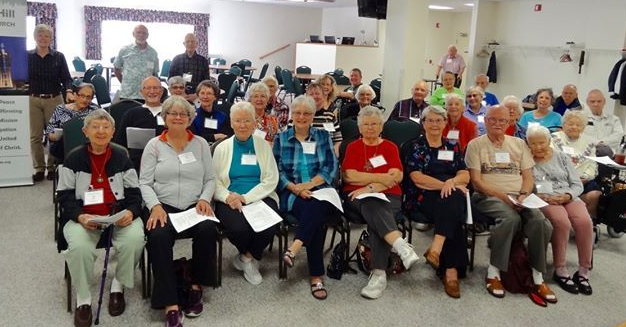
I searched for a photo of Jenny, and I believe she is seated just to the left of the column.
In those days, the senior engineers had a choice of moving or not, and most of them chose not to. So there were communities of young families with young children. Before Boeing, before NASA, Huntsville was a cotton town; once we got there, it was a city of 20- and 30-somethings. I had young children, my husband was an engineer, I was college educated. I needed something to do because I couldn’t just stay at home. The League of Women Voters really did keep me sane. My husband didn’t really approve of the amount of time I spent working, but I did it anyway. I was president of the local chapter. In those days I could mimeograph flyers at my house. We met at my house over the years.
I was in Huntsville the year the President signed the Civil Rights Act and the Voting Rights Act. We worked hard. One of our projects was a weekly bi-racial lunch, where we went to lunch as a group of Black women and white women–together–to a restaurant. In Alabama in the 1960s that was a radical act. You just didn’t do it. My husband’s job was integrated because it was the federal government, so they hired Black engineers. George Wallace was governor during that time, and it was not easy.
I used to tell my friends in the West that not everybody in Alabama was racist, that there were people there who worked for civil rights. I tried to bring my children up that way; of course, sometimes the teachers reported that they were being disrespectful. They didn’t say “ma’am.” But they turned out fine. Eventually, more of the women went to work outside the home, so there were fewer of us who could do volunteer work with the League. When my husband was transferred to Washington State, that was the end of my Alabama years.
By that time, we were finished with our shortcake. I’m keeping you, I said. Yes, I’d just as soon go home now, she replied mater-of-factly, as she asked me to dial her current husband George on my cell phone. George, this is Jenny. You can come and pick me up now in front of the cafeteria. Five minutes, yes. Goodbye. Spoken like a Westerner.
This morning, an opinion piece from the New York Times popped up in my news feed called Where Are the Socially Conservative Women in This Fight? The American family needs defending and right now men are leading the charge. Written by Helen Andrews of the conservative Washington Examiner, a central them was a critique of the “Two Income Trap,” a term coined by Senator Elizabeth Warren in her book by the same name. Andrews opines:
Marriage simply no longer offers the financial security it once did. The consumer goods that singles buy have gotten cheaper, but the things that middle-aged parents spend the most money on — houses, education, health care — have gotten more expensive, while wages have stagnated. It has become difficult for a family with one breadwinner to afford a middle-class standard of living. “Mom’s paycheck has been pumped directly into the basic costs of keeping the children in the middle class,” Ms. Warren’s book “The Two-Income Trap” explained. The mass entry of women into the work force is one reason for this financial insecurity.
Look at that last sentence again. It’s important, as Andrews turns her argument for the emergence of conservative women toward women’s desire for marriageable men. She references the now-viral quote by Fox’s Tucker Carlson: “Study after study has shown that when men make less than women, women generally don’t want to marry them. Maybe they should want to marry them, but they don’t.” Andrews expounds:
As it happens, there is an abundance of data on Mr. Carlson’s side. Wendy Wang is the director of research at the Institute for Family Studies, and before that she worked at the Pew Research Center, where she co-wrote a report about unmarried Americans. “The number of employed men per 100 women dropped from 139 in 1960 to 91 in 2012” among never-married Americans 25 to 34, her report found. “In other words, if all never-married young women in 2012 wanted to find a young employed man who had also never been married, 9 percent of them would fail, simply because there are not enough men in the target group.”
Poor white men. No one wants to marry them. And why not? Because women have taken their jobs!
Here’s another jewel from Andrews, citing an MIT study: When women’s wages went down relative to men’s, marriage and fertility actually went up. I do not have to paint the phallic imagery here, do I?
So, rather than build an economy built on sustainable infrastructures, living wages, affordable health care and child care, paid leave for parents of all genders, tax payer funded college tuition, and jobs in a 21st century world–Alabama leads the rest of the country in this ignoble approach to economics, which, make no doubt about it, it is. Abortion legislation is not about morality or religion or the salvation of Alabama souls. It is political, for it will keep the good Christian people voting Republican–against their own financial and reproductive interests. And this, friends, will keep the Republican coffers full.
The Alabama bill, along with Andrews’s call for conservative women to take up the call to put women back at home rearing children while their men go off to work, is dangerous. Under the guise of fighting for our “right” to stay home and raise children–and do the majority of domestic labor without pay as part of the contractual obligation to which their marriageable men are entitled–women will be demanding to have our rights revoked. Rights that people like Jenny Nixon worked–from her home, while her children were at school–to make available to us. And, women like Governor Kay Ivey, who have the facade of power, do the bidding of male legislators. If you want to see what the world will look like when this retro-vision is enacted, look no further than the Alabama legislature. Or the list of Fortune 500 CEOs, or the U.S. Senate.
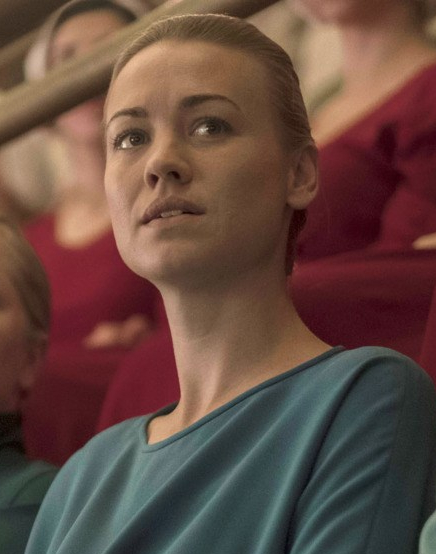
There’s another place you can look. Watch The Handmaids Tale, Seasons 1 & 2. It was not Commander Waterford who was the architect of Gilead. Rather, it was his wife, Serena Joy, who was the power and talent of the movement. In one chilling scene, which I’ve included below, Serena uses her charismatic speaking talent to turn a group of college student protesters to her conservative vision. Keep watching, though, to see how it turns out for her after she cedes her power. See how she lives in Gilead. The cost of equity and equality is high–we continue to pay it. But there is also a cost to maintain our liberty, and part of that cost is vigilance. Margaret Atwood noted in her book the wages of inattentiveness. Nothing changes instantaneously: in a gradually heating bathtub you’d be boiled to death before you knew it.
Have you written your story down, recorded it somewhere, I asked Jenny. No, she said. I thought about it but haven’t. I still remember it, though. I pray that we will all remember, before we boil in a bathtub of our own making.
All my brainiac friends don’t get excited. This ain’t about Judith Butler. There is one part of being a professor that I actually don’t mind: the annual review process. I also enjoyed (!) the Tenure & Promotion process a few years ago, which is very similar, just a little bit higher stakes. Am I a glutton for punishment? Do I also enjoy visiting the dentist or gynecologist? No, I think find the review process meaningful because, at least so far, when I have paused to give account of myself professionally, I have come out on the plus side. My friend Nichole, also an academic–and one whose good opinion I value and want to keep–helped me start the process this year. She has told me several times that she ought to hang out a shingle for all the counseling she gives me. I don’t argue with her. This time, I was bemoaning my lack of discipline and motivation for writing. “Whitlock,” she said, “what are you talking about? You spent a year interviewing people for your book. And you had an edited collection published this year!” I guess, I told her, I hadn’t thought about those. I tend to focus on the writing that I don’t get done. I wonder if other academics do that. I wonder if other women academics do it. It is a very prohibitive and debilitating habit. With that in mind, I approached my annual review, which this year must meticulously be entered into an online system. One good thing about having to enter each tiny part of publication information into separate fields is that you can’t miss what you’ve done! In the hope that I won’t lose sight of it this time and thereby break my nasty habit of null productivity (I made that up just now), here is a list of what I have done this year: I was invited to speak at TCU as part of the Green Honors Chair Lecture Series. I was awarded a sabbatical (see previous post). I chaired a dissertation committee and served as external member on two from Georgia Southern. I wrote a book review that I’m now revising, and I have one book chapter in press and one published. I wrote an invited afterword in a special edition of a journal. I was invited by the dean to give a lecture in her speaker series. I gave three conference presentations. I researched for a book. As far as service (the bane of most academics’ existence), I am associate department chair. I served on a department-level tenure and promotion committee and on a college-level one. I taught an online course for the first time (and liked it!). And: I started seminary at Emory’s Candler School of Theology and moved from my apartment into a bungalow in Atlanta. I started back to church and joined the choir. I made new friends and reconnected with old ones. All in all, this has been one of the best years I’ve ever had.
A sabbatical is a powerful thing. At my university, they aren’t actually called sabbaticals; They are “Enhanced Faculty Leave.” They are competitive, awarded based on a research proposal. At universities that honor the writing processes of its faculty, sabbaticals are given about once every six or seven years. Sabbaticals, not Enhanced Faculty Leave. Why can’t my university call a sabbatical a sabbatical? Because it would imply to the voting (Republican) public that we lazy, blood-sucking socialist/communist academics were getting something for nothing. That’s about what folks think of academics. Just once I’d like our leadership to take a break from politicking local legislators for additional funds for things like football programs and inform the public that about once every six or seven years, professors need time. Just time. To let the fields lie fallow, which is what has to happen for re-creation, creativity, and good writing to take place. As an act of resistance, I will call my Enhanced Faculty Leave a Sabbatical. It takes a while to settle in to a sabbatical–I still haven’t completely done it yet. I keep waiting to have to get up and get ready to go somewhere or do something. What I feel beginning to happen is my mind “un-tensing”–relaxing. I’m mentally starting to sort through how I want to approach my various writing projects. I got out a large yellow pad yesterday–the kind people used to hand write dissertations on years ago. I love those yellow pads; you can tell I’m ready to get down to business when I break out an official pad. While I always have top-notch pens, I’ll write on anything. So yesterday I wrote out a list of every project I want to work on this semester. Here’s the list: 1) two conference papers, 2) an essay for a book about my mentor Bill, 2) a book review that’s a year over due, 3) a review of a manuscript for a publisher, 4) my annual review documents, 5) an essay for a new curriculum studies handbook, 6) a book. Thank God I’m on Enhanced Faculty Leave and not a lazy good for nothing sabbatical. Putting everything on a list is helpful to me. Now, I have sense enough to know that these can’t all be 6 separate writing projects. The conference papers will have to have some framing in common. The book will mine from what I write in them, etc. This prevents me from having to start with a blank page, which is self-defeating to me. If I can only cut and paste a little, I can go forth steadily. Usually. First, I’m going to do the mindless work of the annual review documents. I’m not being flip about taking them seriously. I do. But, it’s like filling out a job application when you have a good resume in front of you. You just lift from on document and put it on the other. This will be time consuming, but little thinking is involved. Next, I will finish the book review before I lose a good friend, the long suffering journal editor, Alan Block. I’m giving myself a week and a half to get these projects done. The others will need framing up theoretically. And that gets tricky. More on this later.
I would bet money that the “oldest (writing assignment) trick in the world” was invented by a high school boy. The kind that ends up a radio show morning dj who, along with one or two other sidekicks–including a woman who is usually the brunt of the sexual joking–fills the a.m. work traffic airwaves with inside jokes and guffaws. I avoid morning radio shows (Rick and Bubba in the Morning, a favorite of my 21 year-old son, which proves my point) at all costs. But in case your’re wondering, I am not a radical public radio snob either, like some of my egghead friends. I don’t need my head hurting from either end of the spectrum in the morning. I send them some money every now and then, though, just to annoy the Republicans. Anyway, you know the kid I’m talking about.
This kid would invariably appear in my Junior English class, where I taught from 1987-2001, and submit a major essay assignment with entitled, “Writing an Essay for Mrs. Hyde’s (that was me then) Formal Essay Assignment.” He then spent 5 paragraphs (intro, body, conclusion) writing about writing (or lack thereof). It was, at first, a cute trick. I always made sure to tweak directions for subsequent essays to include, “and please do not write an essay about how you stayed up all night attempting to compose an essay and here it is, etc., etc.” That usually worked. Actually, some of those compositions were not so bad, probably because the kid thought it was a good idea, got excited about it, and therefore, wrote it pretty well.
This is not exactly that kind of entry. Only half of writing a blog is to mine fresh ideas and strive to find my own relevance. The other half is to write–to keep a writing exercise journal. That means writing–even sometimes lacking a fresh idea. So, this one may not be too innovative, but I have a thought or two about it.
I’ve been thinking a lot about being relevant. I wrote a grant proposal a few weeks ago. Granted, I came up with a topic from scratch–it wasn’t my lifelong burning passion to be sure. Still, I spent weeks on it, and I know it was well written. I’ve never received external funding for my work (possibly because my work sounds a lot like this) and this was a test case at the very least. I was turned down–and I really thought it stood a chance of getting funding.
A big part of academic life (being a professor, for those who do not regularly refer reverently to “the academy”) is rejection. It’s something most of us at one time or another must deal with. I’ve been doing it for seven years and it isn’t getting easier. Although, I realize even when I didn’t do anything but eat Little Debbie cakes and watch tv at home (dreary, lost years indeed) rejection was still present in different ways and still was not any fun. Academics get rejected in all kinds of ways: by journals, conferences, universities where we apply for jobs, publishing companies. We get rejected by anybody who has the ability to reject us, it seems. Some of us more than others, which is an entry all to itself and is coming, believe me.
The grant proposal rejection sparked an ongoing thought for me lately: relevance. Nobody has actually used that word referring to my work; when people do actually read it, it is usually well-received. More to their surprise than mine. This comes under my being my own toughest critic. Here’s the thing. Writing is what I want to do; I am a professor, for crying out loud, which does more than just imply that I have something to profess. I don’t have any news, or celebrity gossip, and I don’t write about vampires. I don’t have any more of a clue than most other people why some children do better in school than others. For me, professing can be very humbling. Who the hell am I and what the hell do I have to profess? Are my thoughts, am I (for it really is the the same thing, see?) relevant? I think about this a lot, and I’m not finished thinking about it.











 The Front Porch Professor