
I added a page to my Homepage to explain my thoughts and personal policy regarding Artificial Intelligence. Here it is as a post.
Within 20 years (perhaps 10, probably 5), this message will no longer be necessary. Within a generation, content producers and consumers will have figured out the ethics of using Artificial Intelligence to generate all kinds of content–from graphic designs, to music, to work documents for all professions, to classroom coursework, to, yes, blogs. We will have found the balance between using AI as a tool to enhance our work and relying on it to do the work for us. We will have figured out the survival–celebration, value–of artists, academics, and writers (human anythings) so that we will not have been replaced, which is a current concern. With a nod to Faulkner, I believe when it comes to AI, we will do more than survive. We will prevail, but we are not there yet.
My institution has three options regarding AI usage in the classroom that we faculty can incorporate into our syllabi–“Generative Artificial Intelligence Use Prohibited,” “Generative Artificial Intelligence Use Allowed with Attribution,” and “Generative Artificial Intelligence Use Encouraged with Attribution.” That pretty well captures the options for use in most settings. We can prohibit the use of AI, allow its use with care, and/or encourage its use. I would argue that the first option is not only unrealistic, but it would also put users at a disadvantage. Option 3 sounds to me like it could turn into a party–a free for all for beginners and professionals alike without boundaries and guardrails. Option 2 is a reasonable place to start, as it insists upon using the creative brain first and primarily, allowing us to form a relationship with AI–which we will do, one way or another, but that is another story–where it is the tool, not us. We humans must stay in the game, after all. (To the people reading this in 20 years–I know you are laughing and shaking your heads. Enjoy!)
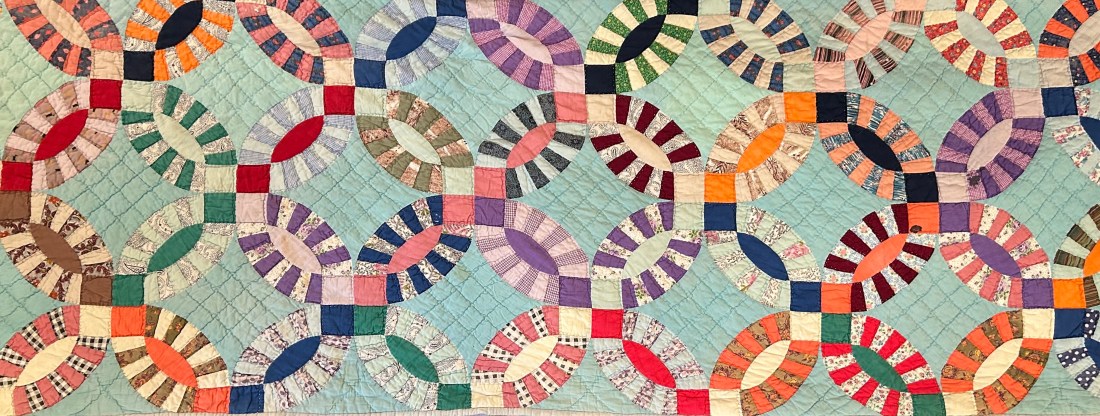
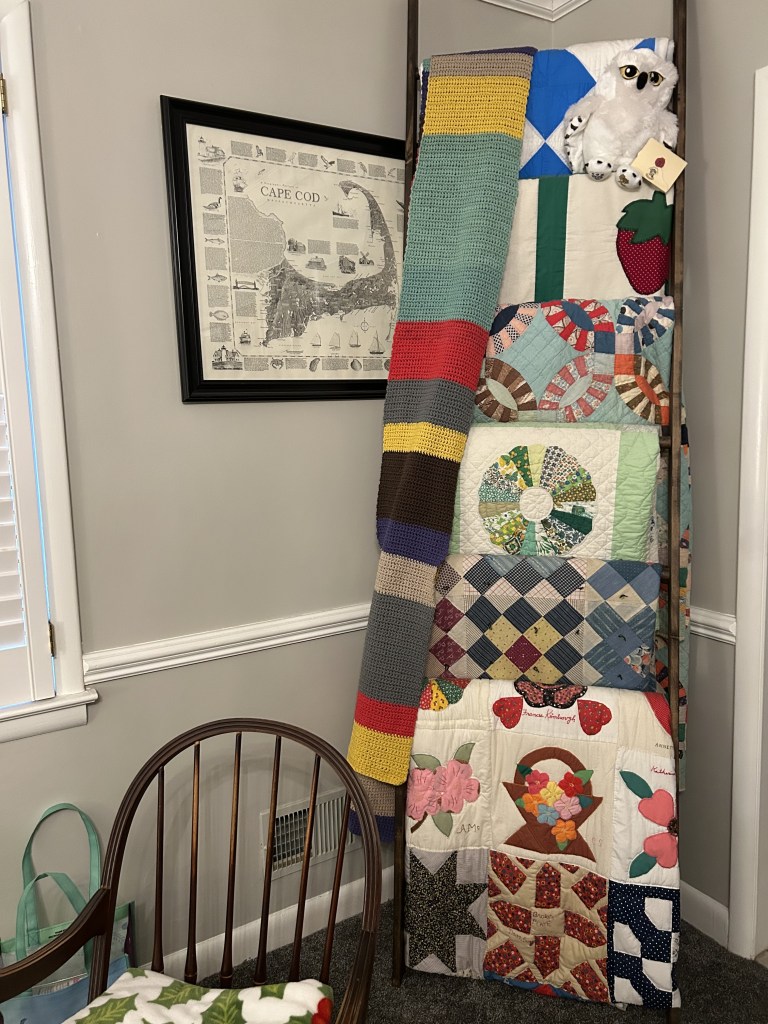
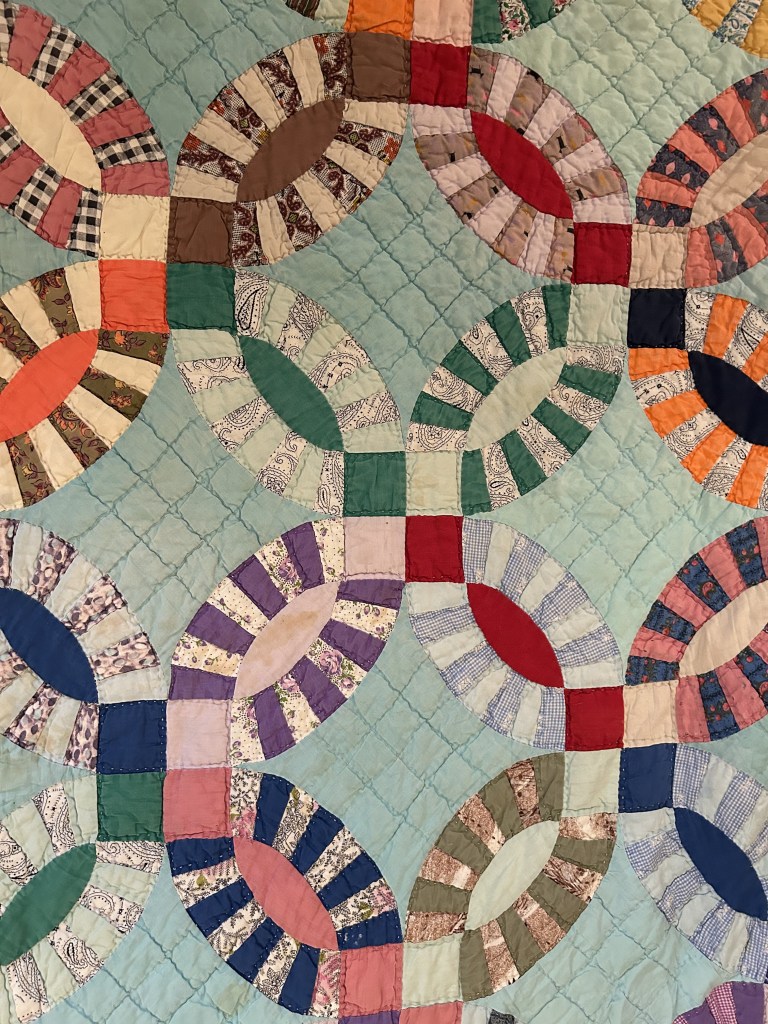
I think of AI like quilts. You can purchase pre-printed quilting material at Walmart or any fabric store. To make your quilt, you only have to put stuffing (called batting or wading) between the printed side and the backing, and outline the printed design with thread, and viola, a quilt. I have one or two of these that my sweet mother and aunt have given me. They are treasures, but they are nothing like the quilts they used to make before their hands got tired and bent from arthritis. Designs were intricate and colorful, made from generations old patterns. Some patterns were made with hundreds of small pieces of cloth, which were stitched painstakingly, creating a “double wedding band,” for example, on the colorful front and plain-cloth backing. These quilts are heirlooms, works of art that are lovingly protected and stored to preserve their beauty. The difference between AI generated content and human generated content is like the difference between the printed quilt and the pieced quilt.
But, you may ask, how is that a valid comparison, since AI content is sometimes indistinguishable, often superior to human generated content? The attributes of beauty, of quality—even, maybe especially, messiness and flaws—are the human elements. Our challenge is not to attempt to catch up to what AI can do–we can’t. Our challenge is what the poets have always sought to evoke in humanity. It reminds me of what Ashley Wilkes tried in vain to express to Scarlett O’Hara: “I do mind, very much, the loss of the beauty of the old life I loved. Scarlett, before the war, life was beautiful. There was a glamour to it, a perfection and a completeness and a symmetry to it like Grecian art.” Ashley, though, mourned for the lost grace and perfection (that never existed), and in so doing, sadly missed the point…and the opportunity. Human completeness and symmetry are not going anywhere; we just have to be intentional about keeping them—us—alive. Aliveness is the pearl that makes Artificial Intelligence artificial.
At the beginning of my classes, my students and I talk about the ethics of using AI for course assignments. We look at the University’s options, above, and I talk to them about Google’s standards for evaluating web content (Google will not publish just anything), the E-E-A-T Guidelines. E-E-A-T stands for expertise, experience, authoritativeness, and trust. Google holds content to this standard in part to screen content that is generated to “manipulate search rankings.” Google uses its automated ranking system to focus on “high-quality, reliable, people-first content” https://developers.google.com/search/docs/fundamentals/creating-helpful-content. I’m sure that me and my little blog and my academic writing were not what Google had in mind when it developed its regulatory content standards. My blog has 4 readers, one of whom is my sweet Mother, and the academic writing has even fewer. But just as AI reaches broadly toward various fields and modalities, so too must the ethics that guide its use.
I try to persuade my students that I would rather read work full of their own emotions, originality, and creativity than a perfectly crafted AI-generated response paper. I’m not naive—AI is too easy to use—so we talk a lot about treating it more as an editor than a creator. I encourage them to maintain and strengthen their sense of creator-ness while learning to use AI responsibly as a tool to enhance their ideas, not replace them. I want them to see themselves as authors of their own thoughts, capable of crafting their work like a beautiful, hand-pieced quilt, rather than relying on AI to assemble their ideas for them.
Some academics will prohibit the use of AI in their courses, focusing on catching students who use it. These are likely the same individuals who hold their peers to a higher standard when it comes to leveraging AI. Over time, these attitudes will adapt. For instance, I was encouraged to find that a Google search for ‘Scholars and academics who use AI’ yielded results emphasizing the responsible and ethical use of AI in research and writing. Just today, Tom’s Guide published an article, ’12 Days of OpenAI,’ reporting on OpenAI’s release of the new Pro More subscription, designed for advanced scientific research and complex mathematical problem-solving, at a cost of $200 per month. I’m old enough to remember when personal calculators were banned in math classrooms out of fear that students wouldn’t learn to calculate on their own. Eventually, we realized that without understanding the underlying concepts, a calculator wouldn’t help a student much. Similarly, while AI has historically struggled with math, it’s improving—and for $200 a month, you can see its progress. Advances like Pro More will inevitably become irresistible and indispensable for researchers. I suspect that as AI continues to evolve, the ethics of its use in academia will become increasingly situational.
For my blog and academic writing, I drafted a disclosure to include with my work. The following is the only AI-generated content in the post. ChatGPT spit this first one out in less than 10 seconds. It’s well-organized and pretty comprehensive, and with my found time I folded a load of laundry. Scroll to the bottom to see the human-created, much simpler finished product:
Personal Ethical Policy for AI Use in Writing
As a writer, I recognize the value of artificial intelligence as a tool to enhance creativity, efficiency, and quality in my work. To maintain integrity and uphold ethical standards, I commit to the following principles:
- Transparency:
- I will disclose the use of AI tools in the creation of any content where its contribution significantly impacts the final product, especially in professional, academic, or published works.
- Originality:
- I will ensure that the core ideas, voice, and creative expression in my writing remain my own. AI will serve as an aid, not a replacement, for my unique perspective and narrative.
- Accuracy and Verification:
- I will verify any AI-generated information, ideas, or suggestions to ensure factual accuracy, avoid misinformation, and maintain credibility in my writing.
- Plagiarism Prevention:
- I will not use AI to produce content that could be considered plagiarized or misrepresented as entirely original. Proper attribution will be given where AI outputs are directly used.
- Mindful Usage:
- I will use AI tools for appropriate tasks such as brainstorming, editing, and administrative writing assistance, while refraining from over-reliance that could diminish my skill development or creative input.
- Respect for Context:
- In collaborative projects, I will adhere to agreed-upon policies regarding AI use and respect any ethical or legal guidelines specific to the context of my work.
- Commitment to Growth:
- I will continuously evaluate the role of AI in my writing practice, striving to balance innovation with authenticity, and learning how to responsibly adapt to emerging technologies.
That’s way too much information, and notice how Chat GPT numbered each item in its own list #1, a fitting reminder that although AI organizes information with precision at light speed, creativity and meaning-making is and will continue to be a human enterprise.
AI went on to ask me: “Would you like adjustments to tailor this for a specific audience, such as professional peers, readers, or students?” I declined the offer, and here is my human version:
The work presented here is original to me. I have used AI tools such as ChatGPT sparingly and ethically for tasks such as identifying trending topics, proofreading, suggesting key words for search engine optimization. I have carefully reviewed AI-generated suggestions to ensure they align with my authentic voice and unique style, thereby preserving the creativity and integrity of the work and myself.
 The Front Porch Professor