Remembering the Teachers Who Inspired Me, Part 2

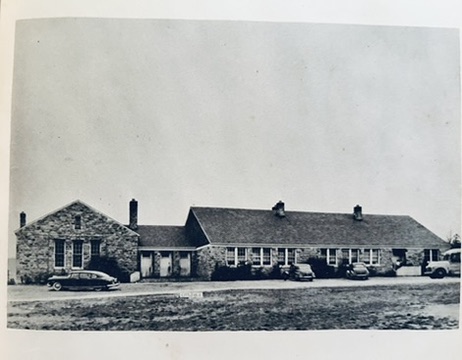
Littleville School, 1949

What I Learned From My Teachers

From Part 1: There’s a lot we carry from our school days—the lessons that stick, the ones that shape us in ways we only realize years later. I’ve been thinking about the teachers who left a deep impression on me, and how those early experiences continue to resonate as a quiet, steady presence in my life and work today. This piece (Parts 1 & 2) is dedicated to the teachers who shaped me, and I want to honor them by name.

Classrooms in Littleville Elementary & Junior High School
Classrooms in front of Littleville School shortly after its closure

Part 2: Miss Thorne, 7th Grade Math: A Lesson in Apology
Miss Janice Thorne, who became Mrs. Berry during our 7th-grade year, is the only teacher I ever apologized to as an adult. My behavior in her class was atrocious. I vividly remember entertaining my classmates by hiding in the classroom while she searched the campus for me—the day the principal, Mr. Morgan, called my dad. Not my mom. Dad. I don’t remember acting out much after that. Like Mrs. Wells, Miss Thorne had the unfortunate task of competing with Miss Renwick for my attention, but unlike Mrs. Wells, she wasn’t a natural commander. I’m really sorry, Miss Thorne.

Miss Thorne also had the misfortune of being assigned to teach us P.E., which required her to wear gym shorts, crew socks, and SeaVees gym shoes. For some reason, this embarrassed me, though I couldn’t have explained why. She was also a member of a neighboring congregation, so I saw her off and on through the years. That made my apology all the more meaningful when I finally had the courage to offer it.

Probably unsurprisingly, Janice left teaching the year after I had her as a teacher. I have reflected on whether my behavior might have contributed to her decision, and my small consolation is that she likely made a good deal of money by going to work for TVA. Miss Thorne—Mrs. Berry—died in 2023, and I am so glad I had the chance to show her respect as an adult.

Mr. Morgan, Principal and 7th Grade Social Studies: The Importance of Being Remembered
Mr. Morgan was the principal of Littleville School and also taught us 7th grade social studies. He was tall, having played basketball in his younger years, and he coached our teams with the same towering presence. His other claim to fame was that he had fought in the Korean War alongside Dan Blocker, who played Hoss in the very popular Bonanza TV show. I was glad to learn that Mr. Blocker was a nice person. Mr. Morgan regaled us with stories like these during social studies—and come to think of it, the Korean War was part of the curriculum. Mr. Morgan had the longest face I’d ever seen–one can’t help but recall Lurch from The Addams Family–and he spoke with a distinct impediment. We students discussed it and surmised that his tongue was attached to the bottom of his mouth—at least, that’s what it sounded like when he talked. But we quickly learned to understand him, and his speech became just another part of who he was.

Littleville School Gymnasium
Run-down gym of Littleville School, a shell of its former self.

Every year I attended Littleville, I earned a paddling from Mr. Morgan. Unlike Mrs. Fowler’s little red-painted ping pong paddle that intimidated second graders, Mr. Morgan’s paddle was a serious piece of wood—it must have been two feet long and was covered in signatures from its many recipients over the years.

In the early 1990s, Littleville School was closed due to low enrollment. The town had suffered during the recessions of the 1970s, and eventually, the numbers just weren’t there to keep the school open. Before the doors closed for the last time, a “homecoming” was held for everyone who had ever attended. That included my parents, my brother, neighbors—even my grandparents. I was a grown young woman by then. My parents were reminiscing with Mr. Morgan, who chose to retire rather than move to another school. He looked at me and said, “I remember when I gave you a paddling one time, Ugena. I had to hold back a laugh when you looked up at me and said, ‘Mr. Morgan, this is going to hurt me more than it hurts you.'”
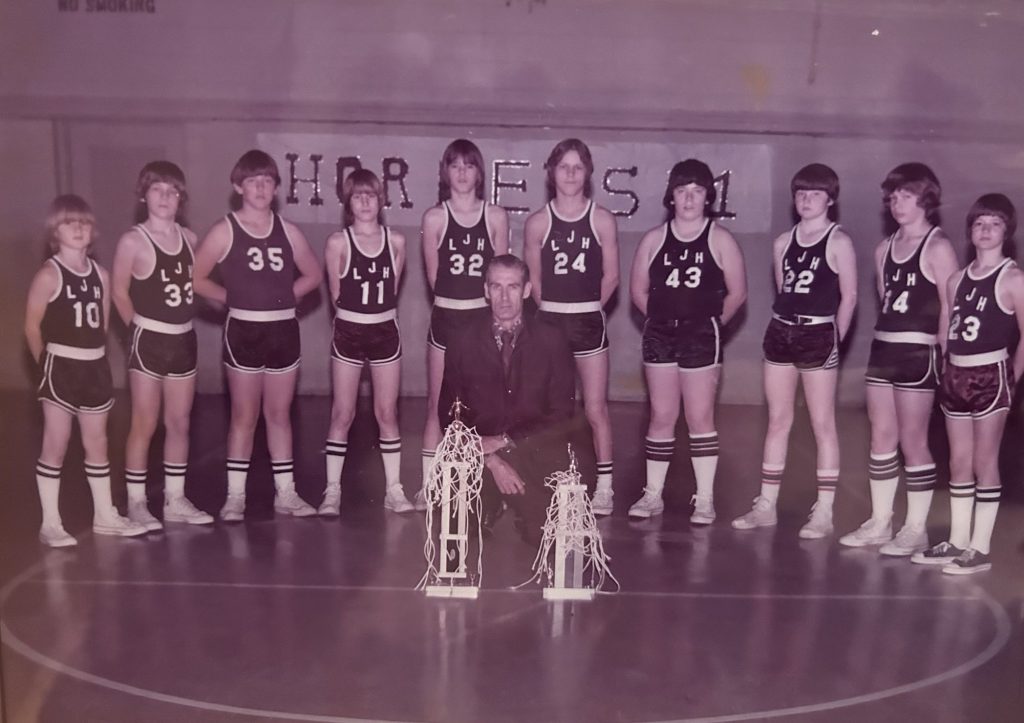
Littleville School "Hornets" Basketball Team, 1974. Center: Mr. Theron Morgan.
Littleville School “Hornets” Basketball Team, 1974. Center: Mr. Theron Morgan.

A 20-year career, and he remembered a joke from a 10-year-old girl. Because I was funny and smart. I had been memorable. That, I think, is my main lesson—that these people thought enough of me to remember me.

Mrs. Mansell, 9th Grade Algebra: Making Math Make Sense
In 8th grade, I transferred from Littleville to Russellville to join the RHS Marching 100 Band. My parents really sacrificed to make this happen, commuting me to school a half-hour away instead of the five-minute trip to Littleville. Almost every teacher I’ve mentioned so far had told my parents that I needed enrichment to keep me busy—that my acting out was because I was smart. That made an impact, so I went to Russellville instead of following my Littleville classmates to the county school. I have often wondered how different my life would have been if I had taken the natural path instead of forging the one I did. Two roads diverged…

The RHS Torch and Tradition, a legacy of E.L. "Prof" Williams
The RHS Torch and Tradition, a legacy of E.L. “Prof” Williams

At Russellville, Mrs. Mansell stood out. She had real presence. She taught 9th grade Algebra and made math understandable in a way it hadn’t been since Mrs. Wells. Her father, E.L. “Prof” Williams, had been principal at Russellville High from 1937 to 1957, and my dad even remembered “Mickey” Mansell helping him register as a new student his ninth grade year. She connected with us, made herself available, and showed patience beyond measure. I remember being at a slumber party before exams, and a group of us girls called her for help. She patiently tutored us over the phone, and we all did well on exam day.
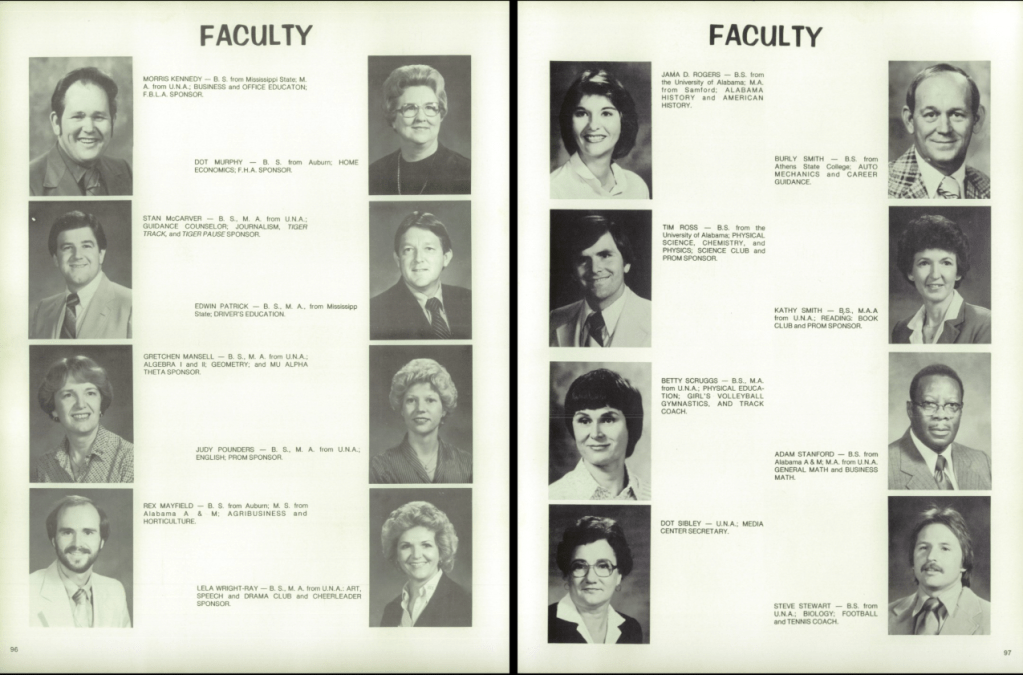
Faculty from 1982 Russellville High School Tiger Tracks Yearbook
Faculty from the RHS Tiger Tracks Yearbook; Mrs. Gretchen “Mickey” Mansell is in far right column, third from top

Despite her dedication and deep roots in the school’s history, Mrs. Mansell wasn’t allowed to teach upper-level math in the late 1970s. Those classes were reserved for a male teacher who prided himself on making his classes competitive. He openly stated that he taught to the valedictorian and salutatorian—to weed the rest of us out. I was weeded out of trigonometry in the first week. Discouraged and disheartened, I switched to Home Ec. I decided I’d rather study European and American furniture styles than endure that feeling on a regular basis.

I suppose I learned a lesson from him too—but of all my teachers, his was the biggest lesson on what not to do.

This piece is dedicated to the teachers who shaped me, and I want to honor them by name. They were the steady presence that guided a little girl from the country, who against all odds, would leave Littleville and go on to earn a doctorate and become a professor. I grew up knowing I was the “smart girl,” in part because they told me so—through their expectations, patience, and nurturing. They taught me lessons about kindness, resilience, community, and the quiet power of believing in someone. And as I reflect on my own teaching, I realize I’m still learning from them, still carrying their influence with me in every classroom I enter. I thank them so much.
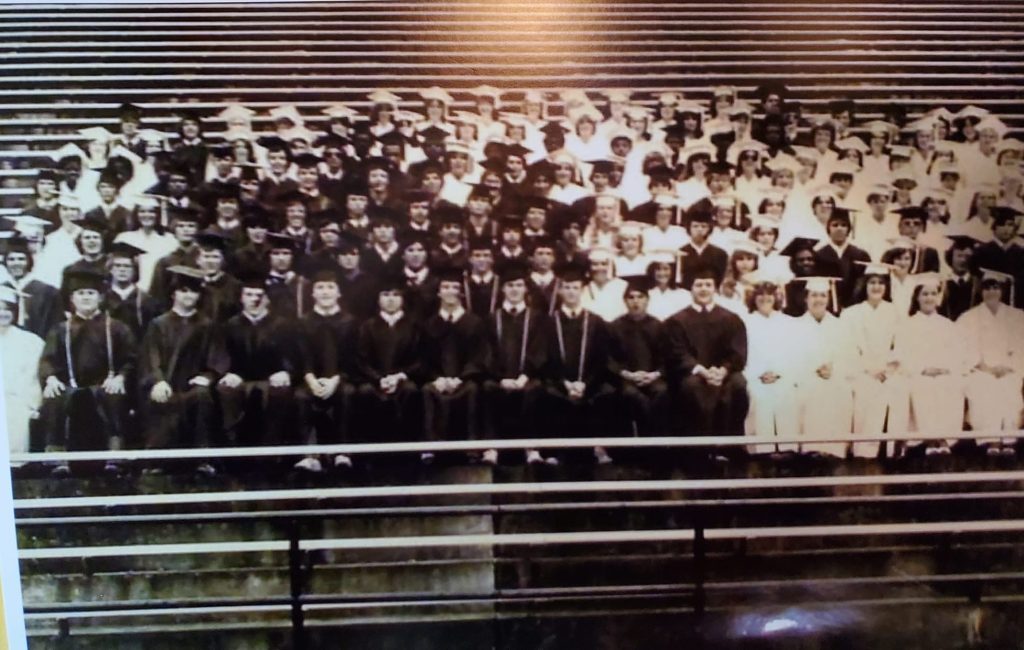

Russellville High School Senior Class Picture, 1981

Exploring Nostalgia, Place and Southern Identity in Writing

Nostalgia, Place, and Feeling Southern

In a recent essay, Evolving From Just Keep Swimming to The Front Porch Professor, I explored the journey of reimagining this blog to reflect my evolving focus on narrative storytelling. At its heart lies the front porch, a symbol that anchors my Southern identity and shapes the lens through which I write. This post builds on that foundation, unpacking the concepts of nostalgia, place, and Southern identity—terms that are complex and intertwined. Sitting on the front porch is an appropriate place from which to give them the careful exploration they deserve.

You may be asking, “Well, when are you going to start writing instead of just writing about your writing?” Good question. The process is a throwback to academic writing, where you have to describe your framework and method for presenting your ideas. In other words, I need to tell you how and why I’m going to tell you what I tell you. Then I can tell you. But you’ll be glad to know I’m about ready to start front porching.

Why The Front Porch Professor?

Claiming the title of professor in my blog name is about more than qualifications; it reflects a blend of storytelling, introspection, and intellectual curiosity. It signals that the reflections here are informed by years of observing and searching for meaning. The image of a professor on a front porch bridges the formality of academia and the warmth of casual conversation. I invite you into a space where lived experience meets thoughtful analysis, encouraging connections and deeper understanding.

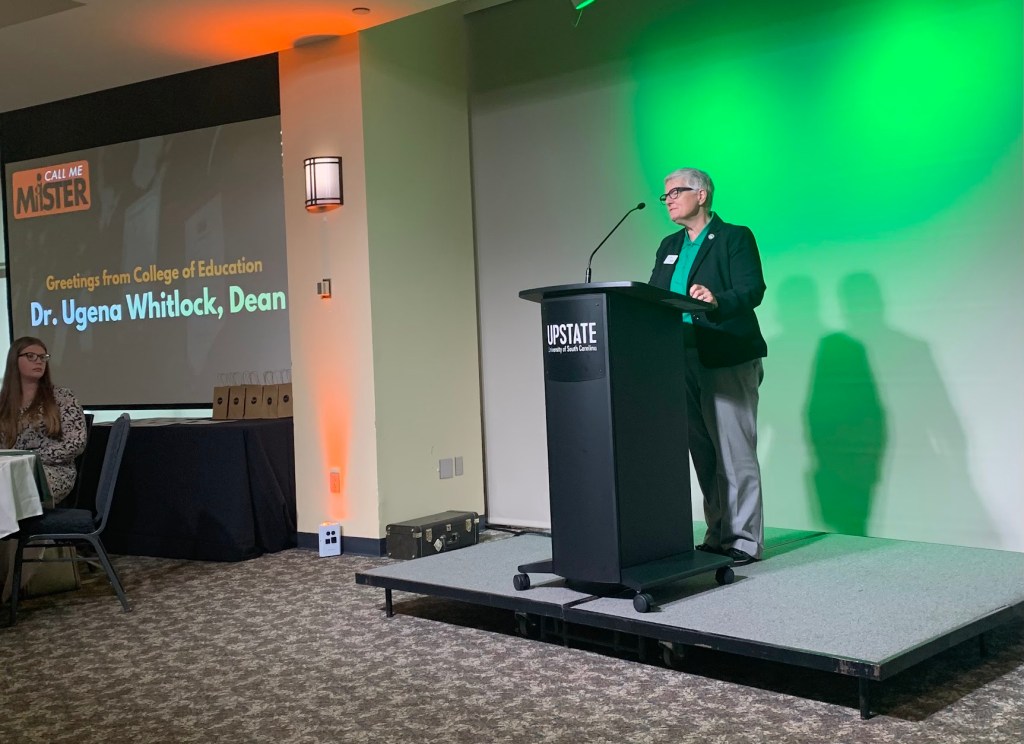
Image of Dr. Ugena Whitlock at USC Upstate
Professor Whitlock

For me, the title is also a tribute. As a small-town girl from rural Alabama, raised by working-class parents, becoming a professor is a point of pride. It’s a testament to their sacrifices and the support of friends and loved ones. They are ever present in my writing, shaping the stories I tell and the perspectives I share. I am both proud of the accomplishment and humbled by the debt and responsibility I owe them.

Place and the Southern Perspective

When I write about place, I’m speaking to more than just geography. Place encompasses the physical environments where life unfolds. Place is the landscape on which contexts of culture, history, and society are painted. It’s where relationships, joys, disappointments, and lessons unfold. All this happens individually and collectively. Place is both a backdrop and a character in our stories, influencing who we are and how we navigate the world.

Image of small downtown Russellville, Alabama, with snow, church, and Roxy theater
Downtown Russellville, Alabama

Being Southern, then, adds layers to this concept. The South is more than a region; it’s a complex web of traditions, histories, and cultural markers. To call oneself Southern is to grapple with the beauty and contradictions of the place. With the South’s ugliness. Can one be proud to be a Southerner, as I am? What does this mean? What am I proud of? And what about the parts of Southern “heritage” that I am not proud of? What is my relationship to those people who claim and celebrate the ignoble parts?

Writing From a Southern Perspective

“Being Southern” is as much a state of mind as it is a physical state. My Southern identity isn’t about celebrating a romanticized version of the South–you know, moonlight and magnolias. Instead, it’s a lens through which I explore themes of home, culture, and identity. The South, for me, is a place of deep connections, shaped by family, history, and the rhythms of everyday life. Southern identity is not monolithic—I don’t assume my identity is exactly like yours, just as your experiences may differ from mine. While we may share certain aspects, identity is deeply individual and uniquely shaped by personal experiences.

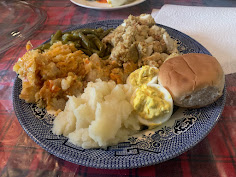
Image of dinner with deviled eggs and mashed potatoes
Southern food–note the Thanksgiving Chicken and Dressing

Family and home are central to this perspective, grounding my stories in the relationships and traditions that define Southern life for me. The culture of the place is a tapestry woven through the land, neighbors, communities, histories, food, churches, schools, music, and football. These often appear in my writing, not only offering insights into shared experiences but also helping us understand the world around us and highlighting the relevance of our observations. Yes, there are lessons to be got from SEC football. Roll Tide, y’all.

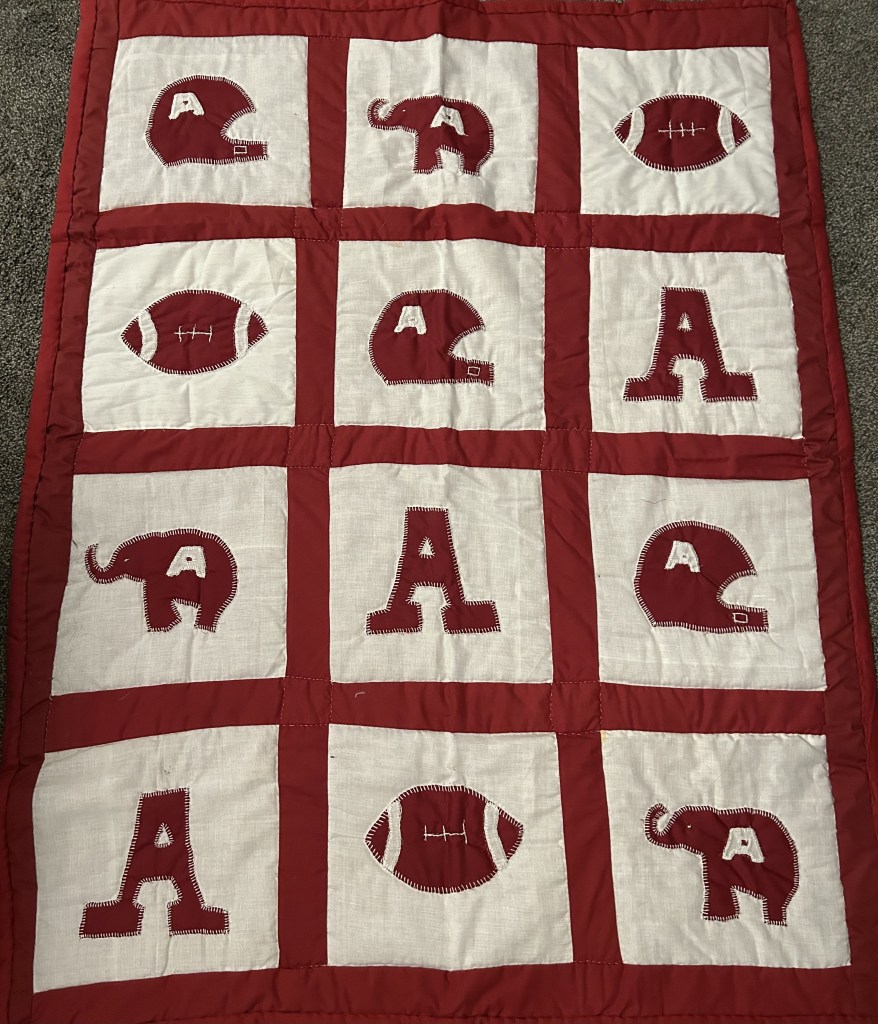
Image of a handmade quilt with a crimson and white Alabama football theme. The quilt features appliqué designs of football helmets, footballs, the letter 'A,' and elephants in alternating squares. Each design is outlined with visible stitching, and the quilt is bordered with a crimson edge, showcasing school spirit and craftsmanship.
Lovingly made Alabama Quilt from my Mother

But writing from a Southern perspective also means wrestling with the region’s complexities. The South is as much about its tensions and contradictions as its traditions. It’s a place where politics, identity, and history converge, challenging us to confront difficult truths while celebrating what makes it unique. Without acknowledging the turmoil and inequalities of its past, any discussion of Southern life, identity, and culture feels inauthentic and incomplete—it’s a Southern writer’s malpractice. As someone who often says, “I love the South,” I can be trusted to both celebrate and critique it. Critique from someone who hasn’t lived it or can’t celebrate it is equally incomplete–and there are plenty of these critics around. This is my not so humble Southern opinion.

Nostalgia: A Lens for Understanding

Nostalgia, as I see it, is not about longing for a bygone era but about connecting the past with the present to find meaning that may inform the future. The word itself comes from the Greek words nostos, meaning “homecoming,” and algos, meaning “pain” or “longing.” It speaks to a deep yearning for the familiarity and comfort of home, even if that home is more an idea than a place. Some homes are not the kind we can long for; rather, we might long to be released from their memory. This etymology captures the duality of nostalgia: it brings remembrances of warmth and connection, yet it also reminds us of what is distant or lost. The dual nature of nostalgia vies for our attention, wrestles for focus, and fights for dominance—keeping many of us in therapy for years.

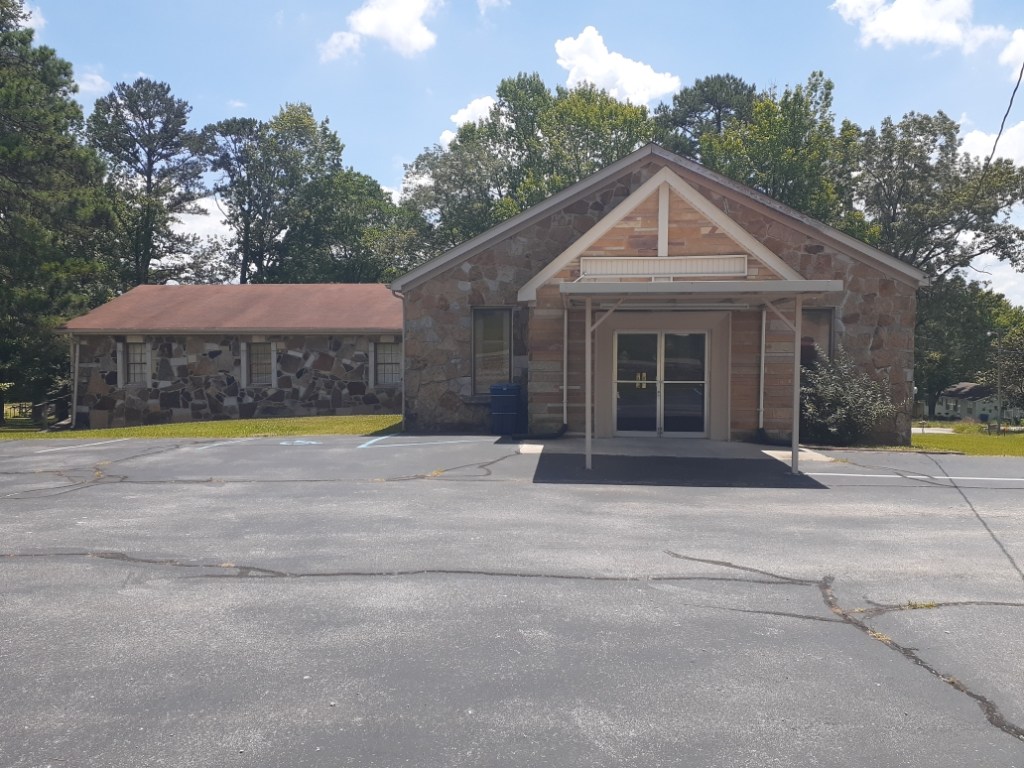
Image of small stone church, Littleville Church of Christ, Littleville, Alabama
My home church, Littleville Church of Christ, Littleville, Alabama

It’s a complex emotion, often blending warm memories with a bittersweet awareness of time’s passage. Far from being purely personal, nostalgia is often collective, rooted in shared experiences and cultural touchstones like family recipes, cherished traditions, or the familiar strains of an old song. In my writing, nostalgia becomes a guide for exploration. Stories about homeplace and family lead me to reflections of broader themes, such as the importance of community, civility, and the pace of modern life. Nostalgia isn’t a destination where we can remain lost in the preferred past; for me, it’s like wrapping myself in an old quilt, offering warmth as I navigate the here and now. You can’t linger too long, though, because living means stepping into the day with clarity and intention.

The Front Porch as a Space for Reflection and Stories

The front porch, in this context, is both a literal and metaphorical space—a place where complex ideas meet honest, accessible conversation. It’s where intellectual rigor mingles with the warmth of shared stories, and where connections are formed through curiosity and reflection. This is the balance I strive for: nostalgia not as an escape but as a framework for growing and learning.

The front porch is open to anyone willing to join the conversation, to explore what place, the South, and our shared histories mean in today’s world. And if you aren’t Southern, you might still have a good time and make connections, too. Together, we can find clarity, joy, and meaning in the stories we tell. I believe we have a responsibility to one another to make the world a better place–a place where we indeed have the liberty to pursue the happiness of a gratifying life. Taking care of our neighbors has never been as important as it is now. It feels like not only have we forgotten how, but we have forgotten that we ought to in the first place. That’s another reason front porches are important. I hope you will join me.

Exciting News: A New Chapter for the Blog!

Image of Logo for Blog The Front Porch Professor with rocking chair, typewriter, and Mazda Miata..

Hello, friends! I’m thrilled to share that my blog is getting a fresh start under a new name: “The Front Porch Professor.” This new space will continue to feature the reflections, stories, and observations you’ve enjoyed, with a renewed focus on life, learning, and the journey ahead—all with a touch of Southern charm.

I’m currently working on exporting all my posts from Just Keep Swimming to the new blog, so nothing will be lost. If you’ve been following here, I hope you’ll join me on this new adventure! With any luck, your subscription will carry over seamlessly, but if not, I’ll share the link to the new blog soon so you can continue following along.

Thank you for your support and encouragement—stay tuned for updates and more from “The Front Porch Professor.”

God Laughs, or Fun with Bell’s Palsy

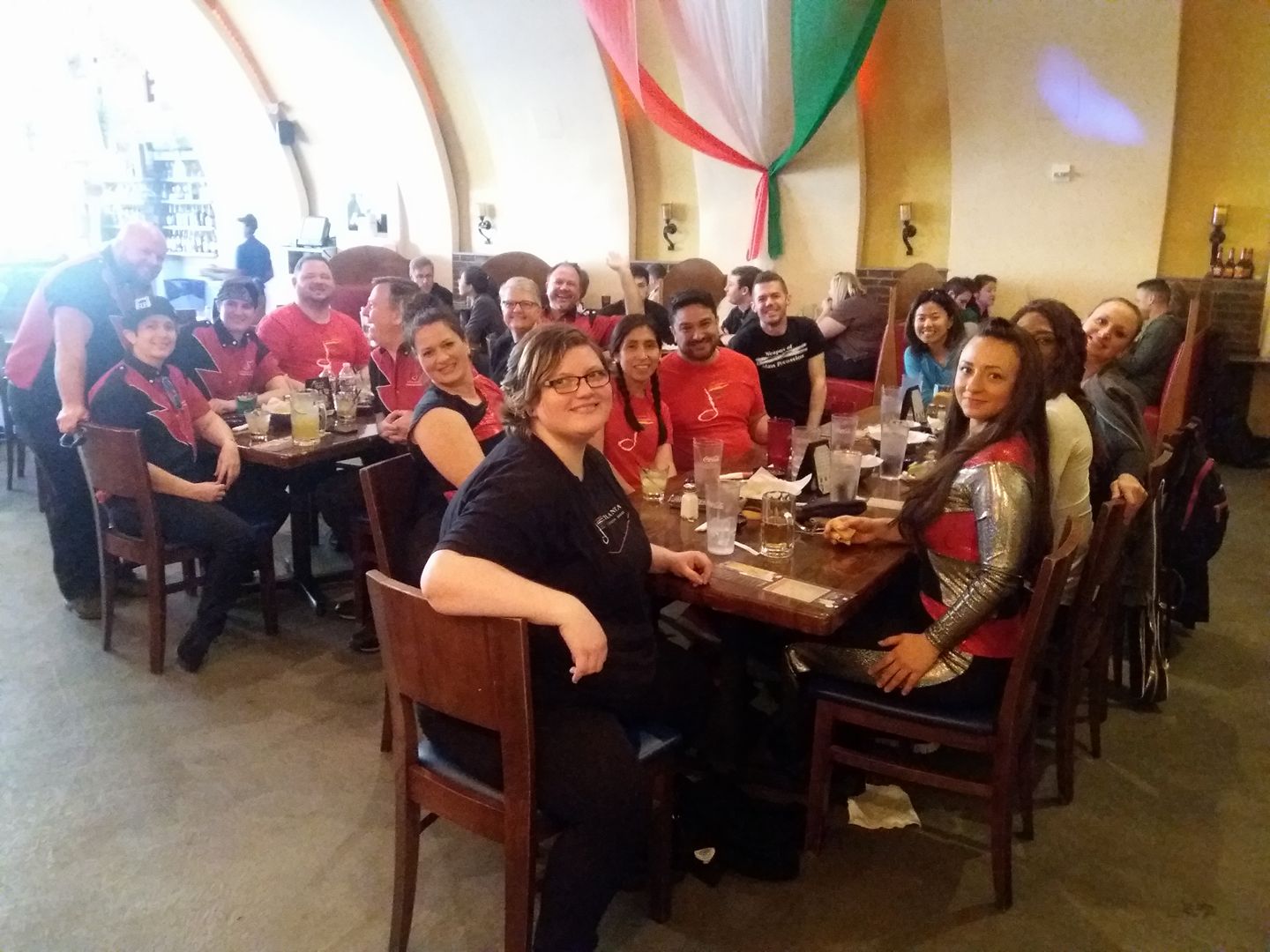
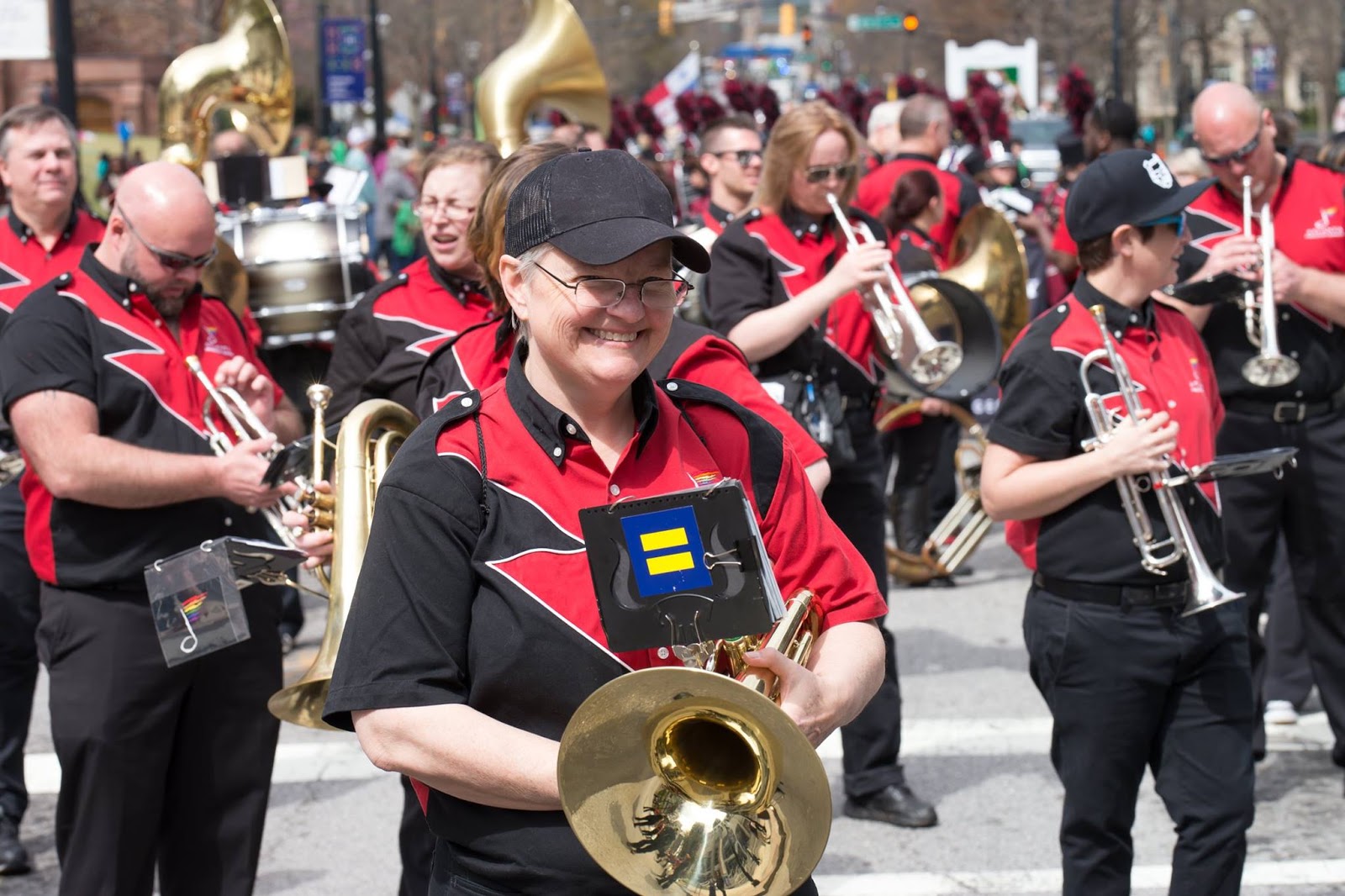
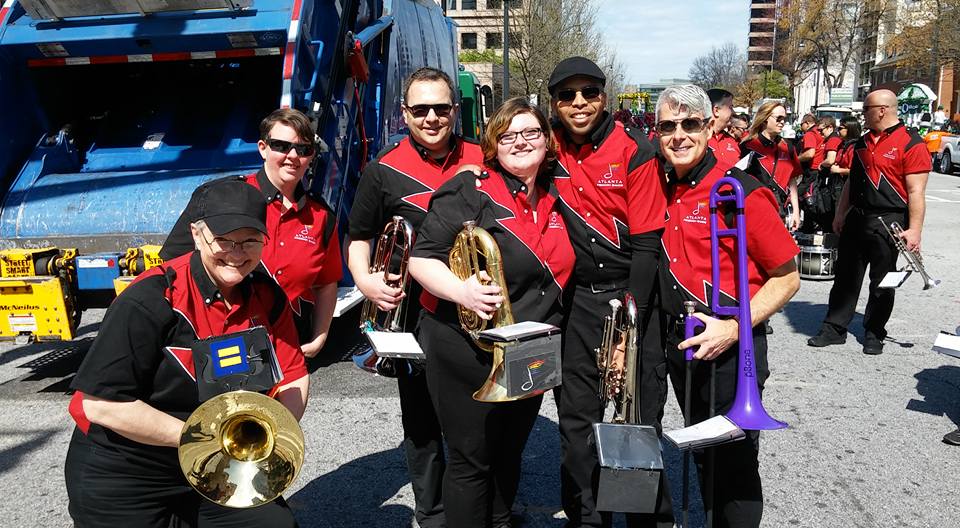
You make your plans, and God laughs. That’s what happened to me over the weekend. Let me go back, though, and start with discovering the Atlanta Freedom Bands, which I wrote about here in November 2014. I recollected how finding the band made me realize how much I had missed making music, marching in parades, performing in concerts. How after more than 30 years, finding the AFB was like discovering a new, yet long lost treasure. Last year, I marched my first season of parades in various Atlanta community festivals. It was wondrous. And at Christmas, I performed in my first concert playing French Horn in 35 years. Last Saturday morning, I marched mellophone with the AFB in the Atlanta St. Patrick’s Day parade. Afterwards, members of the band had lunch and drinks and fellowship at a local restaurant, which is the custom with this group.

Saturday night, kept waking up with what felt like a neck cramp. When I woke up early Sunday my speech was slurred, which I chalk up to needing a little more sleep, so I went back to bed. When I woke up again, I couldn’t blink my left eye. I ended up Sunday at the emergency room in Marietta. After they have ruled out a stroke, which was probably the best news I have ever received in my life, they told me I had a textbook case of Bell’s palsy. After a lot of googling I found out that it’s caused by virus, kind of like shingles. Likely because I had the flu, and that virus was in my system, it ended up attacking my facial nerve, causing it to be droopy and paralyzed. Like shingles, it was likely triggered by stress. In addition to facial paralysis–a word, like biopsy, fills me with terror–I have heightened ear sensitivity in my left ear, so loud noises, including my own sneezing, amplify like I’m standing in front of a Bose speaker. By all accounts, I will (should?) regain use of my facial muscles. Most well-wishers report success stories. It is totally unrelated to a stroke, and contracting it one time does not mean I will get it again. Those are the things I know. The worst part is that I can’t blink, so my eye gets dry and irritated. And that can lead to all kinds of trouble. I have to keep eye drops in it and wear a patch. Having only one eye affects depth perception and means I can’t drive. I can’t whistle or smile or buzz my lips. And buzzing one’s lips is essential to playing a horn.

Even though I realize I am very blessed in that this could’ve been so much worse, I’m still having to learn to deal with it. There are lots of adjustments I’m having to make pretty quickly. I’m learning how to have meals with straws and napkins. I’m learning how to turn my head in order to see better with an eyepatch. I’m learning to enunciate words using one side of my mouth. I’m learning how to encounter other people whose first response is to look away from me. I tried to go to the office yesterday, and by the end of the day I was exhausted from having to compensate physically in order to get from point A to point B, or participate in meetings. Talking and looking took a lot of energy that I had taken for granted. Part of the dealing with is going through my own stages of grief: denial, anger, bargaining, depression, and acceptance.

Sunday and Monday I was in denial. I jokingly made a list with Sarah of one eyed characters for costume parties. We go back and forth with one-eyed jokes. In case you didn’t know, there are many one-eyed one liners. Believing the doctors that taking the meds would speed up recovery by months, I thought, Well if I can’t play horn, I’ll just break out the old flute and play that! I tried for half an hour to form the embrasure to blow air across the mouthpiece.  I waited to blink at any minute. I planned to go to choir. Tuesday night begin my descent into anger. I kept a dinner engagement with some visitors to campus, old friends from my curriculum world. When I entered the restaurant, Marlows Tavern, which I had been to so many times over the past few years, the hostess looked at me and then looked away. Same thing happened when the waitress came to take my drink order. I realize now that I do the same thing automatically–probably most of us do.  The next day, I mentioned choir to Sarah, who slowly turned and looked at me and said, Honey, you’re not going to choir. When I looked back at her in one-eyed disbelief, she started singing a little bit of the Hallelujah Chorus, which we’ve been working on for a month. I thought my left ear would blow out. No, I wasn’t going to choir. When she dropped me at the office,  just walking from one building to the next took all my energy to keep my eye covered so it would not dry out. I had two meetings where it was very important that I be able to speak, and that was extra energy. My colleagues, wonderful people, tried very hard to look at me in a normal way–and for that I will forever be appreciative. Nevertheless, I feel different, I talk different, I look different. And that was psychological and emotional energy spent that I wasn’t used to spending.

I’ll let you know when I’ve moved from anger to bargaining. Till then, in order to work through some of that anger, in order that something generative and therapeutic might come from it, I decided to pick up the blog again. It’s always been my favorite, preferred mode of writing. Academic work is important, but it isn’t accessible, and it limits my flow of thinking since I have to measure my tone and phrasing as well as the thoughts themselves. Here, I can have a conversation, if only with myself. Plus, Sarah approves of it since it will help keep me out of trouble–like trying to do home-improvement projects with one eye that doesn’t need to get dust in it. Most important, this is all helping me put my life in perspective and put the parts of my life in priority. It isn’t an overnight revelation, but I realize that stress is counterproductive and can be harmful. I reaffirm that life is always already about the people in it. That being present and being mindful is living. I am intentionally choosing hope and happiness. Hope and happiness are not default properties, and being intentional about them makes a difference. As I think about it, coming to this place is a kind of bargaining. I will trade impatience for writing, frustration for processing, sight for insight.

Band friends at Sr. Patron’s
Mellophone


A mello-photo bomb

On X-Men and Orlando

On X-Men and Orlando

I’ve been making my family watch a lot of X-men movies this week, as a kind of research project for the new X-Men: Apocalypse. One of the themes throughout all the movies is good versus evil (another theme, especially in X-Men: The Last Stand, is marginalization of people because of their mutation–a clear parallel to homophobia and reparative therapy often forced upon LGB people–but that is another story…). For example, there are good mutants and evil mutants, good humans and evil humans. Sometimes, the evil forces come out on top. But sometimes, Professor X, Charles Xavier, gets through to them. “Don’t do this,” he persuades telepathically. “It isn’t who you are.” Occasionally, he gets through, even to Magneto.

Evil is among us. Whatever prompts us to reject our ethical thinking toward one another by supporting unregulated weapons purchases, or failing to commit meaningful resources to domestic violence and mental illness, or reinforcing homophobia through reframing it as “Religious Freedom”–that is evil. If those issues had been addressed through ethical, social responsible action, then the shooting on Sunday morning most likely would not have happened. They are the root cause–not one person’s or a group’s faith-beliefs toward the Holy Being. We must hold each other accountable, must remind and encourage each other–through real, responsible action, that this is not who we are. Like Professor X, I believe our world depends upon it.

Protest and Privilege

Last night, we sat in front of the television and watched the announcement of the Grand Jury decision from Ferguson, Missouri. From the time the broadcast started, there was a split screen, one camera on the crowd and another on the DA who was reading the lengthy statement. For a while, we watched the people straining to hear what he was saying on their radios and phones. Then, when he got to the point and announced that the Grand Jury had voted not to indict the white policeman who shot Michael Brown, we watched the people process the information, at first in stunned silence. Then the protests started. Even as I write that, just like the camera crews, I realize was expecting them to begin almost on cue. We were waiting. So, I watched them start up, then heat up, and Sarah tracked them all over the country on Twitter.
Then, at around 11:00, we called it a night.
That, friends, is one example of what is known as White Privilege. I had built my evening tv viewing around the press conference and coverage of the “event.” After about the second round of teargas had been shot into the crowd in Ferguson, Sarah looked up from the string of protests starting in every major U.S. city and said, “I think I’m just going to sit here in my white privilege.” I, caught up in the unfolding story, asked her what she meant. “I don’t HAVE a riot outside MY door.” I can be thick as mud sometimes.
Thomas Jefferson wrote, “I tremble for my country when I reflect that God is just; that his justice cannot sleep forever.” Ferguson is the 21st Century version of “Selma,” a cry for justice that in one word captures the collective voices of the disenfranchised. And last night, for me it was there for my viewing pleasure. A few weeks ago, Pastor Kim preached a sermon about it; I shook my head, wrung my hands, and felt sufficiently bad, but not bad enough to stay for the continued Sunday School discussion the following week. That’s part of my white privilege too: I can join up with a church committed to social justice and have the audacity to think that I’m “covered” just by signing the roll. When really, PUCC is a place for me to re-charge and build up my strength to go, to do, to live justice.  Thing is, I don’t really know specifics on how to do that, or maybe I do deep down, but the White Privilege is that little voice inside me that tells me that I don’t—or that it activism can be terribly inconvenient.
I’ll tell you what I couldn’t look at last night, still couldn’t look at this morning when I was seeing all the posts on Facebook. I couldn’t look at the pictures of Michael Brown’s family in what I understand as pain at hearing the verdict. I do not get to share in that pain, don’t get to try to empathize and feel it. I don’t get to feel it because my White Privilege means I can conveniently shut the feelings off whenever I want to. And not just feelings—if I wanted to, at least until the awakening of the Just God, I could live my life for the most part without ever encountering injustice based on my race. I have for half a century, after all. In all likelihood, my son will not be shot by a policeman when he wears his hoodie or has his hands in his pockets. And if that ever happened, I would not be expected to be a stately presence on tv who represents all White mothers everywhere. So, to me, I don’t get to look upon my Black sisters’ and brothers’ anguish now, although, to me, I MUST hear what they are saying. It sounds to me a lot like what Jefferson said 200 years ago. Tremble, country, for God is just.
I’ll end by sharing link to a blog post entitled, “12 Things That White People Can Do Now Because of Ferguson.” Ferguson is now, like Selma was in the 60s, a complicated and contested issue. But if “doing” is what is needed, and I believe it is, then here is a “do-able” way to start. The link is
http://qz.com/250701/12-things-white-people-can-do-now-because-ferguson/. Anti-racist activist Tim Wise (see www.TimWise.org) points out that racism hurts everyone, and that until White people understand that, we will not really become invested in living for a world that is just for everyone. This is a hard knowledge, not a warm fuzzy one. But in the end of this church year, where we have fallen short of the promise of peace on earth, good will toward all people, it is a realization we might—no, must—seek.

Finding Free: The Atlanta Freedom Bands and Coming Full Circle

When I was in fifth grade at Littleville Elementary School, something magical happened. One day, our teacher announced that the band teacher from the nearby high school would be coming to Littleville to talk to kids and their parents about joining the band. It was 1973, and resources for extra-curricular activities–heck, resources for curricular activities–were limited. I remember in previous years, our musical exposure at school had been the on the rare occasions when our teachers had brought out a box with mostly percussion instruments and let us play with them, mostly trying to keep time while a record was playing. This was different. This was band. I could hardly wait for the meeting. When the evening came, the band director, Mr. Wright, brought a variety of instruments so that we could try them out and, with his advise make our selection. I realize looking back that, of course, he wanted a well rounded group of instruments, which is probably why I became a flute player. From that point on, I was in love.

I went to high school in a football town, and a football town doesn’t scrimp on its band. When two new, shiny mellophones arrived at the bandroom, I volunteered to learn to play, and I loved the big, smooth sound of a horn–I was a woodwind no more! We were the Marching 100. I remember the day I was issued my uniform. I remember band camp and big, chartered band buses, chocolate sales and Homecoming parades. I can still remember how to play The Horse–if you have ever marched, you know The Horse. I remember our signature parade song–a marching mix of China Grove and Smoke on the Water. I still remember–and feel–lining up on the sideline for the halftime show, and I can feel again what it felt like then standing on the field, horn up, knees slightly bent, leaning back to hold the last note until the crowd stood and cheered. And they did. Every time.

I quit the band just before my senior year for a very, very bad reason. It’s a story for another time, because this one is about joy. But I must say–for the rest of it to make sense–that over the next thirty years I had recurring dreams about being back. Sometimes, they would let me join them again for just one performance. Sometimes, in my dream, it was entirely acceptable for an alum to join up years later. Whatever the scenario, I slept happy. Then woke. It was not unlike dreaming of someone who has passed then waking to sadness when you realize it was only a dream.

So  when I say how happy I am to find the Atlanta Freedom Bands and to sign up to march with them, you get some idea of how much it means to me. I’ll write more about it later no doubt, but this post was prompted by a conversation I had with my new band friend Mitchell. He  mentioned that during the recruitment drive at Pride this year, one new member was telling him that finding the AFB was like coming home again–a feeling not unlike ones I have been having. I bet I’m not the only one, either, or that new fellow. I bet a lot of band members feel like this is both a musical and community home. I bet a lot of us thought we might not ever have that kind of home again. Of course it’s also a helluva fun group that throws a mean party. Robert Frost wrote, “Home is the place that when you have to go there, they have to take you in.” I know the “Freedom” in Atlanta Freedom Bands has rich, multiple meanings, but certainly for me–and I bet for others–it is a home place that sets me free. I am awfully glad they have taken me in.

The Gay Agenda, Or, The Zoo and Me

First of all, let’s just get it out there: there IS a gay agenda. Sort of. But it’s probably not what you’re thinking. When anti-gay people speak of a “Gay Agenda,” they make up some items to maintain the politics of fear that have proven successful. Gays getting married. Gays having children. Gays in schools. Gays in the military. Gays in the workplace. Gays in church. Gays in the government. Gays parading. Gays everywhere. Wait. No, that’s not scary enough, not to mention that it’s already the case. Gays converting your children. Gays converting YOU. Gays in YOUR church. Gays being treated like they are normal, even when everybody-knows-what-they-do-in-bed. Gays running sex dens and converting you and your children as you are mesmerized by sequins and disco music.
None of that is my gay agenda, neither the real nor the absurd, nor the in-between spaces where sexuality, gender, and everyday life interact fluidly and contingently. FOX News is making stuff up.

Our gay agenda looks a lot different from that, which has become more apparent since we found Spike just over a month ago. Now, Sarah is an activist. She is very connected to LGBTQ (she knows all the letters of representation) groups in Cobb County and Atlanta, regularly meeting with organizations and attending functions. She performs with the Atlanta Freedom Bands, and wrote the Safe Zone training manual for her university. She’s an advocate for campus equality for LGBTQ students, and she is a presence for students on campus. She forwards me a half dozen news and policy updates from online media every week. And me? I teach LGBTQ-themed classes in KSU’s Gender & Women’s Studies Program and queer-up just about everything I write about. My activism is a little more sedentary. Regardless, if anybody should know about a gay agenda, it’s us.

This topic reminds me of a line by John Proctor in The Crucible. “If there is a faction, then I must find it and join it.” If there is a sexy, provocative Gay Agenda, I’d sign up for it.  But I’m pretty happy with ours. We talk about it; rather, we note it, at the oddest times. For example, for the first month, we had to “poop” the cat. Baby cats rely upon the mama cat to help get its bodily functions going (I’ll leave it at that). We had to assume that role and responsibility since Spike was abandoned. So, while I was holding the kitten over the sink and proceeding, Sarah leans over and says, “THIS is some gay agenda!” Sometimes when we’re up to our elbows in cooking dinner or doing dishes, we’ll make the same observation. Or when we’re loading three animals into a small car to transport to South Atlanta for the weekend–and then repeat at 5:00 AM on Monday morning. This is SOME gay agenda. Or when we FINALLY get a night out to go to Pride because Spike is FINALLY getting litter box trained and we end up volunteering to help close up the booth for KSU’s fledgling (and terrific!) LGBTQ Resource Center. While we were there, Sarah mentored a young trans student and set up his schedule for spring semester. THIS is SOME gay agenda. Or, finally, when we made it to the concert area, spread our blanket under the stars to listen to music and one of us says, “Gee, do you think it’s time to go and check on Spike?” And the other says, “Yeah, I was just thinking that.” And we go home to play with zoo before bed. To sleep because we are so exhausted from living the gay agenda. Our gay agenda.

The point is, for me–I think for us–the gay agenda is living a life. Finding happiness, following our bliss. This is NOT to say in assimilationist fashion, “See, we’re just like everybody else….” We aren’t. But as for marriage, adoption, employment equality–those are not “gay rights” or items on an agenda. Those are human expectations, needs, and/or choices. I think, maybe, that the gay agenda involves being-human-with-one-another. And if that is the case, it is one I am happy to promote.

Hissing Ball of Fury: Losing Diana

The cat hated everybody. Everybody, that is, except me. And Sarah, of course–but she had owned Sarah for seventeen years, so that was to be expected. I only knew her for five months, and I didn’t really expect her to warm up to me. More than that, I never expected to warm up to her. So when we helped her to her final sleep on Monday, the last thing I expected was to feel what I felt and react how I did. 

First of all, I am not a cat person. I had a cat once, and I despised it. Yes, my cat-loving friends will be shocked at that. Kitty was part Siamese and was mean. Worse than that, she caused me to lose sleep every night. If she was outside, she wanted in; if she was inside, she wanted out. Day in and day out. Why didn’t I just leave her in or out, you might ask? Well, I believe if you ask that, YOU are not a cat person. She would come to my bedside and claw at the blinds until I was awake. If I shooed her away, she’d wait till I lay back down and begin again. When she was outside, she would come to my bedroom window and claw on the screen, which is not a sound conducive to sleeping, especially as I lay there envisioning a trip to Home Depot to replace yet another screen. When I moved from Louisiana to Georgia, I gave the neighbors a bag of cat food and $20 to take care of the cat. I drove the U-Haul truck away as fast as I could so that Kitty couldn’t somehow attach herself and hang on for the cross-country trek. I was free of cats. Until Diana. 

Sarah called her Hissing Ball of Fury because that’s what she turned into whenever anybody tried to touch her. Over the months, as I met Sarah’s friends, they all asked, “And how are you getting on with the Little Cat?” Only they don’t say “Cat.” They had learned the hard way. “Oh, she’ll like ME,” they had said, one by one. “I’m good with animals,” they had said, one by one. And one by one, they had approached Diana talking softly and reaching to pet her, only to have her turn into Miss Fury. Diana had been banned from veterinary practices in two states because she bit. I witnessed this myself when we took her to the vet three months ago. Two young techs had assured us, “Oh, she’ll be fine with us,” only to bolt from the room to fetch the doctor to do this first-year vet school procedure himself. “Diana bites” was written in bold red letters across the top of her chart. And so she did. 

So what was my secret? I think it was that I let Diana be Diana. I let her come to me. When she sat with her back to us, which was her usual position until she got ready to be petted, I let her be. I only spoke to her when she looked at me, and never reached out to touch her. Then one day when she came to Sarah for her evening head-butts (Diana was a head-butter), she walked right into my hand. Then one morning I awoke with a cat sleeping on my head. On my head. She only hissed at me once. I had reached down to pet her as I walked by the couch where she was lying, foolishly thinking that we had bonded over the head-sleeping. “Don’t get to comfortable with me, old gal,” she seemed to imply in that hiss. “I come to YOU.” I only picked her up once. It was the day before she died. That is how I knew it was over. 

The vet must have felt the same way when he picked her up on Monday morning and said, “This is the first time I’ve really gotten to examine her completely.” He gently felt her frail body and asked Sarah if she was sure of her decision. She was. We had set up what Sarah called “Kitty Hospice” at the bungalow over the weekend, administering IV fluids and concocting what looked like an awful mess but was evidently a cat delicacy Sarah called “duck soup.” Diana would take a little, then lie on a pile of Sarah’s clothes and her old teddy bear, Ted, until we took her outside to lie in the grass warmed by the sun. The fluids never pepped her up as Sarah had expected; she was that far gone. So we fed her duck soup and let her be outside as much as she wanted. She even hissed at a stray cat once. We had one brief second of hope, then watched as she turned away all but a bite of food. I am glad we had that weekend. As we watched Diana, I watched Sarah say goodbye to her friend of seventeen years. 

I think things happen for a reason. Like finding an abandoned kitten two weeks ago–one that has pretty much taken over our lives by blessedly taking up our attention during the last week. I’ve heard the old saying that we don’t find pets–rather, pets find us. This one was put in our way at precisely the appropriate place and time. Just like Pastor Kim’s prayer in church on Sunday. As I sat there in the choir loft during the service, the words startled me out actually praying, hoping that it might in some way bring Diana’s human some comfort. Give us the courage and grace to live through the dying season, was the prayer. The grace to understand death, as well as life, even though the dying–the perpetual winter–dims a light in our souls.

As we sat outside with Diana Saturday, Sarah told me that she had chosen her name from Edith Hamilton’s famous book Mythology. It is appropriate–and somewhat ironic now–that her name had come from that book. In it, Hamilton quotes from Aeschylus’s Agamemnon
Drop, drop—in our sleep, upon the heart
sorrow falls, memory’s pain,
and to us, though against our very will,
even in our own despite,
comes wisdom

by the awful grace of God.
Aeschylus describes the process by which we come to the understanding for which the pastor prayed. Drop by drop upon the heart by the awful grace of God. How profoundly simple that it might come from the great blessing of being owned by a pet. But, if you are a cat person–like I am now–that is no surprise. 

What I Learned from My First Dragoncon

Upon thinking about my first Dragoncon experience, I wanted to set down a list of important lessons learned. They are in no particular order, but some are more important than others.
1. It is invaluable to go your first time with someone who has been many, many times. Sarah not only knows how to navigate the hamster tubes that connect the conference hotels, she also knows the back stairs to the back doors to get out the back way when 40,000 people are trying to go up 6 elevators in the Marriott.
2. Dragoncon before 9:00 pm is very different from Dragoncon after 9:00 pm. Do not take children to Dragoncon after 9:00 pm. We did not.
3. Batman and Spiderman can come in all shapes and sizes. If the first thing you notice when you see a person in costume is body size/shape, you need to tweak how you look at things. I had to tweak how I looked at things.
4. Good costumes take at least a year to design and execute. Poor costumes are thrown together in the car on the way downtown. If you want respect of the conference goers, do a good costume. It is appropriate to ask to photograph someone who has obviously gone to great lengths on his or her costume.
5. Do not expect to learn all the language specific to Dragoncon during your first experience. This is homework in preparation for next year.
6. Do not touch handrails. If you forget and touch a handrail, do NOT touch your mouth. Here is our encounter at the top of the escalator: Sarah: “Did you touch the handrail?” Me: (Lying) “No.” Sarah: (No words, just a cocked eyebrow). Me: “Ok, yes.” Sarah: “Did you touch your mouth?” Me: “Yes.”
Sarah: (Squirting Purell liberally on both hands) “You just shared the germs of 50,000 people.”
7. MARTA is God’s gift to Dragoncon goers.
8. Three-gallon jugs of Cheese Balls are essential to the experience. For what I believed to be a somewhat random product, I saw these on about every third luggage cart.
9. If you have preconceived notions about people who go to conventions like Dragoncon, toss them out the window. Before I went I pointed out to a colleague that I didn’t feel like I’d fit with that particular crowd. She looked at me for a minute and said, “Who do you think goes? It’s a whole collection of people who don’t fit.” That one statement changed my outlook and greatly improved my experience.
10. If you go early enough, there is no line for the free zombie makeovers. Have a free zombie makeover….