Our Deacon Named Our Love Child Chaps

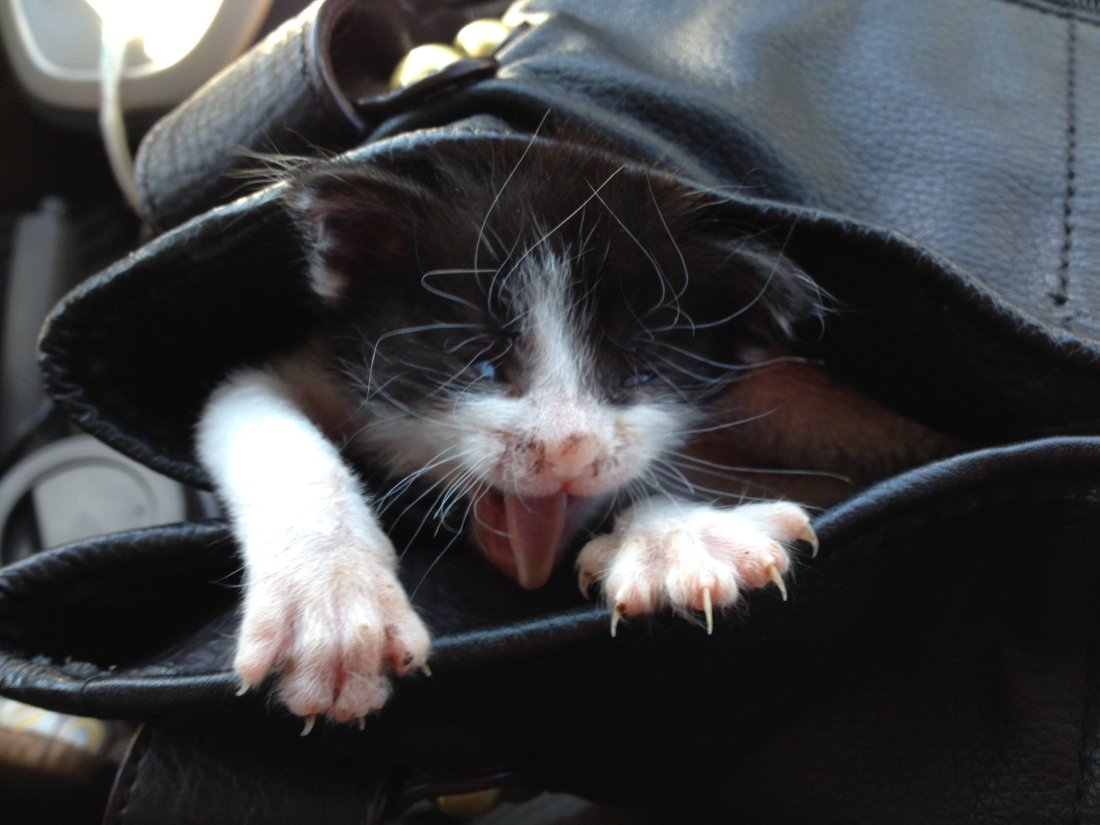
This morning we found an abandoned kitten outside the apartment. Well, actually, Duncan the Scottie “treed” it under the stairs and I dug it out from among spider webs and dead leaves. If I could pause writing now to show you a video of the pandemonium that ensued, that would be better than I could describe it. Since I can’t, I’ll do my best. I walk in with a screaming 3-day old kitten that looks more like a baby skunk or possum or rat. I will say that Duncan and I were both fairly proud of ourselves for the rescue–he was prancing while I was still covered in webs and leaves, grinning from ear to ear. Sarah, determined that she’s about to die from an oncoming cold, is sitting on the couch with her phone in her hand about to call in sick to work. She never did make that call; the immune system kicks in like a machine when there’s something bigger than us involved.

Within seven and a half minutes, Sarah was out the door on the way to Kroger, having given me instructions to keep the kitten warm at all costs and whatever I do–do NOT name it. Within eleven more minutes, she was back with two packages of bottle droppers, a feeding syringe, and cat milk. I had no idea one could buy cat milk at Kroger. How she knew still baffles me. Nevertheless, we were feeding, then “pooping” a kitten. For you who are uninitiated, you don’t even want to know about that one. I looked at Sarah. His name is Spike, I said.

Fast forward nine hours. Past the hot water bottle and the shoe box. Past packing up a diaper bag for a 4 ounce cat. Past a math department taking and a sorority adopting a kitten. Past the creation of its own Facebook page (which she checked until midnight, delighting at every “Friend Accept.”). Past my special trip to Petsmart to get a proper kitten bottle and newborn formula. Past the dog deciding that it was his baby and going into protect mode. Fast forward to choir practice (You didn’t see that coming, did you?).

This wasn’t our usual choir practice–that would have been too easy with a yelping kitten in a Chaps shoe box. This was for a benefit concert of fifteen choirs at a Catholic church out in the middle of nowhere–I reckon it was in some netherworld between Kennesaw and Marietta. That’s the best I could tell since she was doing the driving with the gps in one hand. Sarah has an interactive relationship with her gps, whom she has named Pilar. Pilar seems to me to put us mostly in the range of the destination, which lets Sarah yell contradictions and alternate routes back at her. Pilar, recall, is actually a phone. So I’m not actually sure where the church is located since I decided that the best plan was for the kitten to sleep through as much of the practice as possible–and the best chance of THAT would be if he had a full belly. Again, the video version of her driving and navigating with an obstinate Pilar while I am force feeding a kitten who, if he had NOT been in shock would surely be now–would surely be so much more vivid. You’ll just have to picture that. Anyway, we eventually got there, along with 100 other cars who were picking up their children from the parochial school. Once we explained to the (probably) Italian man directing traffic–IN (probably) ITALIAN–that we were actually there for the choir, he stopped yelling at us–not unlike Sarah had been engaging with Pilar–and we parked next to our deacon Lynn.

So as Lynn carried in armloads of our music, we loaded up with the diaper bag and the Chaps box with the hot water bottle and Spike. Looking back, I’m trying to imagine how we looked, a couple going in that big sanctuary, one of us with diaper bag in tow the other trying to hold a box to minimize jostling around the baby inside. Thing is, I’m pretty sure we looked like a couple to anybody who was looking, and not all the choirs there were from open and affirming churches. That’s ok, though, because ours was, and they were pretty much enchanted by Spike. With one minor exception–Lynn was not a fan of his name. I think you should name him Chaps, she said, clearly inspired by his carrying box. I don’t know if Sarah believes it’s bad luck to change a name like I do, or if she, like me, somehow wanted to honor the way our deacon had just honored something of us, but she decided–and I agreed–that Chaps would make a perfectly fine middle name–IF the first name had additional syllables (two monosyllabic names just don’t sound right).

So, that is how our deacon named our love child Chaps, and his name became Spikemandius Chaps TBDLastName, the Feline. 

Spike the Feline’s Facebook Page

Giving Account of Oneself

All my brainiac friends don’t get excited. This ain’t about Judith Butler. 

There is one part of being a professor that I actually don’t mind: the annual review process. I also enjoyed (!) the Tenure & Promotion process a few years ago, which is very similar, just a little bit higher stakes. Am I a glutton for punishment? Do I also enjoy visiting the dentist or gynecologist? No, I think find the review process meaningful because, at least so far, when I have paused to give account of myself professionally, I have come out on the plus side. 

My friend Nichole, also an academic–and one whose good opinion I value and want to keep–helped me start the process this year. She has told me several times that she ought to hang out a shingle for all the counseling she gives me. I don’t argue with her. This time, I was bemoaning my lack of discipline and motivation for writing. “Whitlock,” she said, “what are you talking about? You spent a year interviewing people for your book. And you had an edited collection published this year!” I guess, I told her, I hadn’t thought about those. I tend to focus on the writing that I don’t get done. I wonder if other academics do that. I wonder if other women academics do it. It is a very prohibitive and debilitating habit. 

With that in mind, I approached my annual review, which this year must meticulously be entered into an online system. One good thing about having to enter each tiny part of publication information into separate fields is that you can’t miss what you’ve done! In the hope that I won’t lose sight of it this time and thereby break my nasty habit of null productivity (I made that up just now), here is a list of what I have done this year: 
I was invited to speak at TCU as part of the Green Honors Chair Lecture Series. I was awarded a sabbatical (see previous post). I chaired a dissertation committee and served as external member on two from Georgia Southern. I wrote a book review that I’m now revising, and I have one book chapter in press and one published. I wrote an invited afterword in a special edition of a journal. I was invited by the dean to give a lecture in her speaker series. I gave three conference presentations. I researched for a book. As far as service (the bane of most academics’ existence), I am associate department chair. I served on a department-level tenure and promotion committee and on a college-level one. I taught an online course for the first time (and liked it!). And: I started seminary at Emory’s Candler School of Theology and moved from my apartment into a bungalow in Atlanta. I started back to church and joined the choir. I made new friends and reconnected with old 
ones. 

All in all, this has been one of the best years I’ve ever had. 

On Writing, Part 2: The Sabbatical Begins

A sabbatical is a powerful thing. At my university, they aren’t actually called sabbaticals; They are “Enhanced Faculty Leave.” They are competitive, awarded based on a research proposal. At universities that honor the writing processes of its faculty, sabbaticals are given about once every six or seven years. Sabbaticals, not Enhanced Faculty Leave. Why can’t my university call a sabbatical a sabbatical? Because it would imply to the voting (Republican) public that we lazy, blood-sucking socialist/communist academics were getting something for nothing. That’s about what folks think of academics. Just once I’d like our leadership to take a break from politicking local legislators for additional funds for things like football programs and inform the public that about once every six or seven years, professors need time. Just time. To let the fields lie fallow, which is what has to happen for re-creation, creativity, and good writing to take place. As an act of resistance, I will call my Enhanced Faculty Leave a Sabbatical. 

It takes a while to settle in to a sabbatical–I still haven’t completely done it yet. I keep waiting to have to get up and get ready to go somewhere or do something. What I feel beginning to happen is my mind “un-tensing”–relaxing. I’m mentally starting to sort through how I want to approach my various writing projects. I got out a large yellow pad yesterday–the kind people used to hand write dissertations on years ago. I love those yellow pads; you can tell I’m ready to get down to business when I break out an official pad. While I always have top-notch pens, I’ll write on anything. So yesterday I wrote out a list of every project I want to work on this semester. Here’s the list: 1) two conference papers, 2) an essay for a book about my mentor Bill, 2) a book review that’s a year over due, 3) a review of a manuscript for a publisher, 4) my annual review documents, 5) an essay for a new curriculum studies handbook, 6) a book. Thank God I’m on Enhanced Faculty Leave and not a lazy good for nothing sabbatical.

Putting everything on a list is helpful to me. Now, I have sense enough to know that these can’t all be 6 separate writing projects. The conference papers will have to have some framing in common. The book will mine from what I write in them, etc. This prevents me from having to start with a blank page, which is self-defeating to me. If I can only cut and paste a little, I can go forth steadily. Usually. First, I’m going to do the mindless work of the annual review documents. I’m not being flip about taking them seriously. I do. But, it’s like filling out a job application when you have a good resume in front of you. You just lift from on document and put it on the other. This will be time consuming, but little thinking is involved. Next, I will finish the book review before I lose a good friend, the long suffering journal editor, Alan Block. I’m giving myself a week and a half to get these projects done. The others will need framing up theoretically. And that gets tricky. More on this later. 

Recovering from Fundamentalism, Part 1

One of my friends is, like me, a recovering fundamentalist Christian. 

She suggested that I might get to the root of my issues, whether about relationships, teaching, or writing–whatever–by forgiving myself. It took a recovering fundamentalist to recognize that and present it in that way. The closest I ever got thinking about forgiveness was when my therapist (the one I pay) suggested that I look back at the girl who married young because of gender role social expectations and not so subtle pressure from family. She asked me to engage with that young woman, going back even to  the smart tom-boy who felt different and often alone. When I did that very hard work, I asked the young me for forgiveness. I realized that I did not feel like I had taken care of her. I remember that was a very hard session. 

But forgiving myself now–that’s different from looking back at me then. Forgive, for what? The issue is the essentially the same it seems. Since my divorce, I have felt robbed of the 16 years I was married. (Side note: it has been 16  years since my divorce. Geez. Get over it.) Robbed, as though they were taken. Passive verb. I had blamed the fundamentalist church, my parents, my husband, Alabama–anyone, everyone. But me. Thing is, I’ve been furious with myself for having done this to myself–and for staying in it for those years. I did this. Me. (Now suddenly the anger issues my paid therapist brought up that I couldn’t see became very clear and noticeable). My unpaid counselor friend calls it discipline fundamentalism. I try to be “good,” but all that old unforgiven baggage surfaces and I act out (yes, there has been acting out), leaving me guilt laden and sorrowful. I make a pact with myself and resolve to do better. Trouble is, that doesn’t work. Hasn’t worked. 

In addition to forgiving my self, I will tell myself as often as I need to hear it, “it is enough.” Not “I am enough.” I know I am–my issues are not about confidence or worthiness. I’m just never satisfied with what I’ve accomplished. It’s almost always writing. When I can’t dig in and write a lot, I will read, or now, write here. That’s enough. It’s working. Even writing it now I feel a tremendous sense of relief and peace. So whatever I do, it’s enough for today.  

You may ask what this deep reflection has to do with fundamentalism. I think the imprint fundamental Christianity has had on me as a female has been about judgement. Naturally, I was taught at all costs to be a good girl because I would be judged by God. Here on earth, meanwhile, I was expected to be good and conform so I would be judged acceptable by others (what will the neighbors think). I learned to be good so that my daddy would not lose his temper. Be good, be good, be good. And if I were ever human–spontaneous, uninhibited, free-spirited (and all the behaviors these entail)–I felt that judgement upon me from all sides and fell short. So, forgiveness and acceptance is the first, deeply internal step to recovery from fundamentalism. It is the step that allows me to see that judgement is something that somebody else does. And it has very little to do with me. More on this later. 

On Writing, Part 1: Friends and Me

I have lately begun surrounding myself with friends who are either Sagittarius or who have backgrounds in a counseling or therapy profession, or both. I did not start out to purposefully do this, but once I noticed that I seemed to be collecting these kinds of people for friends, I kept keeping track. Now, It is altogether possible that they are drawn to me, so I am trying to figure out what it is that is appealing about me for these inquisitive, curious archers and advising helping professional types. I suspect it is that I tell a good story and tend to have some sort of conflict (I refuse to say drama), entanglement,  or crossroads in my life that I am seeking input for. I don’t mind saying that I like to get different viewpoints about what’s going on in my life. It helps me make decisions; it also means I can change my mind based on what seems to be most suitable. 

They have different approaches, these groups of friends. I don’t think any of them are both Sagittariuses and therapists. If I could find that person, I’d try very hard to move next door to her. Anyway, what this means is that I get different categories of feedback and support. Generally the Sagittarius free-forward-moving spirit helps me break out of my Virgo straight jacket and see my own possibilities. A Sagittarius cheers me on with, “You can DO it! You must GO for it!” as she is boarding the plane for her own next adventure (did I mention that my friends are almost exclusively women friends?). A counselor/psychologist, on the other hand, mainly asks me questions and insists that I feel my feelings before acting on them. 

Let me try to back myself out and try to figure out what it is about me that these bits of cheers and counsel meet. Reading the paragraph above, my Sagittariuses pick up on the doubtfulness, tentativeness, resistance, and hesitancy that I counter with impulsive acting out. My mind-pros insist I get to the root of those feelings, which I avoid by impulsive acting out. Reading the paragraph above, I am surprised I have any friends at all. I think I do tell a good story, and am just endearing enough that they keep me around. I am glad they do.   

What does any of this have to do with the topic, writing? Well, that’s mostly what I am doubtful, tentative, resistant, and hesitant about. And that is not a good thing, since I really, really need and truly want to be writing. Lately I’ve had the thought that even though I am a professor, I don’t have anything that I want to especially profess. That’s kind of like being on the Island of Misfit Toys. It is not that I don’t feel worthy or lack confidence; I have friends who have those issues as demons. I feel plenty worthy and confident. I think I haven’t found my joy, my bliss in it yet. I don’t think I’ve found a way, even after over a dozen years of being in the academy in one way or another, to do this job, this work, joyfully. And I truly believe it can and should approached and engaged with joy. So, joyfully onward today. My day, my work, my terms. My bliss. 

Elvis and Me

Today, January 8, is Elvis’s birthday. He would have been 79 years old, which seems astonishing to me. So on this day, I will offer some random thoughts about Elvis and me. Because of those various threads that run through one’s life from age to age, stage to stage, place to place, Elvis runs through mine. 

I saw Elvis in 1975 when he came to the new civic center in Huntsville, Alabama. My parents, who have never been to a concert before or since, sent away through the mail for tickets. It’s really remarkable to look back that it ever happened at all–but we went. I, nerd that I am, was having a little temper tantrum because I was having to miss the last day of my 5th grade class. That didn’t last long. My parents remind me that I commandeered the one set of opera glasses they bought and saw Elvis magnified throughout the concert. As I have done since then whenever conversations turn to how his body became ravaged and bloated from drugs, I can testify here that in 1975, Elvis looked good. He was in shape physically and vocally; he was on his game in Huntsville. Of all the things I have done in my life, I am glad I saw Elvis Presley in concert. I am glad my parents sent off for those tickets. 

But let me back up. Elvis was a fixture in our house my whole life. My mother owned several original 45 records, and I think eventually she collected every album he ever recorded. I have listed elsewhere all my mother’s Elvis collectibles, so I won’t do it again here. Those records were treasures. The tacit understanding among us was that Elvis was different from the other singers from the 50s they had listened to as teenagers. Even now in my mind there is Elvis and there is Everyone Else. And, as I have also written before, as a good Southern boy, he was ours. 

I am listening to the Elvis station on Sirius radio as I write this, a rare live recording of Doncha Think It’s Time. His voice is familiar and comforting. I know all the retorts, have heard them all. Elvis stole black music. He didn’t write his own songs. He was just a performer. He let himself go physically. He split his pants and busted notes on stage. He shot out tvs and caroused with the Memphis Mafia. He did drugs. He mad b-a-a-a-d movies. He posed for a picture with Nixon. And you know what? I’m at the point in my own life to where I say, “So?” 

Finally, then, what of Elvis and me? Elvis knew who and what he was. He used his gifts. He had fun and worked hard. He loved his mama and his daddy. He gave back. He never stopped seeking (the last book he was reading was called The Scientific Search for the Face of Jesus). And he sang. I’ve decided not to make any more excuse for Elvis. Or me. He is what he is, was what he was. Coming back to this blogging space, I will confess something. When I started it, I was very careful not to reveal anything really personal about myself. As a result, there were chunks of explanation–and really good stuff–that would have been through lines to tie the anecdotes together, making it palpably uninspired.  So, like the open casket picture the Enquirer touched up from Elvis’s funeral, I’m writing this for myself, but you are invited to view. 

More on this later. 

For your listening pleasure, here is Elvis singing the best song ever recorded. 

http://youtu.be/yWgprZu4Hk4

Getting Happy

Somebody I used to know once told me she thought happiness was overrated. I’ve thought about that statement for going on a dozen years now, and I think she was wrong. Well, I think she was talking about pleasure, about following one’s desire, about gratification–and all of these are different from happiness. Not only is happiness not overrated, I don’t believe it is rated nearly highly enough on our collective list of priorities.

I was recently on a long, 9-hour drive from Atlanta to South Florida when I began running through my usual thoughts: money, work, goals, writing, weight. I was even running scripts through my mind of events that I envisioned happening so that I would have a ready response. For example, I pictured a scenario in which my boss asks me to assume additional duties at work. I was amazing myself at my sardonic, pointed remarks to her. Then I thought to myself, “I have a 9-hour drive and I am going to sit here and make myself miserable the whole time? This is my vacation, what if I only thought happy thoughts the whole drive, heck, the whole trip?” So I practiced. I made myself happy, or so I thought at the time. Looking back, I think it’s more accurate to say, I rejected negative thoughts for positive ones. Happiness, a deceptively simple notion, is more complicated than it seems.

I’m reading a book by Barbara Ehrenreich called Bright-sided: How positive thinking is undermining America. Ehrenreich has nothing against positive thinking per se, but she argues it has become a tool to lull Americans into compliance with a neo-liberal, consumerist culture. It is, according to her, in the best interest of institutions to keep the population thinking positively because it deflects attention off inequities of capitalist society by focusing on ourselves. Be positive, work harder, pick yourself up, you can do it (!), you deserve it, and my own personal favorite, “everything is going to be just fine/work out….” Ehrenreich goes on to present some amazing survey results: even though we Americans have embraced the power of positive thinking, we don’t report that we are very happy. There are plenty of other, frankly, negative countries whose people are happier than we are. Being happy is not the same as thinking positively. Positive thinking is something you can choose to do; and while I’ve heard it suggested that we “choose happiness,” I think it is more of a state of being. I”m sure the two are connected somehow, and maybe I’ll think about that later.

I can be negative. I am often cynical and suspicious (of politics and banks, for example). I get the blues and feel lonesome. I come from a long line of worriers–it would have been a piece of cake to have found something to worry about the whole drive down to Florida. But, I am a happy person. I am not jolly, and I don’t feel euphoric all that often. So am I sure about this happiness thing? Yeah, I’m sure. I haven’t figured out yet whether happiness is situational, contextual, or even genetically influenced. In fact, I have just begun to think about it at all–apart from that comment about it being overrated all those years ago. Lots of thing “make me happy”: music, Taco Bell, marathons on TNT, watching the ocean, people in my life. But really, I think these things bring me some joy; they bring me feelings of happiness. Happiness, it seems to me, is what you are left with if feelings were stripped away. I think it would and should be articulated differently by different people. For me, it is serenity of the soul. But that’s just a way of saying it. Can one “get happy”? What is happiness? How does happiness fit in with the violence all around us? That is, can our own happiness intersect with that of others? What does that look like? What good does being happy do us? That’s a lot of questions for something so taken for granted.
More on this later.

Alabama the ("Your word here")

Since I decided that my next project would be a place study on my Country South by storying my great-grandmother Jeffreys’ life, I’ve been doing a lot of reading about Alabama, my state. One book, Dixie’s Forgotten People, by Alabama native and Auburn professor (I can forgive him for that) Wayne Flint, is what I would call an objective account of Alabama’s poor whites. He talks about both their rich culture and the racist thoughts and acts. I learned a lot from Flint’s book–like my people were most likely southern Appalachian–a particular kind of “Southerner,” having a whole unique heritage. I had always thought of Appalachian people as being from the mountains of West Virginia or East Tennessee, but these are my people. I am theirs.

Another book I picked up was Alabama Getaway by Allen Tullos. He is an American Studies scholar who exhorts Alabama to distance itself from its “Heart of Dixie” brand name. For him, this monicker is code for nostalgia for a plantation mentality, that includes Jim Crow, George Wallace, and Confederama. I won’t disagree with him; “Dixie” is like the Biblical offending eye–holding onto it does a lot more harm than good. Still, Getaway, Alabama (as it could also be called) is hard to read if you are a white Alabamian looking for a reason to publicly love your state.

Part of the problem is that Alabama has never done enough to stand out. And not being Mississippi is not enough. Even my pal and fellow Alabamian feminist Mab Segrest claims to prefer Georgia because there’s just not that much “to” Alabama. While I can see her point, I think we need to dig a little deeper.

I think a place to start is to think of a really good replacement for “Heart of Dixie.” Our official state motto is: We dare defend our rights. This is almost as bad, as it practically conjures George Wallace in the school house door. The current slogan on auto tags is “Sweet Home Alabama,” which I really like as a white Alabamian. The Leonard Skynard Southern rock song is like the state anthem, especially since the band is like Alabama’s Buddy Holley, lead singer perishing in a plane crash at the height of their popularity. But, it may not be sweet and homey to everybody. I think we will probably do better to just stick to the land itself.

Minnesota has already taken the 10,000 lakes slogan–even though Alabama has an awful lot of lakes, rivers, and streams. But if we put anything about water, Minnesota would cry foul. And, hunting and fishing are major activities because of the forests and wooded areas. Louisiana already claims that it is a Sportsman’s Paradise, so that one’s out. I always liked the tags and signs at the state lines that said “Alabama the Beautiful.” I never understood why they would change that, probably paying a consulting firm a quarter million dollars to say there is some benefit of replacing it with “Stars fell on Alabama”–on the tags, anyway. I don’t much understand what that means. I know it was a love song. But, my daddy is already concerned that a meteor is headed directly for earth, and NASA confirms about a million pounds of space trash is out there. I don’t think we ought to draw attention to falling objects.

So, until somebody more creative than I am can think of the perfectly appropriate slogan, I am sticking with Alabama the Beautiful. From the highland rim of my Appalachian ancestors to the Coastal Plains where my daughter lives now–and everywhere in between, there is great natural beauty to be found in my state. And, I have eternal hope that the people who inhabit this place can shape up and behave ourselves and maybe make Alabama a state that has to narrow down its choice of slogan instead of stretch to come up with one.
More on this later.

The Oldest (Writing) Trick in the World

I would bet money that the “oldest (writing assignment) trick in the world” was invented by a high school boy. The kind that ends up a radio show morning dj who, along with one or two other sidekicks–including a woman who is usually the brunt of the sexual joking–fills the a.m. work traffic airwaves with inside jokes and guffaws. I avoid morning radio shows (Rick and Bubba in the Morning, a favorite of my 21 year-old son, which proves my point) at all costs. But in case your’re wondering, I am not a radical public radio snob either, like some of my egghead friends. I don’t need my head hurting from either end of the spectrum in the morning. I send them some money every now and then, though, just to annoy the Republicans. Anyway, you know the kid I’m talking about. 
 
This kid would invariably appear in my Junior English class, where I taught from 1987-2001, and submit a major essay assignment with entitled, “Writing an Essay for Mrs. Hyde’s (that was me then) Formal Essay Assignment.” He then spent 5 paragraphs (intro, body, conclusion) writing about writing (or lack thereof). It was, at first, a cute trick. I always made sure to tweak directions for subsequent essays to include, “and please do not write an essay about how you stayed up all night attempting to compose an essay and here it is, etc., etc.” That usually worked. Actually, some of those compositions were not so bad, probably because the kid thought it was a good idea, got excited about it, and therefore, wrote it pretty well. 
 
This is not exactly that kind of entry. Only half of writing a blog is to mine fresh ideas and strive to find my own relevance. The other half is to write–to keep a writing exercise journal. That means writing–even sometimes lacking a fresh idea. So, this one may not be too innovative, but I have a thought or two about it. 
 
I’ve been thinking a lot about being relevant. I wrote a grant proposal a few weeks ago. Granted, I came up with a topic from scratch–it wasn’t my lifelong burning passion to be sure. Still, I spent weeks on it, and I know it was well written. I’ve never received external funding for my work (possibly because my work sounds a lot like this) and this was a test case at the very least. I was turned down–and I really thought it stood a chance of getting funding. 
 
A big part of academic life (being a professor, for those who do not regularly refer reverently to “the academy”) is rejection. It’s something most of us at one time or another must deal with. I’ve been doing it for seven years and it isn’t getting easier. Although, I realize even when I didn’t do anything but eat Little Debbie cakes and watch tv at home (dreary, lost years indeed) rejection was still present in different ways and still was not any fun. Academics get rejected in all kinds of ways: by journals, conferences, universities where we apply for jobs, publishing companies. We get rejected by anybody who has the ability to reject us, it seems. Some of us more than others, which is an entry all to itself and is coming, believe me. 
 
The grant proposal rejection sparked an ongoing thought for me lately: relevance. Nobody has actually used that word referring to my work; when people do actually read it, it is usually well-received. More to their surprise than mine. This comes under my being my own toughest critic. Here’s the thing. Writing is what I want to do; I am a professor, for crying out loud, which does more than just imply that I have something to profess. I don’t have any news, or celebrity gossip, and I don’t write about vampires. I don’t have any more of a clue than most other people why some children do better in school than others. For me, professing can be very humbling. Who the hell am I and what the hell do I have to profess? Are my thoughts, am I (for it really is the the same thing, see?) relevant? I think about this a lot, and I’m not finished thinking about it. 
More on this later.