God Laughs, or Fun with Bell’s Palsy

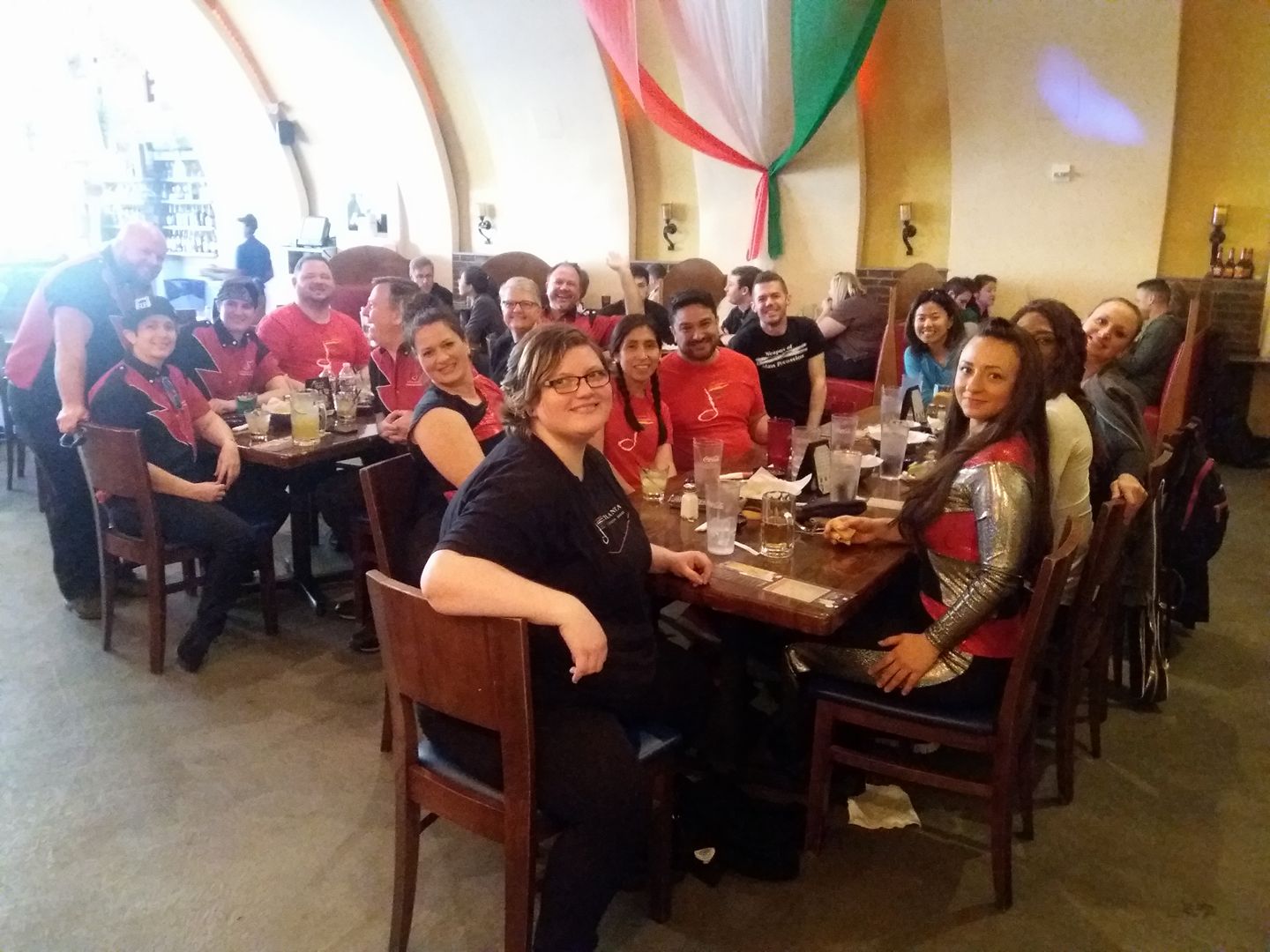
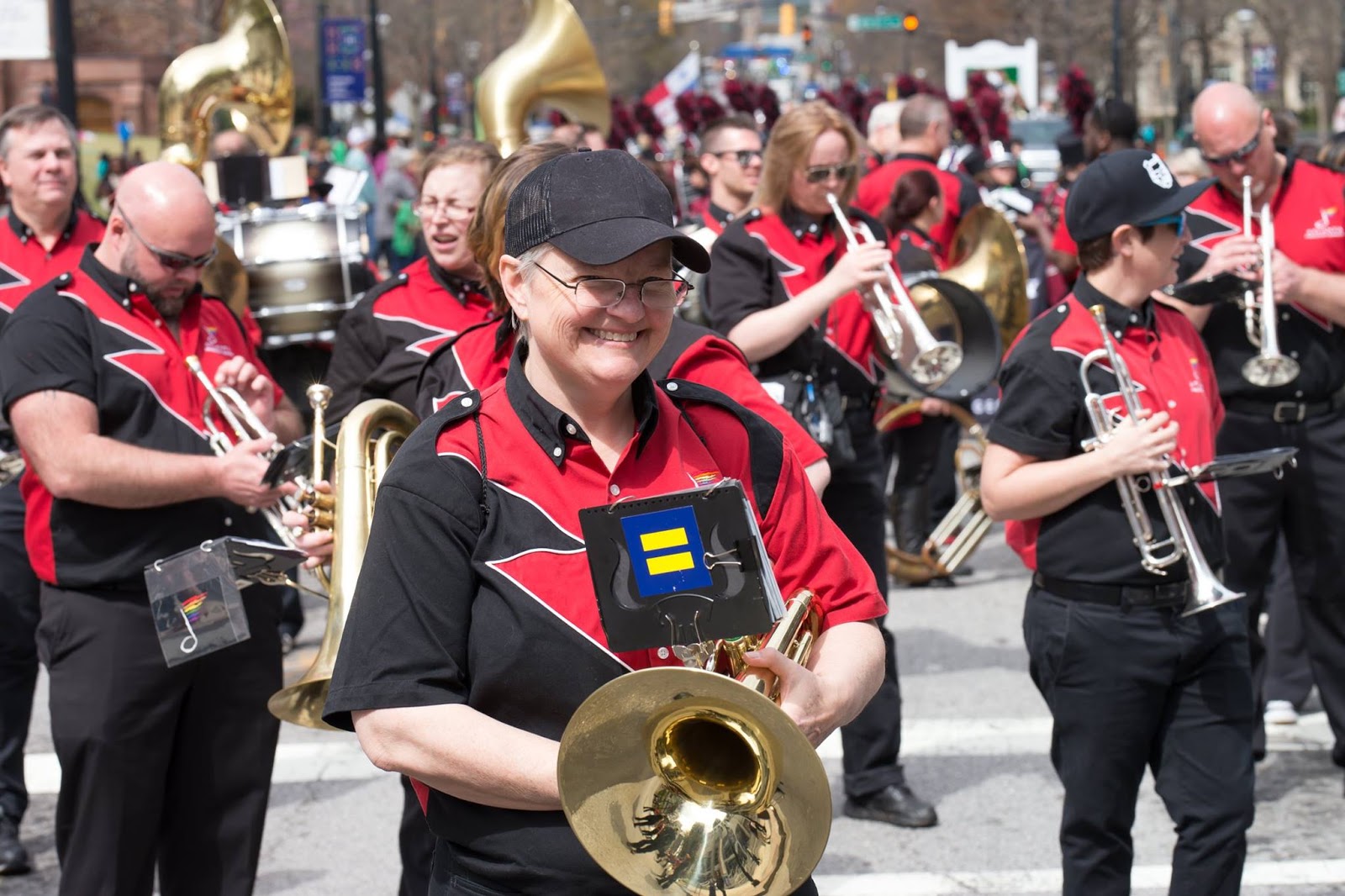
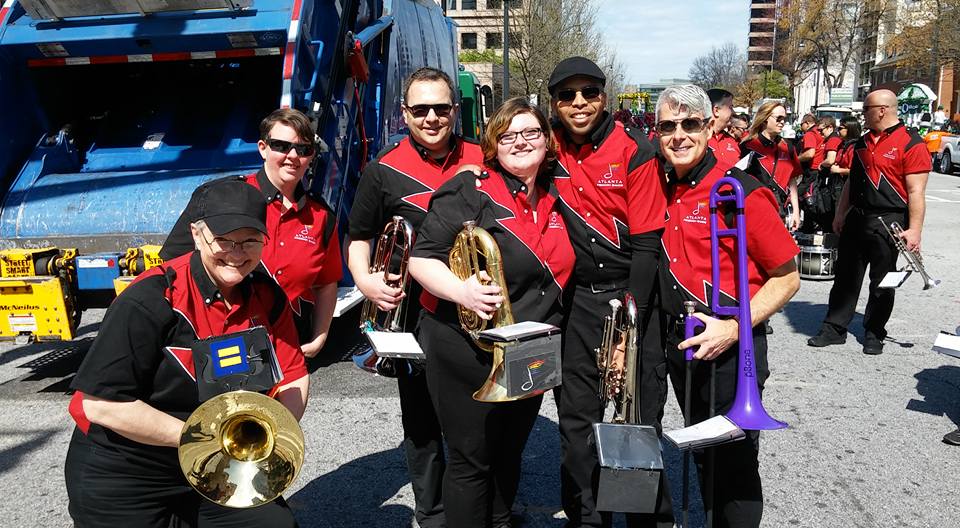
You make your plans, and God laughs. That’s what happened to me over the weekend. Let me go back, though, and start with discovering the Atlanta Freedom Bands, which I wrote about here in November 2014. I recollected how finding the band made me realize how much I had missed making music, marching in parades, performing in concerts. How after more than 30 years, finding the AFB was like discovering a new, yet long lost treasure. Last year, I marched my first season of parades in various Atlanta community festivals. It was wondrous. And at Christmas, I performed in my first concert playing French Horn in 35 years. Last Saturday morning, I marched mellophone with the AFB in the Atlanta St. Patrick’s Day parade. Afterwards, members of the band had lunch and drinks and fellowship at a local restaurant, which is the custom with this group.

Saturday night, kept waking up with what felt like a neck cramp. When I woke up early Sunday my speech was slurred, which I chalk up to needing a little more sleep, so I went back to bed. When I woke up again, I couldn’t blink my left eye. I ended up Sunday at the emergency room in Marietta. After they have ruled out a stroke, which was probably the best news I have ever received in my life, they told me I had a textbook case of Bell’s palsy. After a lot of googling I found out that it’s caused by virus, kind of like shingles. Likely because I had the flu, and that virus was in my system, it ended up attacking my facial nerve, causing it to be droopy and paralyzed. Like shingles, it was likely triggered by stress. In addition to facial paralysis–a word, like biopsy, fills me with terror–I have heightened ear sensitivity in my left ear, so loud noises, including my own sneezing, amplify like I’m standing in front of a Bose speaker. By all accounts, I will (should?) regain use of my facial muscles. Most well-wishers report success stories. It is totally unrelated to a stroke, and contracting it one time does not mean I will get it again. Those are the things I know. The worst part is that I can’t blink, so my eye gets dry and irritated. And that can lead to all kinds of trouble. I have to keep eye drops in it and wear a patch. Having only one eye affects depth perception and means I can’t drive. I can’t whistle or smile or buzz my lips. And buzzing one’s lips is essential to playing a horn.

Even though I realize I am very blessed in that this could’ve been so much worse, I’m still having to learn to deal with it. There are lots of adjustments I’m having to make pretty quickly. I’m learning how to have meals with straws and napkins. I’m learning how to turn my head in order to see better with an eyepatch. I’m learning to enunciate words using one side of my mouth. I’m learning how to encounter other people whose first response is to look away from me. I tried to go to the office yesterday, and by the end of the day I was exhausted from having to compensate physically in order to get from point A to point B, or participate in meetings. Talking and looking took a lot of energy that I had taken for granted. Part of the dealing with is going through my own stages of grief: denial, anger, bargaining, depression, and acceptance.

Sunday and Monday I was in denial. I jokingly made a list with Sarah of one eyed characters for costume parties. We go back and forth with one-eyed jokes. In case you didn’t know, there are many one-eyed one liners. Believing the doctors that taking the meds would speed up recovery by months, I thought, Well if I can’t play horn, I’ll just break out the old flute and play that! I tried for half an hour to form the embrasure to blow air across the mouthpiece.  I waited to blink at any minute. I planned to go to choir. Tuesday night begin my descent into anger. I kept a dinner engagement with some visitors to campus, old friends from my curriculum world. When I entered the restaurant, Marlows Tavern, which I had been to so many times over the past few years, the hostess looked at me and then looked away. Same thing happened when the waitress came to take my drink order. I realize now that I do the same thing automatically–probably most of us do.  The next day, I mentioned choir to Sarah, who slowly turned and looked at me and said, Honey, you’re not going to choir. When I looked back at her in one-eyed disbelief, she started singing a little bit of the Hallelujah Chorus, which we’ve been working on for a month. I thought my left ear would blow out. No, I wasn’t going to choir. When she dropped me at the office,  just walking from one building to the next took all my energy to keep my eye covered so it would not dry out. I had two meetings where it was very important that I be able to speak, and that was extra energy. My colleagues, wonderful people, tried very hard to look at me in a normal way–and for that I will forever be appreciative. Nevertheless, I feel different, I talk different, I look different. And that was psychological and emotional energy spent that I wasn’t used to spending.

I’ll let you know when I’ve moved from anger to bargaining. Till then, in order to work through some of that anger, in order that something generative and therapeutic might come from it, I decided to pick up the blog again. It’s always been my favorite, preferred mode of writing. Academic work is important, but it isn’t accessible, and it limits my flow of thinking since I have to measure my tone and phrasing as well as the thoughts themselves. Here, I can have a conversation, if only with myself. Plus, Sarah approves of it since it will help keep me out of trouble–like trying to do home-improvement projects with one eye that doesn’t need to get dust in it. Most important, this is all helping me put my life in perspective and put the parts of my life in priority. It isn’t an overnight revelation, but I realize that stress is counterproductive and can be harmful. I reaffirm that life is always already about the people in it. That being present and being mindful is living. I am intentionally choosing hope and happiness. Hope and happiness are not default properties, and being intentional about them makes a difference. As I think about it, coming to this place is a kind of bargaining. I will trade impatience for writing, frustration for processing, sight for insight.

Band friends at Sr. Patron’s
Mellophone


A mello-photo bomb

On X-Men and Orlando

On X-Men and Orlando

I’ve been making my family watch a lot of X-men movies this week, as a kind of research project for the new X-Men: Apocalypse. One of the themes throughout all the movies is good versus evil (another theme, especially in X-Men: The Last Stand, is marginalization of people because of their mutation–a clear parallel to homophobia and reparative therapy often forced upon LGB people–but that is another story…). For example, there are good mutants and evil mutants, good humans and evil humans. Sometimes, the evil forces come out on top. But sometimes, Professor X, Charles Xavier, gets through to them. “Don’t do this,” he persuades telepathically. “It isn’t who you are.” Occasionally, he gets through, even to Magneto.

Evil is among us. Whatever prompts us to reject our ethical thinking toward one another by supporting unregulated weapons purchases, or failing to commit meaningful resources to domestic violence and mental illness, or reinforcing homophobia through reframing it as “Religious Freedom”–that is evil. If those issues had been addressed through ethical, social responsible action, then the shooting on Sunday morning most likely would not have happened. They are the root cause–not one person’s or a group’s faith-beliefs toward the Holy Being. We must hold each other accountable, must remind and encourage each other–through real, responsible action, that this is not who we are. Like Professor X, I believe our world depends upon it.

Protest and Privilege

Last night, we sat in front of the television and watched the announcement of the Grand Jury decision from Ferguson, Missouri. From the time the broadcast started, there was a split screen, one camera on the crowd and another on the DA who was reading the lengthy statement. For a while, we watched the people straining to hear what he was saying on their radios and phones. Then, when he got to the point and announced that the Grand Jury had voted not to indict the white policeman who shot Michael Brown, we watched the people process the information, at first in stunned silence. Then the protests started. Even as I write that, just like the camera crews, I realize was expecting them to begin almost on cue. We were waiting. So, I watched them start up, then heat up, and Sarah tracked them all over the country on Twitter.
Then, at around 11:00, we called it a night.
That, friends, is one example of what is known as White Privilege. I had built my evening tv viewing around the press conference and coverage of the “event.” After about the second round of teargas had been shot into the crowd in Ferguson, Sarah looked up from the string of protests starting in every major U.S. city and said, “I think I’m just going to sit here in my white privilege.” I, caught up in the unfolding story, asked her what she meant. “I don’t HAVE a riot outside MY door.” I can be thick as mud sometimes.
Thomas Jefferson wrote, “I tremble for my country when I reflect that God is just; that his justice cannot sleep forever.” Ferguson is the 21st Century version of “Selma,” a cry for justice that in one word captures the collective voices of the disenfranchised. And last night, for me it was there for my viewing pleasure. A few weeks ago, Pastor Kim preached a sermon about it; I shook my head, wrung my hands, and felt sufficiently bad, but not bad enough to stay for the continued Sunday School discussion the following week. That’s part of my white privilege too: I can join up with a church committed to social justice and have the audacity to think that I’m “covered” just by signing the roll. When really, PUCC is a place for me to re-charge and build up my strength to go, to do, to live justice.  Thing is, I don’t really know specifics on how to do that, or maybe I do deep down, but the White Privilege is that little voice inside me that tells me that I don’t—or that it activism can be terribly inconvenient.
I’ll tell you what I couldn’t look at last night, still couldn’t look at this morning when I was seeing all the posts on Facebook. I couldn’t look at the pictures of Michael Brown’s family in what I understand as pain at hearing the verdict. I do not get to share in that pain, don’t get to try to empathize and feel it. I don’t get to feel it because my White Privilege means I can conveniently shut the feelings off whenever I want to. And not just feelings—if I wanted to, at least until the awakening of the Just God, I could live my life for the most part without ever encountering injustice based on my race. I have for half a century, after all. In all likelihood, my son will not be shot by a policeman when he wears his hoodie or has his hands in his pockets. And if that ever happened, I would not be expected to be a stately presence on tv who represents all White mothers everywhere. So, to me, I don’t get to look upon my Black sisters’ and brothers’ anguish now, although, to me, I MUST hear what they are saying. It sounds to me a lot like what Jefferson said 200 years ago. Tremble, country, for God is just.
I’ll end by sharing link to a blog post entitled, “12 Things That White People Can Do Now Because of Ferguson.” Ferguson is now, like Selma was in the 60s, a complicated and contested issue. But if “doing” is what is needed, and I believe it is, then here is a “do-able” way to start. The link is
http://qz.com/250701/12-things-white-people-can-do-now-because-ferguson/. Anti-racist activist Tim Wise (see www.TimWise.org) points out that racism hurts everyone, and that until White people understand that, we will not really become invested in living for a world that is just for everyone. This is a hard knowledge, not a warm fuzzy one. But in the end of this church year, where we have fallen short of the promise of peace on earth, good will toward all people, it is a realization we might—no, must—seek.

Finding Free: The Atlanta Freedom Bands and Coming Full Circle

When I was in fifth grade at Littleville Elementary School, something magical happened. One day, our teacher announced that the band teacher from the nearby high school would be coming to Littleville to talk to kids and their parents about joining the band. It was 1973, and resources for extra-curricular activities–heck, resources for curricular activities–were limited. I remember in previous years, our musical exposure at school had been the on the rare occasions when our teachers had brought out a box with mostly percussion instruments and let us play with them, mostly trying to keep time while a record was playing. This was different. This was band. I could hardly wait for the meeting. When the evening came, the band director, Mr. Wright, brought a variety of instruments so that we could try them out and, with his advise make our selection. I realize looking back that, of course, he wanted a well rounded group of instruments, which is probably why I became a flute player. From that point on, I was in love.

I went to high school in a football town, and a football town doesn’t scrimp on its band. When two new, shiny mellophones arrived at the bandroom, I volunteered to learn to play, and I loved the big, smooth sound of a horn–I was a woodwind no more! We were the Marching 100. I remember the day I was issued my uniform. I remember band camp and big, chartered band buses, chocolate sales and Homecoming parades. I can still remember how to play The Horse–if you have ever marched, you know The Horse. I remember our signature parade song–a marching mix of China Grove and Smoke on the Water. I still remember–and feel–lining up on the sideline for the halftime show, and I can feel again what it felt like then standing on the field, horn up, knees slightly bent, leaning back to hold the last note until the crowd stood and cheered. And they did. Every time.

I quit the band just before my senior year for a very, very bad reason. It’s a story for another time, because this one is about joy. But I must say–for the rest of it to make sense–that over the next thirty years I had recurring dreams about being back. Sometimes, they would let me join them again for just one performance. Sometimes, in my dream, it was entirely acceptable for an alum to join up years later. Whatever the scenario, I slept happy. Then woke. It was not unlike dreaming of someone who has passed then waking to sadness when you realize it was only a dream.

So  when I say how happy I am to find the Atlanta Freedom Bands and to sign up to march with them, you get some idea of how much it means to me. I’ll write more about it later no doubt, but this post was prompted by a conversation I had with my new band friend Mitchell. He  mentioned that during the recruitment drive at Pride this year, one new member was telling him that finding the AFB was like coming home again–a feeling not unlike ones I have been having. I bet I’m not the only one, either, or that new fellow. I bet a lot of band members feel like this is both a musical and community home. I bet a lot of us thought we might not ever have that kind of home again. Of course it’s also a helluva fun group that throws a mean party. Robert Frost wrote, “Home is the place that when you have to go there, they have to take you in.” I know the “Freedom” in Atlanta Freedom Bands has rich, multiple meanings, but certainly for me–and I bet for others–it is a home place that sets me free. I am awfully glad they have taken me in.

The Gay Agenda, Or, The Zoo and Me

First of all, let’s just get it out there: there IS a gay agenda. Sort of. But it’s probably not what you’re thinking. When anti-gay people speak of a “Gay Agenda,” they make up some items to maintain the politics of fear that have proven successful. Gays getting married. Gays having children. Gays in schools. Gays in the military. Gays in the workplace. Gays in church. Gays in the government. Gays parading. Gays everywhere. Wait. No, that’s not scary enough, not to mention that it’s already the case. Gays converting your children. Gays converting YOU. Gays in YOUR church. Gays being treated like they are normal, even when everybody-knows-what-they-do-in-bed. Gays running sex dens and converting you and your children as you are mesmerized by sequins and disco music.
None of that is my gay agenda, neither the real nor the absurd, nor the in-between spaces where sexuality, gender, and everyday life interact fluidly and contingently. FOX News is making stuff up.

Our gay agenda looks a lot different from that, which has become more apparent since we found Spike just over a month ago. Now, Sarah is an activist. She is very connected to LGBTQ (she knows all the letters of representation) groups in Cobb County and Atlanta, regularly meeting with organizations and attending functions. She performs with the Atlanta Freedom Bands, and wrote the Safe Zone training manual for her university. She’s an advocate for campus equality for LGBTQ students, and she is a presence for students on campus. She forwards me a half dozen news and policy updates from online media every week. And me? I teach LGBTQ-themed classes in KSU’s Gender & Women’s Studies Program and queer-up just about everything I write about. My activism is a little more sedentary. Regardless, if anybody should know about a gay agenda, it’s us.

This topic reminds me of a line by John Proctor in The Crucible. “If there is a faction, then I must find it and join it.” If there is a sexy, provocative Gay Agenda, I’d sign up for it.  But I’m pretty happy with ours. We talk about it; rather, we note it, at the oddest times. For example, for the first month, we had to “poop” the cat. Baby cats rely upon the mama cat to help get its bodily functions going (I’ll leave it at that). We had to assume that role and responsibility since Spike was abandoned. So, while I was holding the kitten over the sink and proceeding, Sarah leans over and says, “THIS is some gay agenda!” Sometimes when we’re up to our elbows in cooking dinner or doing dishes, we’ll make the same observation. Or when we’re loading three animals into a small car to transport to South Atlanta for the weekend–and then repeat at 5:00 AM on Monday morning. This is SOME gay agenda. Or when we FINALLY get a night out to go to Pride because Spike is FINALLY getting litter box trained and we end up volunteering to help close up the booth for KSU’s fledgling (and terrific!) LGBTQ Resource Center. While we were there, Sarah mentored a young trans student and set up his schedule for spring semester. THIS is SOME gay agenda. Or, finally, when we made it to the concert area, spread our blanket under the stars to listen to music and one of us says, “Gee, do you think it’s time to go and check on Spike?” And the other says, “Yeah, I was just thinking that.” And we go home to play with zoo before bed. To sleep because we are so exhausted from living the gay agenda. Our gay agenda.

The point is, for me–I think for us–the gay agenda is living a life. Finding happiness, following our bliss. This is NOT to say in assimilationist fashion, “See, we’re just like everybody else….” We aren’t. But as for marriage, adoption, employment equality–those are not “gay rights” or items on an agenda. Those are human expectations, needs, and/or choices. I think, maybe, that the gay agenda involves being-human-with-one-another. And if that is the case, it is one I am happy to promote.

Hissing Ball of Fury: Losing Diana

The cat hated everybody. Everybody, that is, except me. And Sarah, of course–but she had owned Sarah for seventeen years, so that was to be expected. I only knew her for five months, and I didn’t really expect her to warm up to me. More than that, I never expected to warm up to her. So when we helped her to her final sleep on Monday, the last thing I expected was to feel what I felt and react how I did. 

First of all, I am not a cat person. I had a cat once, and I despised it. Yes, my cat-loving friends will be shocked at that. Kitty was part Siamese and was mean. Worse than that, she caused me to lose sleep every night. If she was outside, she wanted in; if she was inside, she wanted out. Day in and day out. Why didn’t I just leave her in or out, you might ask? Well, I believe if you ask that, YOU are not a cat person. She would come to my bedside and claw at the blinds until I was awake. If I shooed her away, she’d wait till I lay back down and begin again. When she was outside, she would come to my bedroom window and claw on the screen, which is not a sound conducive to sleeping, especially as I lay there envisioning a trip to Home Depot to replace yet another screen. When I moved from Louisiana to Georgia, I gave the neighbors a bag of cat food and $20 to take care of the cat. I drove the U-Haul truck away as fast as I could so that Kitty couldn’t somehow attach herself and hang on for the cross-country trek. I was free of cats. Until Diana. 

Sarah called her Hissing Ball of Fury because that’s what she turned into whenever anybody tried to touch her. Over the months, as I met Sarah’s friends, they all asked, “And how are you getting on with the Little Cat?” Only they don’t say “Cat.” They had learned the hard way. “Oh, she’ll like ME,” they had said, one by one. “I’m good with animals,” they had said, one by one. And one by one, they had approached Diana talking softly and reaching to pet her, only to have her turn into Miss Fury. Diana had been banned from veterinary practices in two states because she bit. I witnessed this myself when we took her to the vet three months ago. Two young techs had assured us, “Oh, she’ll be fine with us,” only to bolt from the room to fetch the doctor to do this first-year vet school procedure himself. “Diana bites” was written in bold red letters across the top of her chart. And so she did. 

So what was my secret? I think it was that I let Diana be Diana. I let her come to me. When she sat with her back to us, which was her usual position until she got ready to be petted, I let her be. I only spoke to her when she looked at me, and never reached out to touch her. Then one day when she came to Sarah for her evening head-butts (Diana was a head-butter), she walked right into my hand. Then one morning I awoke with a cat sleeping on my head. On my head. She only hissed at me once. I had reached down to pet her as I walked by the couch where she was lying, foolishly thinking that we had bonded over the head-sleeping. “Don’t get to comfortable with me, old gal,” she seemed to imply in that hiss. “I come to YOU.” I only picked her up once. It was the day before she died. That is how I knew it was over. 

The vet must have felt the same way when he picked her up on Monday morning and said, “This is the first time I’ve really gotten to examine her completely.” He gently felt her frail body and asked Sarah if she was sure of her decision. She was. We had set up what Sarah called “Kitty Hospice” at the bungalow over the weekend, administering IV fluids and concocting what looked like an awful mess but was evidently a cat delicacy Sarah called “duck soup.” Diana would take a little, then lie on a pile of Sarah’s clothes and her old teddy bear, Ted, until we took her outside to lie in the grass warmed by the sun. The fluids never pepped her up as Sarah had expected; she was that far gone. So we fed her duck soup and let her be outside as much as she wanted. She even hissed at a stray cat once. We had one brief second of hope, then watched as she turned away all but a bite of food. I am glad we had that weekend. As we watched Diana, I watched Sarah say goodbye to her friend of seventeen years. 

I think things happen for a reason. Like finding an abandoned kitten two weeks ago–one that has pretty much taken over our lives by blessedly taking up our attention during the last week. I’ve heard the old saying that we don’t find pets–rather, pets find us. This one was put in our way at precisely the appropriate place and time. Just like Pastor Kim’s prayer in church on Sunday. As I sat there in the choir loft during the service, the words startled me out actually praying, hoping that it might in some way bring Diana’s human some comfort. Give us the courage and grace to live through the dying season, was the prayer. The grace to understand death, as well as life, even though the dying–the perpetual winter–dims a light in our souls.

As we sat outside with Diana Saturday, Sarah told me that she had chosen her name from Edith Hamilton’s famous book Mythology. It is appropriate–and somewhat ironic now–that her name had come from that book. In it, Hamilton quotes from Aeschylus’s Agamemnon
Drop, drop—in our sleep, upon the heart
sorrow falls, memory’s pain,
and to us, though against our very will,
even in our own despite,
comes wisdom

by the awful grace of God.
Aeschylus describes the process by which we come to the understanding for which the pastor prayed. Drop by drop upon the heart by the awful grace of God. How profoundly simple that it might come from the great blessing of being owned by a pet. But, if you are a cat person–like I am now–that is no surprise. 

What I Learned from My First Dragoncon

Upon thinking about my first Dragoncon experience, I wanted to set down a list of important lessons learned. They are in no particular order, but some are more important than others.
1. It is invaluable to go your first time with someone who has been many, many times. Sarah not only knows how to navigate the hamster tubes that connect the conference hotels, she also knows the back stairs to the back doors to get out the back way when 40,000 people are trying to go up 6 elevators in the Marriott.
2. Dragoncon before 9:00 pm is very different from Dragoncon after 9:00 pm. Do not take children to Dragoncon after 9:00 pm. We did not.
3. Batman and Spiderman can come in all shapes and sizes. If the first thing you notice when you see a person in costume is body size/shape, you need to tweak how you look at things. I had to tweak how I looked at things.
4. Good costumes take at least a year to design and execute. Poor costumes are thrown together in the car on the way downtown. If you want respect of the conference goers, do a good costume. It is appropriate to ask to photograph someone who has obviously gone to great lengths on his or her costume.
5. Do not expect to learn all the language specific to Dragoncon during your first experience. This is homework in preparation for next year.
6. Do not touch handrails. If you forget and touch a handrail, do NOT touch your mouth. Here is our encounter at the top of the escalator: Sarah: “Did you touch the handrail?” Me: (Lying) “No.” Sarah: (No words, just a cocked eyebrow). Me: “Ok, yes.” Sarah: “Did you touch your mouth?” Me: “Yes.”
Sarah: (Squirting Purell liberally on both hands) “You just shared the germs of 50,000 people.”
7. MARTA is God’s gift to Dragoncon goers.
8. Three-gallon jugs of Cheese Balls are essential to the experience. For what I believed to be a somewhat random product, I saw these on about every third luggage cart.
9. If you have preconceived notions about people who go to conventions like Dragoncon, toss them out the window. Before I went I pointed out to a colleague that I didn’t feel like I’d fit with that particular crowd. She looked at me for a minute and said, “Who do you think goes? It’s a whole collection of people who don’t fit.” That one statement changed my outlook and greatly improved my experience.
10. If you go early enough, there is no line for the free zombie makeovers. Have a free zombie makeover….


Our Deacon Named Our Love Child Chaps

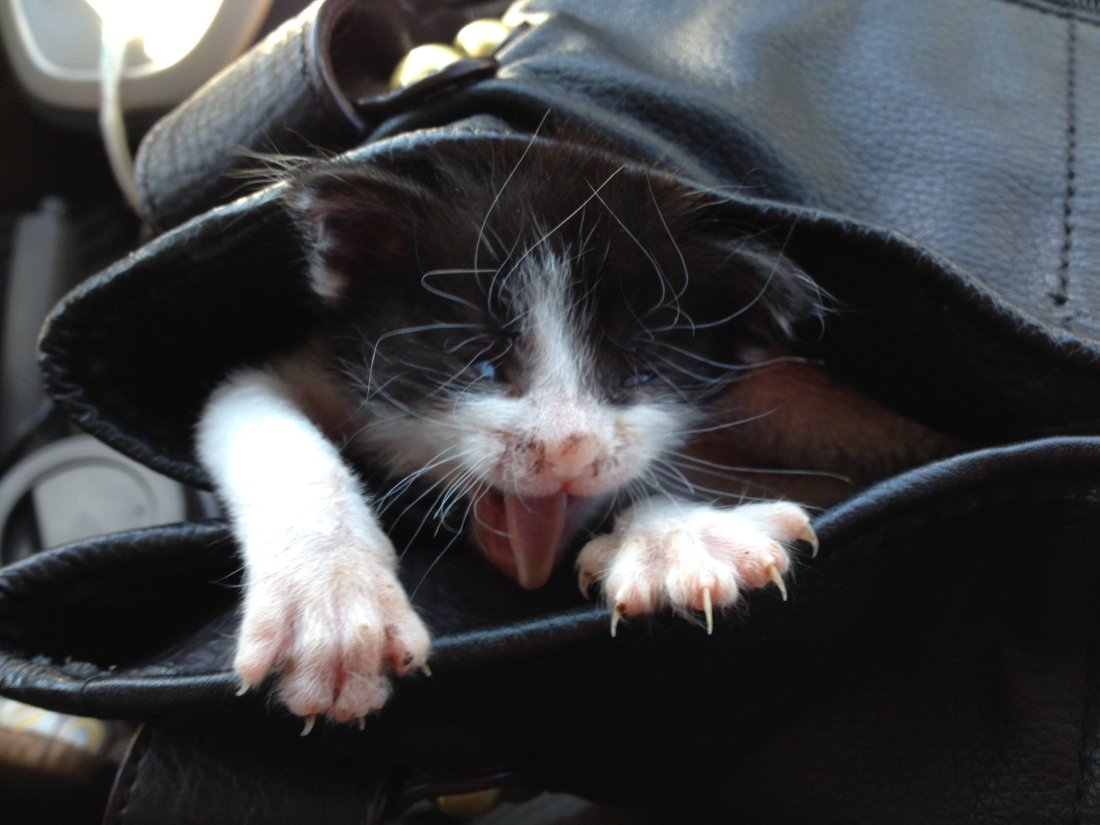
This morning we found an abandoned kitten outside the apartment. Well, actually, Duncan the Scottie “treed” it under the stairs and I dug it out from among spider webs and dead leaves. If I could pause writing now to show you a video of the pandemonium that ensued, that would be better than I could describe it. Since I can’t, I’ll do my best. I walk in with a screaming 3-day old kitten that looks more like a baby skunk or possum or rat. I will say that Duncan and I were both fairly proud of ourselves for the rescue–he was prancing while I was still covered in webs and leaves, grinning from ear to ear. Sarah, determined that she’s about to die from an oncoming cold, is sitting on the couch with her phone in her hand about to call in sick to work. She never did make that call; the immune system kicks in like a machine when there’s something bigger than us involved.

Within seven and a half minutes, Sarah was out the door on the way to Kroger, having given me instructions to keep the kitten warm at all costs and whatever I do–do NOT name it. Within eleven more minutes, she was back with two packages of bottle droppers, a feeding syringe, and cat milk. I had no idea one could buy cat milk at Kroger. How she knew still baffles me. Nevertheless, we were feeding, then “pooping” a kitten. For you who are uninitiated, you don’t even want to know about that one. I looked at Sarah. His name is Spike, I said.

Fast forward nine hours. Past the hot water bottle and the shoe box. Past packing up a diaper bag for a 4 ounce cat. Past a math department taking and a sorority adopting a kitten. Past the creation of its own Facebook page (which she checked until midnight, delighting at every “Friend Accept.”). Past my special trip to Petsmart to get a proper kitten bottle and newborn formula. Past the dog deciding that it was his baby and going into protect mode. Fast forward to choir practice (You didn’t see that coming, did you?).

This wasn’t our usual choir practice–that would have been too easy with a yelping kitten in a Chaps shoe box. This was for a benefit concert of fifteen choirs at a Catholic church out in the middle of nowhere–I reckon it was in some netherworld between Kennesaw and Marietta. That’s the best I could tell since she was doing the driving with the gps in one hand. Sarah has an interactive relationship with her gps, whom she has named Pilar. Pilar seems to me to put us mostly in the range of the destination, which lets Sarah yell contradictions and alternate routes back at her. Pilar, recall, is actually a phone. So I’m not actually sure where the church is located since I decided that the best plan was for the kitten to sleep through as much of the practice as possible–and the best chance of THAT would be if he had a full belly. Again, the video version of her driving and navigating with an obstinate Pilar while I am force feeding a kitten who, if he had NOT been in shock would surely be now–would surely be so much more vivid. You’ll just have to picture that. Anyway, we eventually got there, along with 100 other cars who were picking up their children from the parochial school. Once we explained to the (probably) Italian man directing traffic–IN (probably) ITALIAN–that we were actually there for the choir, he stopped yelling at us–not unlike Sarah had been engaging with Pilar–and we parked next to our deacon Lynn.

So as Lynn carried in armloads of our music, we loaded up with the diaper bag and the Chaps box with the hot water bottle and Spike. Looking back, I’m trying to imagine how we looked, a couple going in that big sanctuary, one of us with diaper bag in tow the other trying to hold a box to minimize jostling around the baby inside. Thing is, I’m pretty sure we looked like a couple to anybody who was looking, and not all the choirs there were from open and affirming churches. That’s ok, though, because ours was, and they were pretty much enchanted by Spike. With one minor exception–Lynn was not a fan of his name. I think you should name him Chaps, she said, clearly inspired by his carrying box. I don’t know if Sarah believes it’s bad luck to change a name like I do, or if she, like me, somehow wanted to honor the way our deacon had just honored something of us, but she decided–and I agreed–that Chaps would make a perfectly fine middle name–IF the first name had additional syllables (two monosyllabic names just don’t sound right).

So, that is how our deacon named our love child Chaps, and his name became Spikemandius Chaps TBDLastName, the Feline. 

Spike the Feline’s Facebook Page

Spiritual Audacity and Radical Amazement: Rabbi Heschel and Prayer

Spiritual Audacity and Radical Amazement
Last week I discovered a document I never knew existed: the manifesto signed by 80 Protestant ministers in Atlanta in November 1957 in response to President Eisenhower’s sending federal troops into Little Rock to allow Black children to go to schools in their own neighborhoods (See  http://rccapilgrims.ning.com/profiles/blogs/80-atlanta-pastors-sign). Later in the week, and completely coincidentally, I began reading the work of Rabbi Abraham Heschel, whose name kept appearing in my research on curriculum and ethics. I’m not talking about a few citations. I mean every time, his well-placed words were used by non-theological scholars to knock their points out of the ballpark. Sometimes God knocks me over the head with stuff.
Rabbi Heschel was born in Poland in 1907, to an Orthodox Jewish family. He studied philosophy at the University of Berlin while also studying for rabbinic ordination. When the Nazis took over, he was arrested by the Gestapo, and after a great deal of struggle, he came to the U.S. in 1940. After several years he ended up at the Jewish Theological Seminary in New York City. Although he escaped, his mother and three sisters were murdered by the Nazis. He never returned to Germany or Poland because, as he put it, “If I should go to Poland or Germany, every stone, every tree would remind me of contempt, hatred, murder, of children killed, of mothers burned alive, of human beings asphyxiated.” In the 1960s he worked side by side with Dr. Martin Luther King for civil rights and to stop the war in Vietnam. When they marched together in Selma, he said, I felt my legs were praying (Essential Writings, p. 36). On March 25, 1968, Dr. King gave a keynote address at Rabbi Heschel’s birthday celebration. Rabbi Heschel invited the King family to join his family for the Passover Seder later in the spring, but we know what happened. Reverend King was assassinated on April 4, just days before Passover. Rabbi Heschel spoke at his funeral and walked in the procession in Atlanta. Like Dietrich Bonhoeffer, we could stop with his biography and consider his life as we stand in amazement. But for Rabbi Heschel, amazement was not sufficient for working toward justice in the world. He called for radical amazement, and to get there, he called for us to pray.
In September 1963 (the month and year I was born) he offered a prayer for Soviet Jews who were not being allowed to practice their religion or even study Hebrew freely. Many years later his daughter found the unpublished prayer on a scrap of paper in his files. It includes these words: Prayer has meaning: the beginning of commitment, the starting point of personal involvement (EW, p. 81). The times, he said, call for radical action (EW, p. 74). In protest to American involvement in Vietnam he wrote, Some are guilty; all are responsible. Prayer is our greatest privilege. Prayer…is radical commitment, a dangerous involvement in the life of God (EW, p. 85). Prayer is radical and it is dangerous. This makes me want to pray, and I need to learn how to pray radically and dangerously. The times still call for radical action. The times call for prayer.
Last month an old friend from high school asked me about prayer, and I confessed to her that I had trouble praying. She replied, Well, isn’t that a problem, since you’re in seminary and all? Uh, yeah, it is. I’d say the words, and try to reach up to God with them, but it felt more rote—like a wish list. Another friend once wrote that when he was a kid God was like Santa Claus. I longed for my prayers to have depth—beyond thank you and please—beyond Santa. I wanted to draw nigh unto God (James 4:8). Rabbi Heschel knew the connection between prayer and justice, and I am grateful that he took the time to explain it to us. I think I’m getting it now.
In his book The Insecurity of Freedom, published in 1966, he wrote about prayer. He begins with the premise of God’s immediate and personal concern for the world and us. He is eminently quotable, and I will cite from him liberally by compiling a kind of Letterman Top Ten List of Rabbi Heschel’s “How To” Guide to Prayer.
10. Prayer is more than a cry for the mercy of God. It is more than a spiritual improvisation. Prayer is a condensation of the soul.
9. For prayer to live in humans, humans must live in prayer.
8. You cannot analyze the act of prayer while praying. To worship God means to forget the self, and extremely difficult, though possible, act.
7. I am not ready to accept [the idea of prayer] as a dialogue. Who are we to enter a dialogue with God? The better metaphor would be to describe prayer as an act of immersion…
6. Prayer is a moment when humility is a reality. Humility is not a virtue. Humility is truth. Everything else is an illusion.
5. [Prayer] begins with praise because praise is the prerequisite and essence of prayer. To praise means to make God present, to make present not only God’s power and splendor but also God’s mercy. God’s mercy and God’s power are one.
4. How does a human become a person, an “I”? By becoming a thought of God. This is the goal of the pious human: to become worthy to be remembered by God.
3. Thus the purpose of prayer is to be brought to God’s attention: to be listened to, to be understood by God….What we long for [in prayer] is not to know God but to be known by God….
2. [Prayer] is the moment of a person in anguish forgetting his anguish and thinking of God and God’s mercy. That is prayer.
And the number one on Rabbi Heschel’s “How To” Guide to Prayer:
1. The way to prayer leads to acts of wonder and radical amazement.
One thing I notice about Rabbi Heschel, he used the word radicala lot throughout his writing. The word has several meanings. Although we usually think of it as meaning extreme, it also means fundamental and existing inherently in a thing or person. Radical action, radical amazement, and radical commitment—those “doing somethings” to which he referred, are fundamental to us as humans. They exist in us, and to get to them, we ask to be known by God. We pray.

Abraham Joshua Heschel Essential Writings (2013). Susannah Heschel, Ed. Modern Spiritual Masters Series. Maryknoll, NY: Orbis Books.

Bonhoeffer and Psalms

**Note: This post is a devotional written for a congregational newsletter. I’m putting it here as a repository. So if this kind of writing isn’t particularly your thing, hang around, I’ll be back as the reprobate soon.
 
 
Psalms 27:6-7
Then my head will be exalted
    above the enemies who surround me;
at his sacred tent I will sacrifice with shouts of joy;
    I will sing and make music to the Lord.
Hear my voice when I call, Lord;
    be merciful to me and answer me.
Dietrich Bonhoeffer and the Prayerbook of the Bible
In 1940 Dietrich Bonhoeffer wrote an 84-page meditation on the Psalms called Prayerbook of the Bible, in which he explains the importance of the Psalms for Christian prayer. I can’t think of Psalms now without thinking of Dietrich Bonhoeffer, who wrote concerning them, “Along these lines the Holy Scriptures tell us that the first thought and the first word of the day belong to God.” Actually, I’ve revised it a bit and say it as a prayer: “Lord, the first word and the last word of the day belong to You.” Saying this helps me re-focus—sometimes find focus because sometimes, left to my own devices, my thoughts go immediately every day to myself, my life, my plans, my trouble, my happiness. When the first and last thoughts of the day belong to God, my life—my day—is given context and perspective. This little phrase is a comforting guidepost for me. It really should have been all along, but it was not—until I met Bonhoeffer.
Maybe you have heard of him. If not, you can access documentaries and a movie about his life on YouTube or Netflix. Documentary fanatic that I am, I was browsing them in Netflix one Sunday afternoon and came upon one about him by accident. I would like to say that I discovered this fellow through theological study, but no. I had run out of historical documentaries about Nazi Germany to watch. I’ve been reading Bonhoeffer ever since. His life is an example of how an ordinary human is capable of extraordinary acts in the face of oppression. That sounds trite as I write it, like a bumper sticker, so let me give you a brief biographical sketch. His life adds depth to his writing for me, just as his writing gives deeper meaning to his life, and between the two, I realize that we can be called upon at any time and place to do that which is right. I do not know how I would meet that challenge.
If Dietrich Bonhoeffer had lived in any other place and time, he would have still been known as a brilliant theologian. His book Discipleshipexplains who Christians are; Life Together explains how we live. He was born in 1907 to a life of privilege. His father was a professor, and his mother came from an old and respected family. By the time he was 23 years old, he had written TWO dissertations In 1931 at the age of 25 he was a professor at the University of Berlin. Wow. He wanted very badly travel to India and study with Gandhi, but he never did. In 1932 Hitler happened instead. If Dietrich Bonhoeffer had taught and preached and turned a blind eye to the Nazis, he would likely have lived, married, had children, traveled, written great theological works, and died like old professors do. That is not what happened. Instead he took a stand that Christ, not the Fuhrer, was the head of the Church. It was his call of disciplieship.
He came to the U.S. twice. The first time was in 1930 on a teaching fellowship to Union Theological Seminary in NYC, where he first met African American Christians. He began teaching Sunday School at Harlem’s famous Abyssinian Baptist Church, and was moved by the “rapturous passion and vision” of the Black church. It is here that he found connections between religion and social justice and developed a love for Black spirituals—both of which he carried back with him to Germany. He shared both with the young seminarians he taught from 1935-1937.  I am glad Bonhoeffer has a U.S. connection.
He returned here in June 1939 again at the invitation of Union Theological Seminary, as Hitler began invading Europe. But he soon regretted his decision, as he wrote Reinhold Niebuhr: “I have come to the conclusion that I made a mistake in coming to America. I must live through this difficult period in our national history with the people of Germany. I will have no right to participate in the reconstruction of Christian life in Germany after the war if I do not share the trials of this time with my people… Christians in Germany will have to face the terrible alternative of either willing the defeat of their nation in order that Christian civilization may survive or willing the victory of their nation and thereby destroying civilization. I know which of these alternatives I must choose but I cannot make that choice from security.” He returned to Germany on the last scheduled steamer to cross the Atlantic before the war.
From 1940 to 1943 he worked as part of the German resistance, helping Jewish people obtain papers to escape. He even knew about the 1944 plot to assassinate Hitler (My quaker friends cringe a little at this part). He was arrested in 1943 because of conflict between the SS and the Military Intelligence organization for which he worked. When the Nazis discovered his connections with the assassination conspirators—who had also worked where Bonhoeffer worked—he was hanged on April 9, 1945, just two weeks before American troops liberated the camp where he was imprisoned.
Bonhoeffer continued his writing—and his ministry—from prison, living and talking Christ to prison guards. His friend, student, and biographer, Eberhard Bethge, recounted the words of the prison doctor who attended his execution, “I saw Pastor Bonhoeffer… kneeling on the floor praying fervently to God. I was most deeply moved by the way this lovable man prayed, so devout and so certain that God heard his prayer. At the place of execution, he again said a short prayer and then climbed the few steps to the gallows, brave and composed. His death ensued after a few seconds. In the almost fifty years that I worked as a doctor, I have hardly ever seen a man die so entirely submissive to the will of God.” Where did he get this strength? Bonhoeffer knew that God heard his prayers because he prayed the Psalms regularly.
From prison he had written his parents, “Before I go to sleep I repeat to myself the verses that I have learned during the day, and at 6 a.m. I like to read psalms and hymns, think of you all, and know that you are thinking of me.” The Psalms were central to his theology—and to his daily life. He began Prayerbook of the Bible with the disciples asking Jesus, “Lord, teach us to pray!” Then he goes on, “At the request of the disciples, Jesus gave them the Lord’s Prayer… It is a great grace that God tells us how we can pray in the name of Jesus Christ.” He sums up a very important point about the Psalms: Jesus died on the cross with words from the Psalms on his lips (Ps 22:2, Ps 31:6). Bonhoeffer considered Psalms significant because in them we have an example of how God wishes us to approach God in prayer, praise, and professions of faith and trust. This significance is confirmed by Jesus—as His model to the disciples and in his final words on the Cross. I can’t help thinking they were among Bonhoeffer’s final words too.
Try this: read our verses above while thinking about the young preacher’s life, and his death, and his utter conviction that the Psalms are God’s words and when we pray them, we pray them with Jesus.